
One Image, One Story
August 2026
By Maria Kumessa
“Bon Vin”
This popular French print, published by the Pellerin printer-bookseller of Épinal between 1800 and 1869 and created by an anonymous author/engraver, depicts a convivial gathering centred around wine. Seated or standing, the men raise their glasses in a spirit of celebration and good fellowship. The title, “Bon Vin” — “Good Wine” — says it all: here, wine is a shared pleasure and an occasion for companionship.
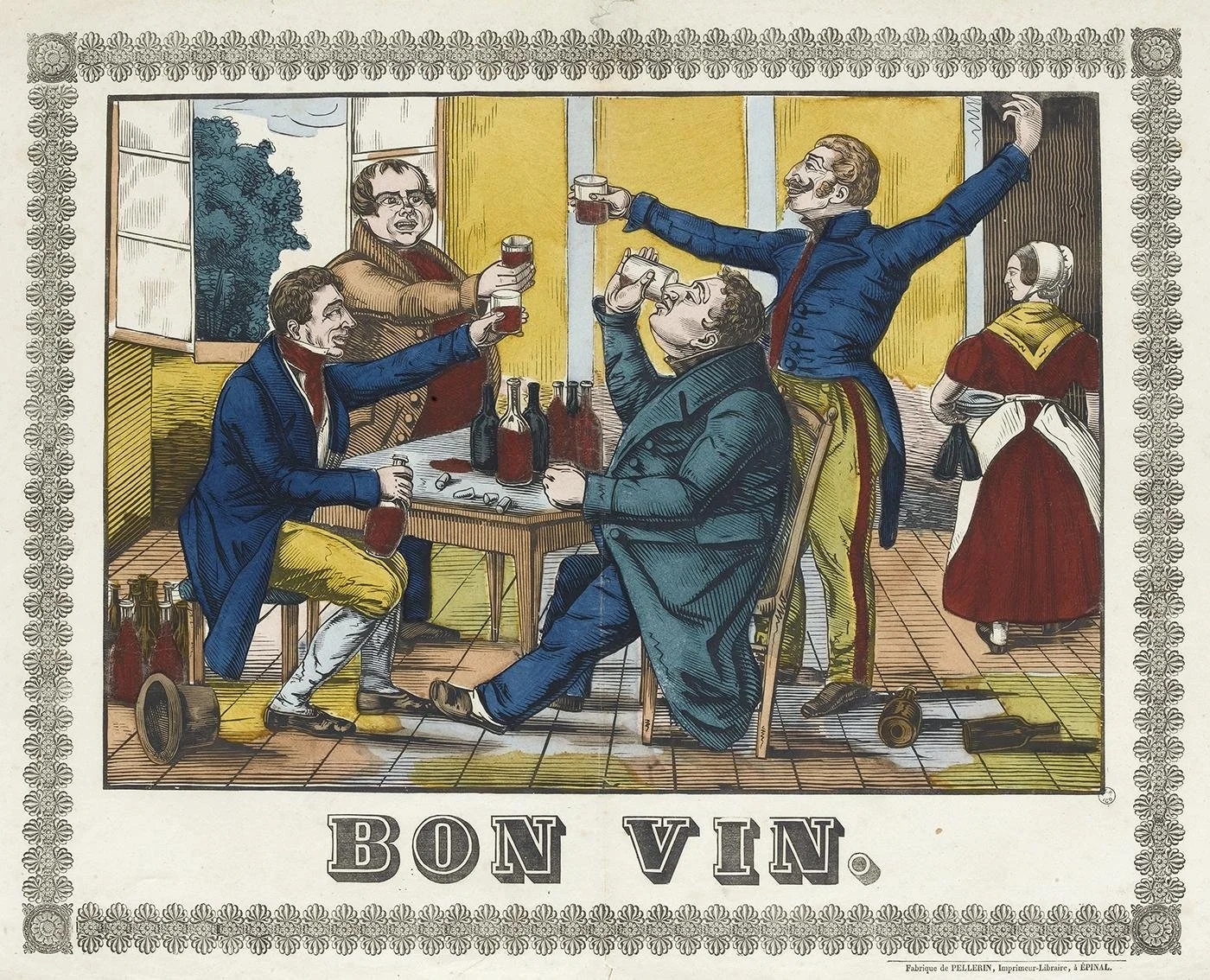
A convivial gathering in an Épinal print
At first glance, everything in this print breathes good cheer. Around a table crowded with bottles, four men clink glasses, drink and gesture in an interior with bright yellow walls; to the right, a serving-woman in a white cap and apron moves away towards a door, her back turned. In large capitals along the foot of the sheet, two words set both the tone and the subject: BON VIN. Printed by the Pellerin workshop at Épinal, the image belongs to that popular tradition of printmaking which, throughout the nineteenth century, carried tales, songs and scenes of everyday life into even the humblest homes.
A composition staged like theatre
The composition is arranged with the efficiency of the theatre. The drinkers are set almost in a circle around the table, and everything — the angle of the bodies, the line of the outstretched arms, the converging glasses — draws the eye back to that hearth of bottles and red wine. One figure dominates the scene, however: standing at the right, he flings his arms wide, glass held high, in a posture of acclamation that seems to sweep the whole table along with him. Against this outpouring of male energy, the serving-woman forms a still and silent counterpoint, confined to the right-hand edge. Two spaces thus take shape without need of a single word: the central, boisterous world of male sociability, and the peripheral, effaced world of service.
Colour and craft in the Pellerin workshop
Colour completes the scene's immediate legibility. Bold blue coats, a yellow setting, red wine, touches of brown and green: the palette seeks not subtlety but contrast, clarity, appeal. This economy stems from the very way these sheets were made. The Pellerin workshop, founded at Épinal in 1796 by Jean-Charles Pellerin, printed the outline from a woodblock, then coloured the impressions by hand — most often through a stencil, each colourist laying down one tint after another. Hence these vivid flat areas edged with a thick black line, and that absence of shadow and modelling which gives the prints of Épinal their unmistakable look.
From tribute to caricature
The question remains as to what, exactly, the image is celebrating. On the surface, it sings the virtues of wine without reserve: the pleasure, the fellowship, the high spirits of a company gathered together. "Bon Vin" works almost as a sign or a slogan, tying drink to a happy life — a sentiment readily shared in a France where wine held a central place, at the table as in the rituals of social life. Yet the drawing says something else as well. The faces are red, the poses forced: one man drinks with his head thrown back, another all but staggers, the ringleader overdoes it. Empty bottles pile up on the table and roll to the floor. Here, good fellowship tips over into excess, and the print slides imperceptibly from tribute to caricature. This is the whole ambivalence of popular imagery about wine, which extols the pleasure of drinking while smiling at the excesses it brings.
A picture, not a photograph of society
It would be wrong, all the same, to read the image as a faithful photograph of society. It simplifies, lays on the line, stages types rather than individuals. It nonetheless preserves the mark of the codes of its day, beginning with a sharply drawn division of roles: to the men, the foreground, the talk and the freedom to make merry; to the woman, reserve, withdrawal and the tasks of service. The print takes this opposition for granted — which is precisely what makes it a document about the way an age saw itself.
More than a scene of drinkers
“Bon Vin” is thus far more than a scene of drinkers. A commercial object spread by pedlars, designed to be taken in at a glance by as many people as possible, the print turns a shared glass into a picture of collective happiness — not without a smile for the excesses that such happiness invites. Beneath its bold colours and its air of merriment, it offers a valuable record of the visual culture, the pleasures and the manners of working-class France in the nineteenth century.