French Wine Regions: The Economics of Terroir
Last updated: 20 April 2026Terroir as Strategic Architecture: How France Turned Geography into Global Market Dominance.
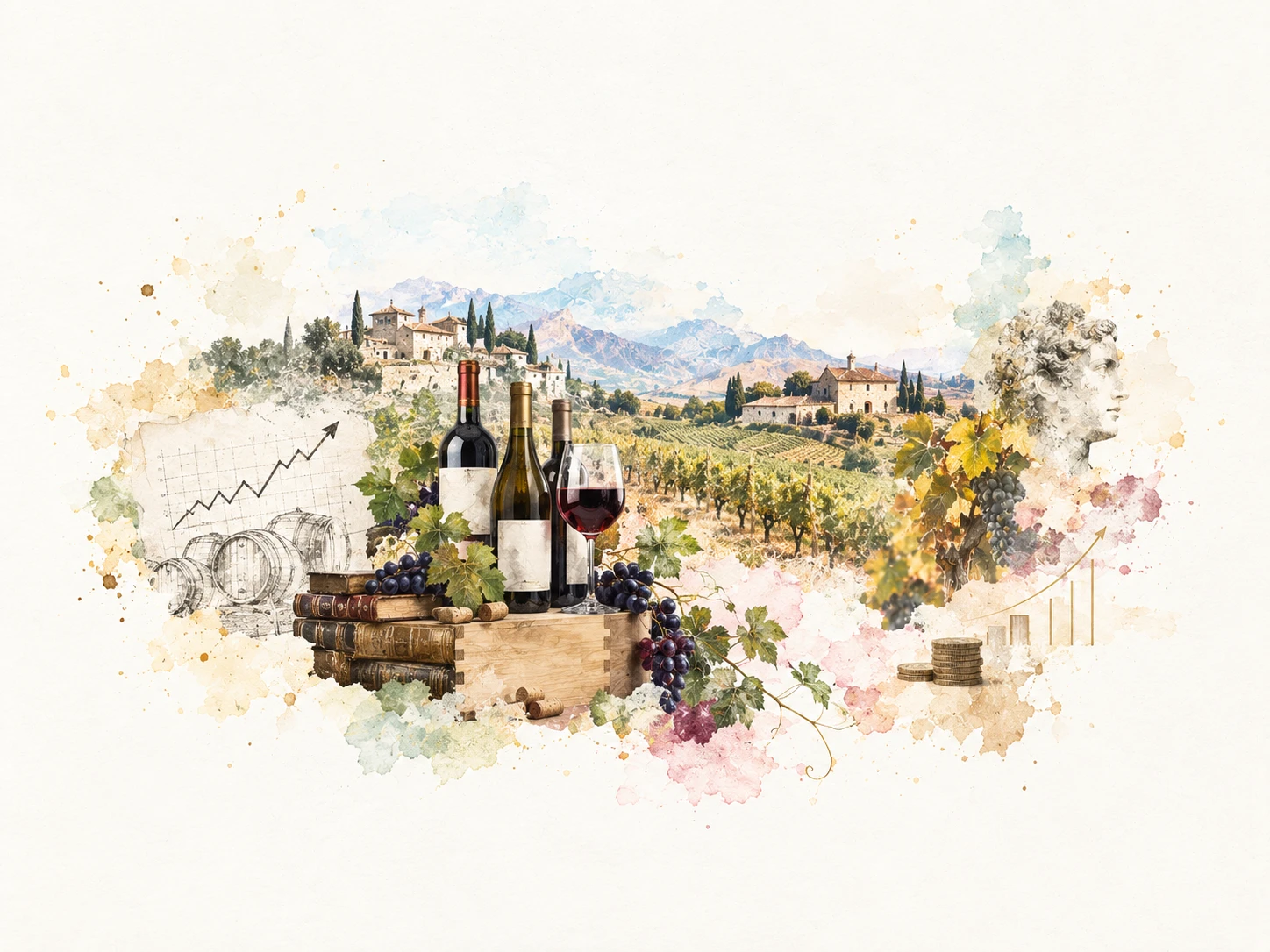
In the global luxury goods landscape, few assets rival the systemic elegance of French wine. What appears, at surface level, as a collection of regional wines differentiated by soil and climate is, on closer examination, one of the most sophisticated brand architecture systems ever constructed, a multi-century institutional project that has transformed geological accident into legally protected competitive advantage.
This analysis moves beyond the sensory register. It examines how France's thirteen wine regions function as a coordinated portfolio of strategic assets, how the appellation system operates as a market barrier rather than merely a labelling convention, and why the pressures of climate change now pose the most serious challenge to a model that has remained structurally intact since the nineteenth century.
What makes French wine exceptional is not what is in the glass. It is the institutional architecture that makes the glass irreplaceable.
Terroir as a Constructed Barrier to Entry
The conventional narrative presents terroir — the combination of soil, climate, topography and human practice — as a natural phenomenon, a fingerprint left by the land. This framing, while poetically compelling, understates the degree to which terroir has been deliberately institutionalised as an economic weapon.
The Appellation d'Origine Contrôlée (AOC) system, formalised in 1935 and now harmonised under the European AOP framework, is not primarily a quality guarantee. It is a legally enforceable geographic monopoly. A wine labelled Chambolle-Musigny cannot be produced anywhere other than a precisely delimited patch of limestone-clay hillside in the Côte de Nuits. No capital investment, no viticultural skill, and no replication of climate conditions elsewhere can manufacture that address. The barrier to entry is, by design, absolute.
For competitors from the New World — California, Australia, Chile, South Africa — this presents an insurmountable structural asymmetry. They can produce wines of equivalent or superior sensory quality at a fraction of the cost. What they cannot produce is provenance. The AOC system has effectively ring-fenced the most valuable real estate in the global wine market behind a wall of institutional legitimacy that took three centuries to build.
Burgundy represents the most extreme expression of this logic. The micro-parcellisation of the Côte d'Or — where a single climat such as Romanée-Conti covers barely 1.8 hectares — is not a viticultural accident but a premiumisation strategy enforced by law, inheritance patterns, and centuries of monastic record-keeping. Scarcity is not a by-product; it is the product. The geological specificity of the Kimmeridgian limestone — the argument that no other soil on earth produces this precise mineral tension — has been elevated into a global marketing differentiator of the first order.
The Côte d'Or's fragmented ownership structure, a legacy of Napoleonic inheritance law, inadvertently created the world's most effective luxury scarcity model.
The Regional Portfolio: Complementarity as Competitive Strategy
Viewed as a single entity rather than a collection of independent territories, France's wine regions constitute a remarkably coherent portfolio, one that covers every segment of the premium and ultra-premium global market with minimal internal cannibalisation.
Bordeaux: The Reserve Asset. Bordeaux functions as the liquidity pillar of the French wine system. Its tannic, structured reds — built on Cabernet Sauvignon and Merlot grown in gravel and clay — are explicitly designed for temporal appreciation. The primeur (en-primeur) trading system, through which Classified Growths are sold as futures before bottling, has transformed wine from a consumer good into a financial instrument. Bordeaux captures the investment-grade segment of the market: buyers whose primary interest is capital preservation and trophy asset accumulation.
Champagne: The Soft Power Gateway. No region better illustrates the alchemy of constraint-into-advantage than Champagne. Its cool northern climate, marginal for viticulture by any conventional measure, produced a wine structurally incapable of conventional still-wine excellence, and was consequently engineered into the world's pre-eminent luxury lifestyle symbol. Champagne is not primarily a wine category; it is the linguistic and sensory proxy for celebration itself. This makes it the most powerful point of entry into the French luxury ecosystem: the first bottle a consumer associates with aspiration is almost invariably a Champagne.
Burgundy: The Singularity Premium. Where Bordeaux sells power and Champagne sells occasion, Burgundy sells irreducibility. The intellectual proposition — that a wine from Gevrey-Chambertin and one from Volnay, separated by twelve kilometres, express fundamentally different truths about the same grape — is the most sophisticated premiumisation narrative in any consumer goods category. It requires, and rewards, connoisseurship. In doing so, it captures the segment of the market most resistant to substitution: the expert buyer for whom provenance specificity is the primary purchase driver.
The remaining regions — Rhône, Loire, Alsace, Beaujolais, Savoie, Jura, and the South — complete the portfolio by addressing accessible price points, gastronomic versatility, and emerging consumer preferences for lighter, lower-alcohol profiles. Crucially, their relative commercial modesty does not diminish the system; it anchors it, providing the volume and distribution infrastructure through which the premium tiers maintain their cultural visibility.
Bordeaux sells power. Champagne sells occasion. Burgundy sells irreducibility. Together, they cover every node in the global luxury consumption matrix.
The Historical Architecture of Dominance
The present configuration of French wine as a global luxury asset did not emerge from agricultural happenstance. It was constructed through a long sequence of commercial, political, and institutional decisions whose effects compound across centuries.
Bordeaux's rise to global prominence was as much a function of maritime geography as of terroir. The Gironde estuary provided direct Atlantic access to the British, Dutch, and Hanseatic trading networks that dominated European luxury commerce from the twelfth century onwards. The English crown's control of Gascony from 1154 to 1453 created a preferential trade relationship whose commercial logic outlasted its political context by several centuries. By the time the AOC system was codified, Bordeaux's international reputation had already been self-reinforcing for five hundred years.
Champagne's transformation from a marginal sparkling wine produced by secondary fermentation into the universal symbol of celebration was the product of deliberate brand management, pursued most systematically by the grandes maisons throughout the nineteenth century. The mythologisation of Dom Pérignon, the standardisation of the méthode champenoise, the aggressive pursuit of royal and aristocratic endorsement across European courts: these were coordinated acts of institutional image-building, not organic cultural emergence.
The French state, through the INAO (Institut National de l'Origine et de la Qualité) and its predecessors, played the role of a sovereign brand manager, using the diversity of its thirteen regions not to fragment the national wine identity but to construct a unified proposition of terroir pluralism, the idea that France alone possesses the institutional maturity and geological complexity to guarantee authentic geographic expression at scale.
Climate Change: The Identity Stress Test
The threat posed by climate change to French wine is frequently framed in agronomic terms — rising temperatures, earlier harvests, increased alcohol levels, disrupted vintage patterns. This framing, while accurate, misses the more consequential challenge: the potential erosion of the identity-terroir nexus on which the entire competitive architecture depends.
Merlot, the dominant variety in the Right Bank appellations of Bordeaux (Saint-Émilion, Pomerol), is acutely vulnerable to thermal stress. Earlier phenological development translates into imbalanced ripening — elevated sugar accumulation without corresponding phenolic maturity — producing wines structurally inconsistent with the profile that built the appellation's reputation. Some leading estates are already harvesting Merlot ten to fourteen days earlier than in the 1980s.
The strategic dilemma is existential: does a Bordeaux remain a Bordeaux if it must progressively substitute Touriga Nacional or Marselan for Merlot to maintain sensory coherence? The AOC framework has been partially modified to permit six additional varieties in Bordeaux AOC blends, a pragmatic concession that, by acknowledging climate-driven necessity, implicitly destabilises the "geographic determinism" argument that underpins the appellation's premium positioning.
Burgundy faces a different but equally structural challenge. As mean temperatures in the Côte d'Or approach those historically associated with Southern Rhône appellations, the mineral tension and aromatic precision that distinguish Grand Cru Burgundy from warmer-climate Pinot Noir risk compression. The terroir-as-singularity argument depends on a climate envelope that is measurably changing.
Conversely, marginal northern appellations — including Champagne — may find their competitive positioning enhanced. A warming Champagne benefits from improved physiological ripeness in its base wines, potentially expanding the stylistic range available to producers without compromising the fundamental acidity structure that defines the category. The irony is precise: the regions whose climate was historically their greatest liability may prove most resilient to the very change that threatens their southern peers.
The question is no longer whether French wine can survive climate change. It is whether the institutional architecture that makes French wine irreplaceable can survive the adaptation required to do so.
Strategic Lessons — Constraint as Competitive Advantage
The deeper lesson of the French wine model is not geographic but institutional. What France constructed over three centuries was a system in which natural constraints — chalky soils unsuitable for most agriculture, continental climates prone to late frost, fragmentary parcels too small for industrial viticultural economics — were progressively reframed as differentiators rather than liabilities.
Champagne's cool climate, which made still wine production unreliable, became the precondition for a sparkling wine whose quality and consistency no warmer region can replicate. Alsace's rain shadow, created by the Vosges massif, produces the dry, aromatic concentration that distinguishes its Rieslings from their German counterparts, and commands corresponding price premiums on export markets. Burgundy's fragmented ownership structure, a by-product of post-Revolutionary inheritance law rather than viticultural intent, inadvertently engineered the scarcity model that now sustains its ultra-premium valuations.
The implication for any analysis of luxury market dynamics is direct: sustainable competitive advantage in heritage categories is rarely built on resource abundance. It is built on the institutional capacity to transform scarcity — of geography, of production volume, of historical legitimacy — into inimitable identity. The AOC system is, in this light, less a wine regulation and more a masterclass in the legal codification of cultural capital.
What the next chapter of French wine requires is not a defence of the status quo but a renegotiation of the same institutional creativity that built the model. The regions that will lead that renegotiation are those capable of answering, with precision and credibility, the question that climate change has made unavoidable: what is the irreducible core of a terroir when its physical conditions are in motion?
Sources and References:Institut National de l'Origine et de la Qualité (INAO). inao.gouv.frBIVB (Bureau Interprofessionnel des Vins de Bourgogne). bivb.comUNESCO World Heritage List. (2015). Climats du Vignoble de Bourgogne. https://whc.unesco.org/fr/list/1425/INAO. (2011). Cahier des charges de l'appellation d'origine contrôlée “Romanée-Conti” [Specification document for the Romanée-Conti controlled designation of origin, in French]BIVB (Bureau Interprofessionnel des Vins de Bourgogne). Fiche vignoble : Vosne-Romanée — Romanée-Conti, Richebourg, La Grande Rue, La Romanée, La Tâche, Romanée-Saint-Vivant [Vineyard technical profile sheet, in French]Johnson, H. & Robinson, J. (2019). The World Atlas of Wine (8th ed.). London: Mitchell Beazley.Lachiver, M. (1988). Vins, Vignes et Vignerons: Histoire du Vignoble Français. Paris: Fayard.Unwin, T. (1991). Wine and the Vine: An Historical Geography of Viticulture and the Wine Trade. London: Routledge.
You May Also Like