How Wine Became a Status Symbol: Taste, Class and Prestige
Last updated: 1 September 2026For most of its history, wine was a staple, a habit, almost a currency. Today it is one of the most freighted objects you can set on a table. Its transformation owes nothing to the liquid in the glass and everything to what societies learned to read around it: a reputation, a hierarchy, a language, a network. This is the story of how a prestige that was never natural came to be built.
Some bottles now sell for thousands of euros, and certain names are enough to command instant recognition. To serve a grand cru at dinner can signal wealth, knowledge, sophistication; knowing how to talk about it sometimes matters as much as knowing which one to choose. Yet for most of its history wine was none of these things. The question, then, is not why wine is prestigious, as though it always had been. It is how it became so.
Before Prestige: Wine as an Everyday Drink
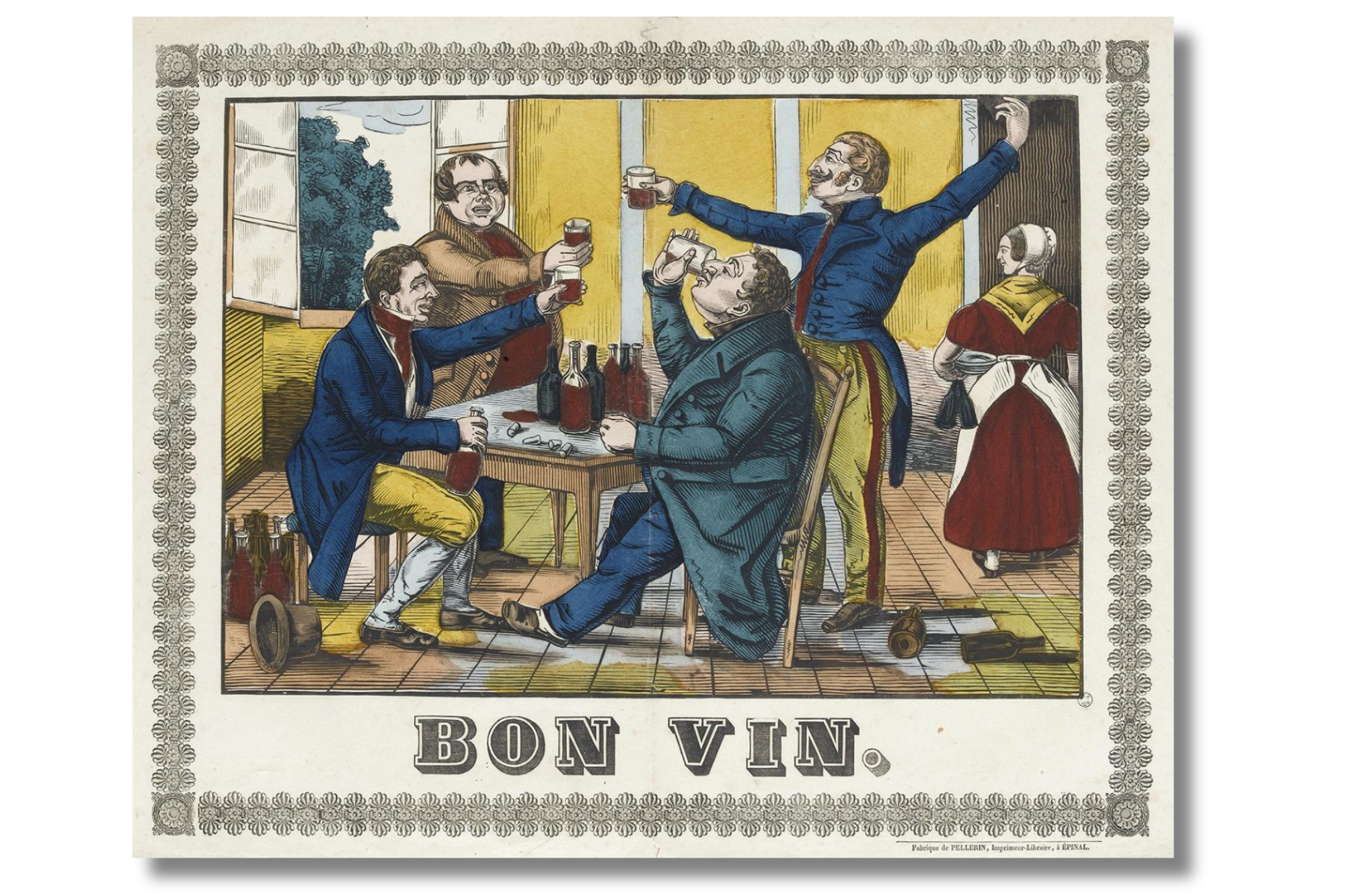
To grasp wine's modern prestige, you must first forget the image of the grand cru. For much of European history, wine was an everyday drink: soldiers, peasants, artisans and townspeople drank it daily, at the table and at work, without subjecting it to any aesthetic analysis. No one yet spoke of terroir, of length on the palate, of structure. Wine was drunk, and needed no explaining.
It would be wrong, though, to picture a wholly common past set against a luxurious present. Some wines have always been bound up with power and the elite: Rome prized named growths such as Falernian, while courts and monasteries sought out particular origins. What was missing was not prestige itself but a system: a shared, codified and durable way of ranking. Modernity did not invent the exceptional wine. It systematised its recognition.
The distinction matters, because it holds the whole argument. A bottle's social value is not simply lodged in the liquid. It depends on what a society collectively learns to recognise, to admire and to prize. Wine is not naturally prestigious: it becomes so. [The engineering of taste →]
How the 1855 Classification Turned Reputation into Rank
The first shift came with trade. As certain wines began to travel well beyond their region of origin, they ceased to be judged by the drinker alone. Bordeaux built close ties with England early on, and particular wines became sought after for their consistency, their ability to travel and their standing among merchants. Quality now attached itself to something new: reputation. A wine was no longer merely drunk; it was recommended, sought out, traded, handed on. And reputation, little by little, became a form of value in its own right.
Merchants were central to this, for they held information that consumers did not: they knew which wines were wanted, which were available, which travelled, which carried a name. Before the modern language of tasting had even taken shape, a hierarchy was already forming: some wines known, others forgotten; some coveted, others ignored.
The 19th century turned this diffuse reputation into an institution. In 1855, for the Paris Exposition Universelle, an official classification of the wines of Bordeaux was drawn up. Contrary to common belief, it did not cover the whole region: it ranked the reds of the Médoc, plus a single Graves estate, Château Haut-Brion, and included a separate classification for the sweet wines of Sauternes and Barsac. Its significance went far beyond commercial housekeeping. It converted a reputation into an official category, one able to outlast generations and to reproduce itself in catalogues, in guidebooks, on restaurant lists and in the talk of enthusiasts. A wine was no longer merely reputed to be exceptional: it was classified. And once a society shares a hierarchy, that hierarchy becomes a code. To know the First Growths is already to know the social world of wine as much as the wine itself.
Why the Right Bottle Says More Than the Priciest One
From then on, a bottle communicates far more than its contents. It can signal the wealth of the person buying it, the knowledge of one who understands why the wine matters, access to what is hard to obtain, the network that opens certain doors, membership of a group whose codes one has mastered. Wine becomes a language: no one needs to present a bottle as a status symbol for those in the know to read it.
It would be a mistake, though, to reduce this status to price. An expensive bottle signals wealth; the right bottle signals something subtler: knowledge. In many circles, always reaching for the priciest option betrays a limited grasp of the codes. The true connoisseur is not the one who spends the most, but the one who knows why this bottle, at this moment, for this occasion. Context is everything: a grand cru perfectly judged at a celebratory dinner would elsewhere seem excessive, clumsy or simply pointless. Sophistication lies not in the spending. It lies in the ability to read a situation.
Wine Vocabulary as Cultural Capital
Status rests not only on the bottle but on the way one talks about it. Over time, wine has gathered around itself a vocabulary of great precision: terroir, vintage, appellation, tannins, structure, acidity, length, maturation, bouquet. This language conveys real information, but it also says a great deal about the person using it. At a tasting, a dinner or a professional gathering, being able to name an estate, a vintage or an appellation instantly alters how a person is seen. Vocabulary becomes a form of capital.
The sociologist Pierre Bourdieu showed how cultural preferences work as markers of distinction, and wine offers an almost perfect illustration. Money buys a bottle, but money alone cannot decipher it: one has to know its history, its origin, its reputation, the codes that allow it to be read. Three forms of capital can thus be distinguished: economic, which lets you buy; cultural, which lets you understand; social, which sometimes lets you in. Their power lies in the fact that they do not operate separately but convert into one another. Financial means open access to experiences, experiences feed knowledge, and knowledge eases entry into the networks through which wine passes.
This knowledge is not evenly distributed. It comes from family, from education, from travel, from restaurants, from schools, from clubs, from networks. The difference between the person who holds the codes and the one who does not is therefore not a matter of intelligence or sensibility: it is a matter of exposure. Those who have mastered them enter the conversation with an invisible advantage. They know what to order, how to ask a question, which references to recognise, and above all what they need not prove. Cultural capital has this singular power: it can be visible without ever being claimed.
But this power has a flip side, one often passed over in silence. Wine does not only include; it intimidates. An unreadable list, a closed vocabulary, the fear of ordering badly can make a guest feel they lack the codes to take full part. The same system that gives some a sense of belonging returns others to the outside, and the effect is felt most sharply where the stakes are highest: at the restaurant, at the business dinner, in the international settings where everyone must guess at codes that are not their own. Distinction never exists without its shadow, exclusion.
Scarcity, Critics and the Price of Prestige
Scarcity brings this mechanism to white heat. A wine made in small quantities and widely desired becomes hard to obtain, and access itself turns into distinction: to own what many covet but few can acquire is a peculiarly powerful signal. That scarcity is built from limited production, a singular terroir, a historic reputation, a classification, international demand, ageing, a restricted allocation, provenance, or simply the market's capacity to declare a bottle exceptional.
This prestige is never produced by consumers alone. Critics, guides, sommeliers, schools and institutions decide what deserves notice, put words to quality, compare, judge, recommend. Recent history offers a striking example in Robert Parker, whose hundred-point scores weighed so heavily that they bent styles of production, some estates setting out to please a scoring scale rather than a palate. But Parker did not invent critical authority: he merely shifted its centre of gravity for a time, a centre long held by France itself through its appellations, its growths and its vocabulary.
From this a circle is born. Reputation feeds demand, demand sustains price, price reinforces prestige, prestige draws attention, and that attention feeds reputation in turn. This is how a bottle can cost far more than its material properties could ever explain. Quality is not thereby a fiction: wine has real physical and sensory properties. But no molecule dictates that a bottle is worth fifty euros rather than five thousand. That gap belongs to another order altogether: history, name, scarcity, institutions and collective expectation.
Nothing demonstrates this better than counterfeiting. The Rudy Kurniawan affair, in which a collector filled prestigious bottles with blends of humbler wine and sold them at auction for fortunes, laid bare an uncomfortable truth: what you pay for lies in the story and the name as much as in the liquid. This is why provenance, the traceability of a bottle, the proof of where it has been, has become a component of its value in its own right.
This market is now global. The greatest collectors are no longer found only in producing countries: Hong Kong, Singapore, the United States and Brazil all now weigh heavily in the economy of wine. That internationalisation raises a deeper question: who decides, now, what counts as prestigious? France long dominated the definition of quality, but the world has widened, and new producers, markets and consumers bring references of their own. The most contemporary sign of distinction, indeed, is no longer always the most expensive bottle: knowing a small grower, championing a natural wine, choosing the least obvious label can count for more than the expected grand name. Prestige is never fixed. It is handed down, contested, redefined.
You Are What You Pour
Wine, then, is not naturally noble, nor prestigious, nor a sign of wealth or refinement. These meanings were built, layer upon layer. Reputation created the first hierarchies, classifications institutionalised them, language made them legible, critics and institutions lent them legitimacy, networks eased access to them, and scarcity and the market turned certain bottles into objects of desire. And drinkers learned to read all of these signals.
This is why the status attached to wine never lies wholly in the bottle. It lies in what the bottle means, and that meaning depends on who pours it, who drinks it and, above all, who knows how to recognise it. Some read at once a history, an origin, a body of knowledge, a sense of belonging, sometimes a form of power. Others see a bottle. It is precisely in that gap that the social power of wine lives.
The next time a prestigious bottle is set down on a table, the real question will not be only 'how much did it cost?' but 'what does it say about the person who chose it, and about those who know what it means?'
Reference:P. Bourdieu, Distinction: A Social Critique of the Judgement of Taste, translated by Richard Nice 1984, Harvard University Press. (Originally published 1979 as "La Distinction").
You may also like