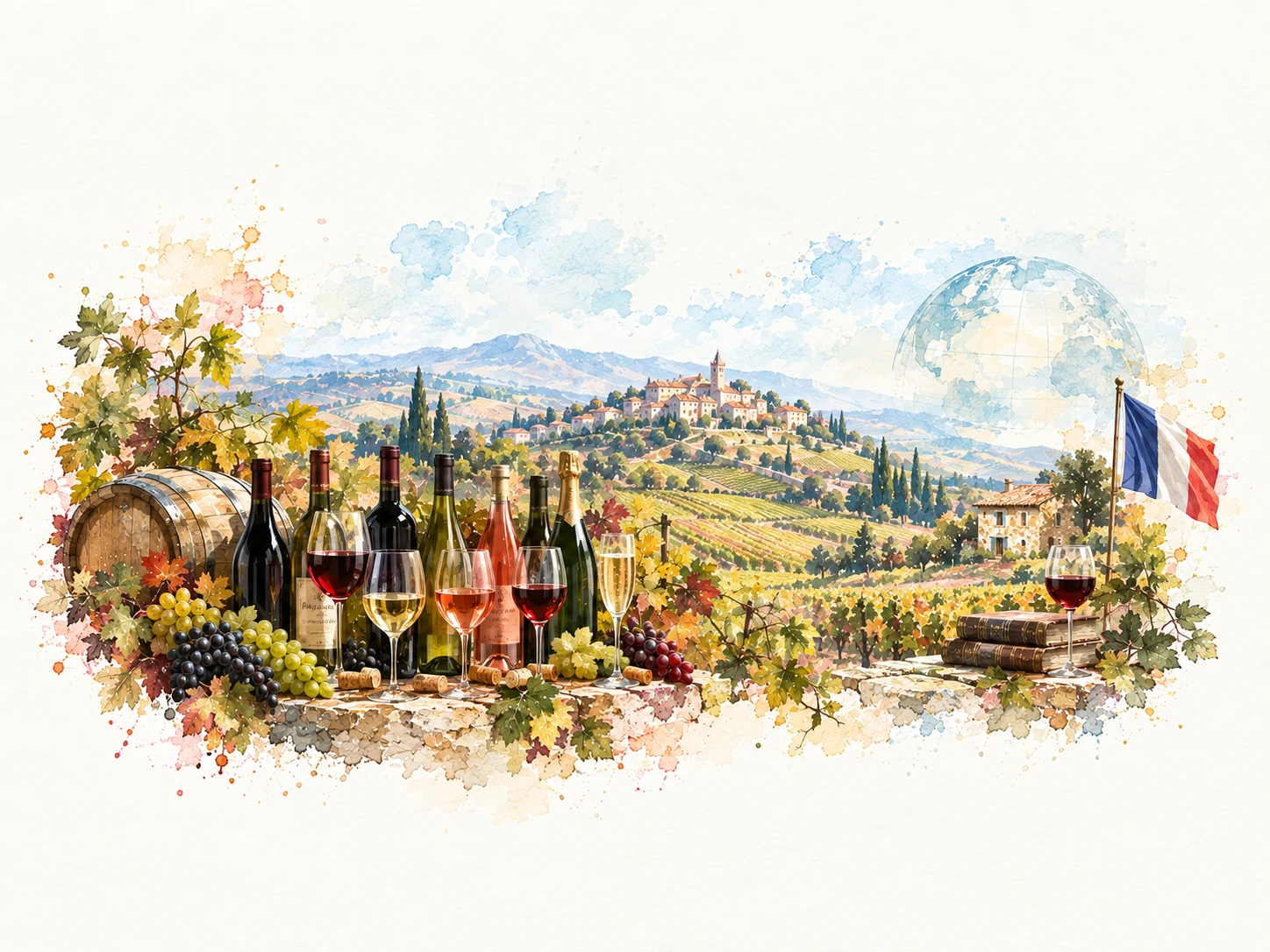
How Taste Makes a Wine’s Value, and Value Remakes Taste
Last updated: 25 September 2026The taste we think is personal, the wine we believe is exceptional, the greatness we assume is self-evident: three assumptions, one mechanism. Taste is not discovered. It is inherited and made, on three levels: the palate that judges, the cellar that produces, the name that consecrates. And if taste makes the value of a wine, value, in turn, remakes taste.
In the world of wine, one illusion is carefully maintained: that taste is a private matter. An intimate preference, spontaneous and authentic. We like what we like, and no one has any business questioning it.
Neuroscience, sociology and the history of wine tell a rather different story, without denying what remains irreducible in each person's sensory experience.
Taste is not a purely individual opinion. It is, in part, a social construction and an inheritance. Yet like any inheritance, it can be questioned, contested, or deliberately acquired. And it does not stop at the palate: the wine itself is a feat of engineering, and its greatness an institution. Three levels, then, on which value is made: the palate, the cellar, the name.
Is a Taste for Wine Innate or Inherited?
Bourdieu and Taste as Cultural Capital
Pierre Bourdieu did not write about wine. He wrote about something more fundamental: the way in which dominant classes turn their preferences into universal norms, and pass off their particular taste as good taste in general.
Distinction (1979) shows that what we call refinement, elegance or aesthetic sensibility is never neutral. It is always someone’s taste (a class, an era, a group) set up as the standard by those with the power to have it recognised as legitimate.
Applied to wine, the mechanism is surgically precise. Knowing that a 2015 Chambolle-Musigny passes for more elegant than a Gevrey-Chambertin of the same year, appreciating the minerality of a Chablis premier cru, telling the autolysis of a grower’s champagne from that of a major house: none of these is an innate skill. They are acquired, passed down within certain families, certain schools, certain circles. They function as capital (Bourdieu’s cultural capital) whose worth rests precisely on its scarcity and its opacity.
What you call your palate is, in large part, the imprint of your social trajectory. Not entirely: individual sensibility does exist. But the interpretive frameworks through which it is expressed, what counts as complex, elegant or great, those frameworks are socially constructed.
The mechanism Bourdieu describes therefore concerns more than the way an individual learns to love wine. It also concerns those who hold the power to define the criteria of legitimate taste. If preferences can become norms, then those who command strong symbolic authority can, in turn, bend the preferences of others. The history of wine offers a spectacular case in point: Robert Parker.
The Parkerisation of Bordeaux
Modern wine history offers an unrivalled case study: Robert Parker. A self-taught American critic, he began publishing his notes in the 1970s. His method was simple: a hundred-point scale, accessible tasting notes, and a fiercely asserted independence. His credibility was real; his influence soon became structural.
What followed was remarkable. Some of Bordeaux’s most prestigious châteaux shifted their practices towards the profile Parker scored highly: more concentration, more extraction, more new oak, more alcohol. Wines that were more immediately seductive, more legible to a palate trained on American reference points. The phenomenon acquired a name: the Parkerisation of Bordeaux.
We should beware of a single-cause reading. Parkerisation is a genuine critical concept, but its history is plural: it owes as much to advances in technique, the rise of an international market and competition from the New World as to any one man. Parker crystallised a tendency rather than creating it alone. Many producers, moreover, adopted these codes willingly, because high scores opened markets and justified higher prices. The complicity was conscious, and rational.
What is striking is the nature of what happened. France, which for four centuries had exported its own system of gustatory values, briefly redefined its production to move closer to a particular palate, and produced wines in which part of the French sensibility no longer quite recognised itself. The country that had colonised the world’s taste found itself colonised in return. Not by force, but by the market.
Yet Parker’s power only makes sense once we place it within a longer history. Before an American critic could bend the tastes of the world market, another system had already secured a dominant position: that of France. Parker did not, then, invent a new mechanism; for a time, he simply shifted the centre of gravity of gustatory authority.
Why the Vocabulary of Wine Is French
For before Parker, it was France that imposed its system of values on a planetary scale, and did so with remarkable efficiency. The great appellations, the hierarchy of the crus, the vocabulary of tasting (tannins, terroir, minerality, length on the palate) form a language that France exported as though it were the universal language of wine. Much of the international tasting lexicon remains deeply marked by French: to speak “correctly” about wine is still, often, to speak French, even in English. Other traditions, Italian, Spanish, German and Anglophone, have left their mark on it; French nonetheless remains its historical matrix.
This framework is not neutral. One might argue that a Barossa Shiraz is judged “great” only in so far as it approaches criteria set by the great French reds: structure, length, the capacity to age. These are French criteria applied universally. It is precisely what Bourdieu called symbolic violence: the imposition of one particular system of values, presented as universal, and accepted as such by those it dominates.
But if prestige decides what is recognised as great, technique decides what can be great in the first place. This is the axis of everything that follows. The value of a great wine has two storeys: a floor, produced in the cellar and decreed by no convention; and a ceiling, instituted by the name and justified by no molecule. Both are real, though not in the same way. To grasp the first, we must go down to the cellar.
How Winemaking Shapes the Taste of Wine
Where Aromas and Tannins Come From
A bunch of grapes and a bottle of Romanée-Conti share the same raw material. What separates them is a sequence of transformations and technical choices. Without control of fermentation and oxygen, the evolution of the must would not lead spontaneously to the complex, stable wine we know: it could, among other things, encourage unwanted fermentations and, in time, souring.
The winemaker’s genius, then, lies less in creating ex nihilo than in revealing and directing a potential already present in the grape, by mastering the conditions under which that potential can express itself.
Fermentation does not simply reproduce the aroma of the grape: it transforms its aromatic expression. Yeasts convert sugars into alcohol and, at the same time, produce many secondary compounds, notably esters and certain aromatic molecules derived from precursors present in the fruit. The grape therefore holds part of the aromatic potential; fermentation helps to make it perceptible. Temperature plays a decisive role here: depending on the profile sought, lower temperatures can favour the preservation of certain fruity aromas, while higher ones alter the kinetics of fermentation and the extraction in red wines.
Maceration then comes into play in building structure. Contact with the skins draws out pigments, tannins and other phenolic compounds. In red Bordeaux, relatively long macerations can favour substantial extraction, depending on the grape variety, the vintage and the estate’s choices. In Burgundy, Pinot Noir, whose phenolic structure differs from that of Cabernet Sauvignon, often calls for more measured extraction. This is not, then, an absolute opposition between two methods, but two ways of matching extraction to the material and the style sought.
Maceration is thus one of the winemaker’s major levers, but also one of the most delicate: extraction does not mechanically yield more quality, and its balance depends on the grapes, the vintage and the style sought.
Why Ageing Makes the Price
Maturation then sets the wine’s economic horizon. Stainless steel, being inert, largely protects the wine from oxygen and preserves its freshness: immediacy against longevity. Oak, through its micro-porosity, allows a slow exchange of oxygen that polymerises the tannins and builds the complexity of wines made for keeping. A 225-litre Bordeaux barrique holds the equivalent of 300 bottles of 75 cl: set against the selling price, its cost per bottle falls sharply as the wine moves up the range, which makes it as much a quality choice as a signal of investment.
And there is a third path, in which time is no longer a means but the very ingredient: the vin jaune of the Jura, matured for more than six years under a veil of yeast, forges an oxidative signature (walnut, curry, wax) that no other method reproduces.
Constraint becomes a luxury. Many of the most celebrated expressions of French savoir-faire are products of adversity mastered. Botrytis cinerea, or noble rot, destroys an ordinary harvest; disciplined within the microclimate of Sauternes, it concentrates sugars and glycerol to levels otherwise unreachable.
In Champagne, it is the marginal northern climate that, by imposing acidic base wines, creates the conditions for autolysis: as the dead yeast cells break down over years on the lees, they release the brioche and toasted-hazelnut notes of the prestige cuvées. Each year of waiting is capital tied up; it is also, quite precisely, what is being sold.
Why Provenance Changes a Wine
Finally, protecting the asset. Complexity counts for nothing if integrity cannot be preserved. Sulphur dioxide (SO₂) is the primary instrument of that protection, at once antioxidant and antimicrobial, and its dosage is one of the most delicate decisions of all: too little leaves the wine open to oxidation, far too much smothers its expression.
And storage itself has a price: vibration and swings in temperature accelerate reactions that, in a bottle left at rest, take decades to unfold. Hence the premium attached to provenance: a bottle of 1982 Pétrus, perfectly cellared, and the same bottle poorly kept are, chemically, two different objects.
The wine is made; it remains to be seen who decrees its greatness. And that, the greatness rather than the wine, is settled neither in the vineyards nor in the cellars.
How Prestige and Price Influence Taste
How the 1855 Classification Made Wines Great
The 1855 Classification, commissioned by Napoleon III for the Universal Exposition, is often read as a commercial exercise. A shallow reading. What the Bordeaux merchants produced that year was not a catalogue but an ontology, an answer to the question, “what really exists in the world of wine?”. The answer: the classified growths, and everything else.
What is dizzying is the system’s self-reference. A Premier Grand Cru Classé is great because it is classified, and classified because it is great. The circle is not merely vicious: it is founding. The classification does not, of course, create the material qualities of the wine on its own. It produces something else: an official recognition that turns a historical hierarchy into a durable category.
This is where the analogy with the philosopher J. L. Austin becomes illuminating. In How to Do Things with Words, Austin shows that some utterances do not merely describe the world: spoken in the right conditions and by the right authorities, they perform an action. A wine classification is not a performative utterance in the strict sense, but it has a comparable property: it does not simply record a reputation, it helps to bring that reputation into being and to sustain it.
To call a wine great before the right institutions, in the right settings, with the right authorities as witnesses, is therefore to produce a social reality that exceeds the mere matter of the wine. Not by illusion, but by a collective convention as real as the value of a currency.
Does Price Change the Taste of Wine?
In 2008, Plassmann, O’Doherty, Shiv and Rangel ran an experiment that has since become famous: participants tasted the same wine, presented under two different price labels, without knowing it was the same product. The wine presented as more expensive was associated with a heightened experience of pleasure, and with increased activity in the medial orbitofrontal cortex, a region involved in the processing of reward.
The finding is important, but its scope needs to be pinned down. The experiment does not show that society “manufactures” taste entirely. It shows something more precise: contextual information, here the stated price, can alter the subjective experience of one and the same sensory stimulus. Information, then, does not merely arrive after the sensation to comment on it; it can help to change how that sensation is actually experienced.
We can reasonably venture a broader hypothesis: if mere information about price can alter the experience of one wine, then the prestige of an appellation, the reputation of an estate or the expectations attached to a classification may also play a part in the experience of tasting. But this extension is a matter of interpretation, not something this particular experiment directly demonstrates.
That said, price obviously does not explain everything. Anyone who has watched a novice, with no codes and no references, be genuinely moved by a great wine knows that something escapes social construction alone. A sensory experience can be authentic without being socially neutral. Individual taste exists; it simply never exists in a cultural vacuum.
What neuroscience allows us to claim here is therefore more precise: our perception of wine is not independent of the context in which we encounter it. The palate receives molecules, but the brain interprets them through expectations, information and prior experience.
Is a Wine’s Value Real or Constructed?
The common response is to choose: either value is real, or it is constructed. A false choice. Yet the right answer is not “instituted, therefore real” either. It is twofold. A floor: the wine is, materially, what it is. A Cabernet macerated for three weeks, a vin jaune aged six years under a veil, a Sauternes concentrated by botrytis are not decreed complex; they are complex chemically, measurably, whether we classify them or not. And a ceiling: greatness is not produced entirely by the wine’s material properties; it results from their interpretation and their social consecration. Nothing in the molecule says that one growth is worth a thousand euros and its neighbour ten; that, the name alone decides.
This is where, and only where, the monetary analogy holds. The value of a banknote lies not in its paper but in a collective convention; a €10 note and a €500 note are, physically, the same object. A wine’s greatness works in exactly this way: as real as money, and just as conventional. But its matter escapes the analogy: a great growth and a table wine are not the same object under two labels. The paper is indifferent; the grape is not. To take the whole value of a wine for convention is to treat it as a banknote, when only its greatness is one.
Hence the true location of the fragility. The matter does not move: if the institutions collapsed tomorrow, the Sauternes would remain botrytised and the vin jaune oxidative. What would evaporate is the greatness, the ceiling and never the base. The grape survives its institutions; prestige does not. The threat, therefore, never comes from the cellar. It always comes from above, from the question of who holds the power to raise the ceiling.
Much of the demand for Romanée-Conti now comes from outside France, notably from Asia and the United States, while vineyards in China, California and South Africa lay claim to their own terroir. The question is not whether a Napa can equal a Chambolle: it is who has the right to decide, and by what criteria.
The most unsettling challenge comes from the very heart of the consecrated terroirs: natural wine. This movement contests the classification from within the consecrated terroirs, Burgundy included, in the name of a fidelity to place more radical than that of the institutions. But the institutions do not suffer this dissent: they absorb it. The INAO (the French national institute for origin and quality) is gradually taking on environmental criteria. Classified estates, too, are adopting organic or biodynamic charters; whether they do so out of conviction, strategy or both, the result for the system is the same: the narrative of natural authenticity becomes, in its turn, a form of symbolic capital too costly to surrender. This is not repression: it is recuperation. Dissent becomes one more box within the existing hierarchy. And here lies the system’s deep robustness: its capacity to turn its adversaries into arguments in its own favour.
Choosing Your Wine Knowingly
To understand that taste is a construction, neural, social and historical, and that greatness is instituted, does not mean that everything is of equal worth, nor that pleasure should be set aside. Wine remains a vehicle of hedonism and of sharing, and these dimensions legitimately escape class analysis.
What this reading offers is an added freedom: that of choosing in full awareness. When you choose a wine for a business lunch, a diplomatic dinner or any other occasion, you are not only choosing a bottle: you are choosing the register of taste in which you place yourself. You can then play with it, sidestep it, or deliberately transgress it. And in each case, you know what you are doing.
Consider the architecture once more. The cellar produces what cannot be decreed; the name institutes what can be extracted from no molecule; the palate interprets both; the market sets the price. The value of a great wine resides in none of these levels alone: it is born of their layering. And it is this layering that makes it so hard to contest: shaking the hierarchy changes nothing in the chemistry, and chemistry alone has never been enough to make a great growth. To understand this scheme is to stop confusing the level on which we stand.
Matter we can prove: it is chemistry. Greatness we cannot. The most enduring values are not those we prove, but those for which we never demand proof. A great growth need not justify its greatness.
Your palate never decides your choices on its own. What decides them are the codes you have internalised, or chosen to question.
References:P. Bourdieu, Distinction: A Social Critique of the Judgement of Taste (trans. Richard Nice, 1984), Harvard University Press. (Originally published in 1979 under the title La Distinction).Plassmann, O'Doherty, Shiv and Rangel, "Marketing actions can modulate neural representations of experienced pleasantness", PNAS (2008).J. L. Austin, How to Do Things with Words (1962).
You May Also Like