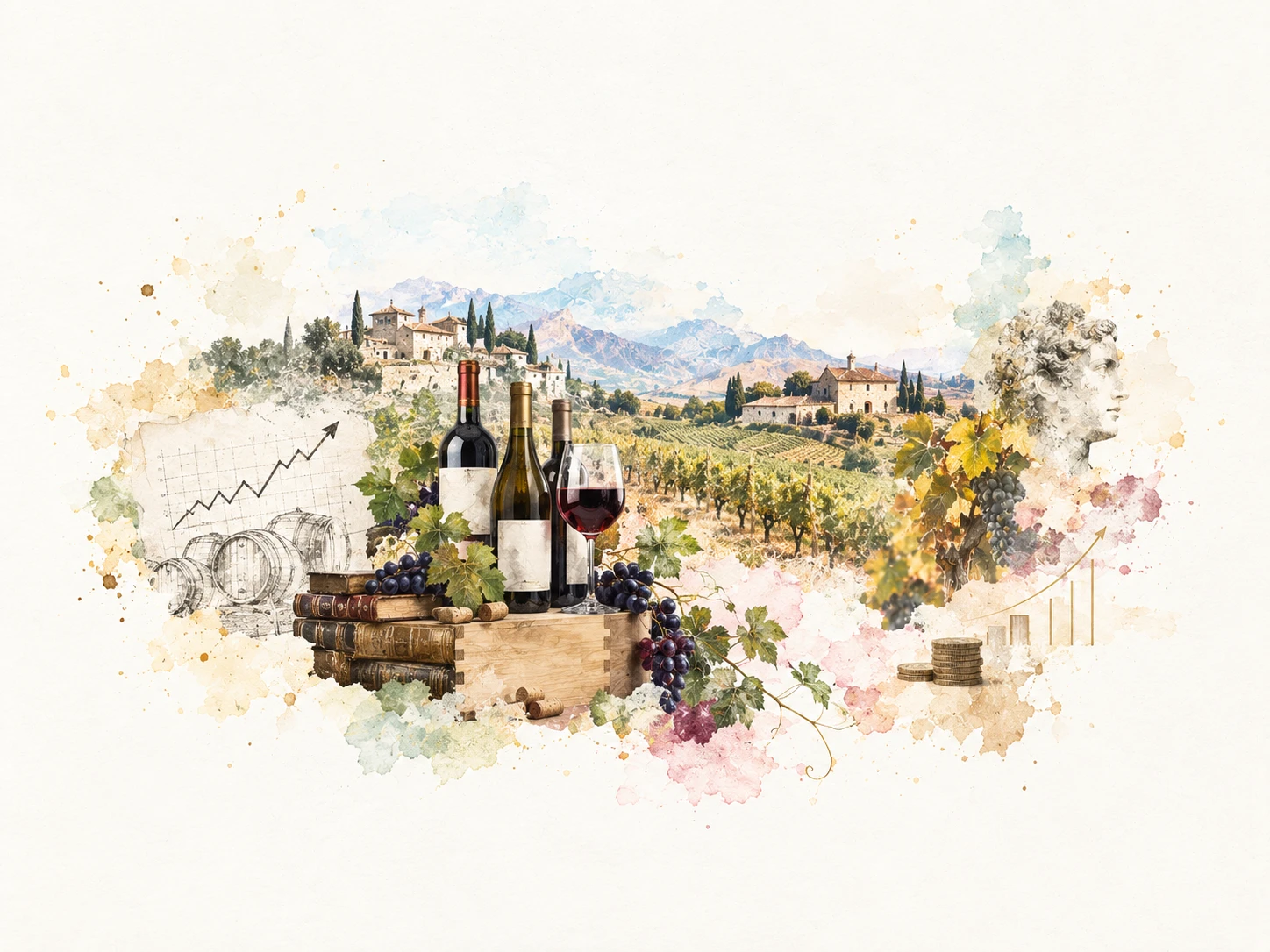
The French Paradox, Revisited: When the World's Wine Country Stops Drinking
What France's domestic disaffection reveals about its soft power — and the value of what it exports.
France's domestic wine consumption has been in structural decline for more than sixty years. The standard reading belongs to public health: the French are drinking less wine, younger generations are turning to alcohol-free alternatives, and the Évin Law permanently altered the cultural relationship with alcohol. That reading is accurate — and for millions of French wine producers, it describes an economic reality too serious to dismiss.
The term "French paradox" is here deliberately reappropriated. Its original medical usage referred to the relatively preserved cardiovascular health of the French despite a rich diet — an epidemiological puzzle. The paradox we are describing is of a different order: the country that made wine one of its most durable instruments of soft power is in the process of distancing itself from that instrument. This shift deserves to be read for what it is — a geopolitical and economic signal whose implications extend well beyond French wine market trends, and which directly concerns those operating at the intersection of France, capital, and power.
The Data as Signal — and as Crisis
The figures are well known but rarely interpreted in their full complexity. Only 11% of French adults today report drinking wine daily or almost daily — down from nearly 50% in 1980. Beck and Richard confirm that this proportion was still 24% in 1992, which measures the acceleration of the phenomenon over the past three decades. Per capita consumption has fallen by more than 60% since the 1960s, dropping from over 120 litres annually to under 40 litres, according to FranceAgriMer and INSEE data compiled by the French National Assembly.
This decline is not uniquely French. It is part of a global nutritional transition observable across all developed economies — falling liquid calorie intake, a search for naturalness, growing health consciousness. Dry January, the rise of non-alcoholic beverages, and increasing mistrust of alcohol among millennials and Generation Z are cross-border phenomena that would likely have produced a similar disaffection regardless of any other variable. Cogordan et al. demonstrate that the deep structural transformations of French society — mass urbanisation, the expansion of female employment, the shift from industrial to service economies — played a decisive role as early as the 1960s. The midday meal with wine, once common among workers and farmers, has all but disappeared with the generalisation of workplace canteens and compressed lunch breaks. Wine is no longer a daily staple — it has become an occasional and deliberate choice.
What is specifically French, however, is the scale and depth of the phenomenon in a country whose cultural identity is intimately bound to the vine. And what is systematically underestimated is its impact on the silent majority of the industry: not the grands crus, whose intrinsic scarcity protects them mechanically, but the volume appellations — Languedoc, the South-West, the southern Rhône Valley — whose economic model depended precisely on the regular domestic consumption that has collapsed. Vineyard uprooting, forced reconversions, the impoverishment of producers who cannot reposition themselves within luxury storytelling: this is the hidden face of the paradox, obscured by any reading that focuses exclusively on prestige wine.
The Évin Law of 1991 accelerated this shift by reconfiguring the cultural perception of wine — from an innocent emblem of the art de vivre to a product associated with real health risks. Gallopel-Morvan et al. showed that while the law did not eliminate advertising exposure, it durably altered the social perception of alcohol in France, effectively reclassifying wine from cultural staple to risk product.
The rise of craft beer offers a complementary indicator — though a more ambivalent one than it appears. Beer has gained 16 percentage points of volume share among alcoholic beverages in France between 2007 and 2023, rising to 45% of volumes purchased, directly at wine's expense, according to FranceAgriMer. This substitution is not new: Gual and Colom documented as early as 1997 that between 1974 and 1992, wine consumption in southern European countries had fallen by more than 40% while beer consumption rose by nearly 37% — evidence that the substitution between the two products is a long-term systemic phenomenon. It would be inaccurate to present this shift as a rejection of distinction in favour of egalitarianism: the craft beer movement has developed its own expert hierarchies, its own codes of recognition, its own occasionally prohibitive prices. Younger French consumers are not abandoning distinction. They are rejecting their parents' codes and constructing new ones — on different terrain, with a different vocabulary, but with an equally elaborated logic of social differentiation.
The Generational Fracture
A break in transmission deserves to be named before going further. Lorey and Poutet demonstrated in 2011 that young French adults hold representations of wine radically different from those of their parents and grandparents: wine is no longer associated with national identity or everyday conviviality, but perceived as elitist, complicated, or reserved for specialists.
This rupture in cultural transmission is confirmed by a broader phenomenon documented across high-income countries since the 2000s: the emergence of a "sober generation" for which alcohol is no longer a central marker of the transition to adulthood — self-control, health, and alcohol-free leisure are increasingly valorised. This is not a French particularity. It is a generational transformation that crosses borders, and which overlays the fundamental structural factors to accelerate disaffection.
Resistance Through Living Wine
It would be inaccurate to present the French wine industry as uniformly in retreat. A quiet but real movement is working to recreate domestic cultural anchoring on entirely different foundations.
The rise of natural, organic, and biodynamic wines represents a form of cultural resistance that analysis by volume alone cannot capture. These segments — carried by a new generation of independent producers, often established in historically undervalued regions — have created a new form of distinction that rests neither on price, nor on classificatory prestige, nor on the vocabulary of traditional expertise. A Jura wine produced biodynamically and sold in a natural wine shop in eastern Paris to thirty-something urbanites is recreating a living connection between French wine and domestic consumption — different from the classical model, but genuinely rooted in a contemporary culture.
This movement will not compensate in volume terms for the broader collapse. But it meaningfully nuances the thesis of inevitable musealisation: part of the industry is not seeking to preserve a frozen heritage, it is building new cultural legitimacy with a younger and more urban audience than that of the traditional grands crus. This may be where, over the longer term, the domestic vitality that French wine needs to remain something other than an export artefact is being rebuilt.
Parkerisation as an Aggravating Factor — Among Others
Domestic disaffection is primarily the product of deep sociocultural transformations that would have occurred regardless of any production decisions. But one aggravating factor deserves to be named, precisely because it is specific to French wine and rarely evoked in this context.
The parkerisation of Bordeaux — the phenomenon by which part of French production reconfigured itself to match the profile that American critic Robert Parker scored highly: more concentrated, more extracted, more immediately seductive — probably did not, in itself, alter the consumption habits of the average French drinker. Its impact is of a different order: it opened a symbolic gap between the viticultural elite and the everyday table. The wine that the international press celebrated and Asian markets competed to acquire was no longer quite the wine that France recognised as its own. This is not a direct cause of volume disaffection — it is a loss of cultural identification, more diffuse but more durable.
This repositioning was economically rational, and its direct beneficiaries chose it deliberately. But it produced, as an unanticipated side effect, a dissociation between the international image of French wine and its domestic anchoring. And that dissociation has consequences that extend well beyond taste.
The Unresolved Tension: Legitimacy or Exclusivity?
This is where the analysis must be honest about its own limits.
A cultural product that is no longer consumed by the culture that produced it begins to lose something essential — not its technical quality, but its legitimacy as a living expression of a civilisation. The risk, stated plainly, is that of the empty shell: a French wine that has become a pure export artefact, disconnected from the table that gave it meaning, and whose international prestige rests increasingly on historical reputation rather than on a living cultural reality.
This risk is real. It is not inevitable — the living wine movement described above is the clearest evidence of that. But it deserves to be named, precisely because optimistic readings centred on "reinforced scarcity" and "growing exclusivity" tend to minimise it.
Scarcity can be an asset in the short and medium term. Over the long term, a product that is no longer consumed in its country of origin eventually loses the substrate that justified its prestige. French luxury — in fashion, gastronomy, perfumery — has always derived its strength from being simultaneously aspirational for the foreigner and rooted in a living reality in France. The day that domestic reality disappears entirely, what remains is a museum, not an art de vivre. And a museum, however well preserved, does not command the same prices as a living civilisation indefinitely.
From Cultural Legitimacy to Financial Risk
This dynamic is precisely what transforms the cultural question into a financial one — and justifies its place in an analysis aimed at investors and executives.
The valuation of prestigious wine assets rests, in the final analysis, on the collective belief that French wine embodies something irreplicable — a terroir, a civilisation, an art de vivre. That belief is sustained, in part, by the fact that wine is still consumed, transmitted, and debated in France. The day that substrate erodes sufficiently, the price of a grand cru no longer reflects a living reality — it reflects a nostalgia. And nostalgias, however well curated, eventually depreciate.
This mechanism does not operate at the scale of a vintage or a decade. But for an investor or family office reasoning over a twenty or thirty-year horizon, the trajectory of the domestic cultural legitimacy of French wine is a variable that deserves to be integrated into valuation models — alongside climate, regulation, and export market dynamics.
What This Means for the International Investor and Executive
Within this framework, what should those operating at the intersection of France, capital, and power take away?
The first observation is bifurcation. The French wine market is splitting at an accelerating pace between two segments with opposing dynamics: prestige appellations whose intrinsic scarcity shields them from domestic disaffection, and volume appellations whose economic model is under severe pressure. Reading "the French wine market" as a homogeneous whole is an increasingly costly analytical error.
The second observation concerns cultural signal. An international executive who selects a great French wine for a business dinner in Paris is inscribing themselves within a system of codes from which France itself is progressively distancing. This tension is real and little discussed: the codes of French wine as a language of power remain operational internationally precisely because they have become rare and non-trivial, even within France. But their signal strength depends, over time, on their capacity to remain anchored in a living culture — not merely in a history.
The third observation concerns long-term risk. Investors who bet on the value of French grands crus as pure scarcity assets are making a sound wager on a five-to-ten-year horizon. Over a longer horizon, the question of cultural legitimacy is a variable that financial models rarely incorporate, and that warrants serious attention.
French Wine Is Not Disappearing. But Its Transformation Is Not Without Risk.
French wine is repositioning — under the combined pressure of public health imperatives, generational shifts, a reconfiguration of its place in contemporary French culture, and a decade of production oriented towards export at the expense of domestic anchoring.
This repositioning creates real opportunities for appellations whose scarcity is intrinsic and whose technical quality is irreplicable. It creates a real crisis for the majority of producers whose model depended on domestic mass consumption. It opens an unprecedented space for producers building new cultural legitimacy through living wine. And it poses a long-term question that neither the optimism of prestige markets nor the catastrophism of the volume sector correctly formulates: can the symbolic power of a cultural product be maintained indefinitely without maintaining its domestic vitality?
France built over centuries a system in which wine was simultaneously a product of daily consumption and an instrument of social distinction. That duality is resolving — in favour of the second dimension, at the expense of the first. This movement concentrates value in the rarest assets. It simultaneously weakens the substrate that justified that value.
For those operating at the intersection of France, power, and capital, understanding both dimensions of this transformation — the short-term opportunity and the long-term risk — is precisely what a superficial reading of consumption trends does not allow.
French wine is not losing its power. It is concentrating it — and in doing so, risks making it fragile.
Sources and References:French National Assembly report, based on FranceAgriMer / INSEE dataFrench National Assembly ReportINSEE. Institut National de la Statistique et des Études Économiques.Évin Law (1991): French public health policy on alcohol advertisingBrasseurs de France. DataFranceAgriMer / CNIV. Quinquennial Wine Consumption Study. Montreuil: FranceAgriMer, 2022.Beck, François, and Jean-Baptiste Richard. "La consommation d'alcool en France". La Presse Médicale 43, no. 10 (October 2014)Cogordan, Chloé, Yves Obradovic, Fabienne Ly-Le Moal, and Mickaël Naassila. "Effects of Alcoholic Beverage Control Policies and Contextual Factors on Alcohol Consumption and Its Related Harms in France From 1960 to 2000". Substance Use & Misuse 49, no. 12 (June 2014)Gallopel-Morvan, Karine, Gérard Spilka, Stéphanie Mutatayi, Régis Rigaud, Ludivine Lecas, and Stanislas Spilka. "France's Évin Law on the Control of Alcohol Advertising: Content, Effectiveness and Limitations." Addiction 112, no. S1 (October 2016)Gual, Antoni, and Joan Colom. "Why Has Alcohol Consumption Declined in Countries of Southern Europe?" Addiction 92, no. 3s1 (March 1997)Lorey, Thierry, and Pascal Poutet. "The Representations of Wine in France from Generation to Generation: A Dual Generation Gap." International Journal of Entrepreneurship and Small Business 13, no. 2 (2011)Månsson, Josefin, Ingrid Berglund, and Torbjörn Forkby. "Doing Adulthood — Doing Alcohol: What Happens When the 'Sober Generation' Grows Up?" Journal of Youth Studies 25, no. 1 (November 2020)
You May Also Like