French Table Manners: The Social Codes Behind Every Gesture
From royal ceremony to the business lunch: an anatomy of power at table. Some gestures carry so much history that we no longer truly perform them – we enact them. Where you are seated, which wine you pour, how long you wait for the host's signal: these everyday acts have become, over centuries, small scenes of social theatre in which everyone watches and is watched.
The French Table as Political Space
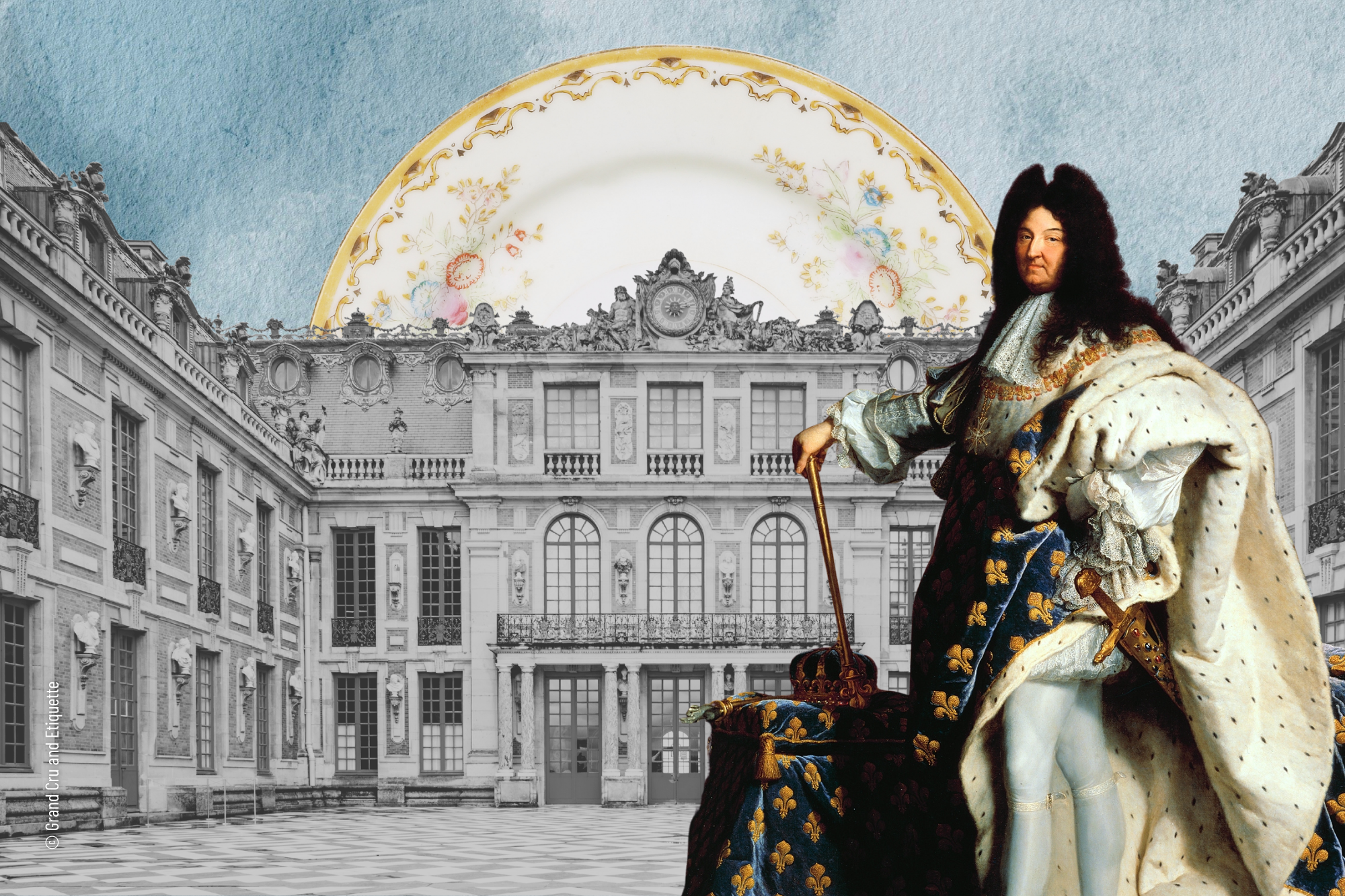
Before it became an invitation to conviviality, the table was an instrument of power. Under Louis XIV, the royal meal was not a private act: it was a public ceremony, precisely choreographed, in which one's position in the room, the sequence of courses, and proximity to the sovereign encoded the hierarchy of an entire court. The service à la française – that codified choreography of the royal table – was no gastronomic whim. It was a grammar of symbolic domination.
What Bourdieusian sociology would later call “cultural capital” was legible in every gesture at table: knowing when to wait, never serving oneself before the host, mastering the sequence of cutlery, distinguishing the moment for cheese from the moment for dessert. These conventions appear trivial. They were not. They signalled belonging, delimited circles, drew invisible yet absolute borders between those who knew and those still learning.
“Every gesture at table is a social signature. The uncomfortable truth is that everyone knows it – and no one admits it.”
The Revolution shattered the aristocratic monopoly on these codes without abolishing them. The grand Parisian restaurants born in the wake of 1789 democratised them by commercialising them. Hospitality schools and haute gastronomie transformed these rites into teachable protocols. But in becoming accessible, the codes did not lose their function: they simply migrated from the political to the social, from the court to the bourgeoisie, from the Tuileries to the drawing rooms of the sixteenth arrondissement.
The grammar of power at table did not disappear. It went underground.
The French Seating Plan: Hierarchy Made Visible
The first of these quiet codes acts before anything is served – before the aperitif, before the first mouthful. It carries a modest name: the plan de table, the seating plan.
We imagine that hospitality begins when the dishes arrive. It does not. It begins the moment one decides who sits where. Placement is hierarchy made visible: fixed in space, and held there for the length of the meal.
The founding rule can be stated in a single word: the right. In France, the place of honour lies to the right of the host. The more a guest matters, the closer they sit; and as the eye travels towards the ends of the table, it descends, gently, through the order of importance. No one announces this. Everyone reads it.
There are even two possible geometries, and they do not say the same thing about the world. In the first, the hosts sit at the centre of the table, facing one another, at the heart of the conversation. In the second, they preside from either end, each commanding their own extremity. Two ways of declaring who reigns, and where.
None of this is confined to private dinners. In diplomacy, a seating plan is a political act in its own right. To place one leader beside another – or pointedly not – is never innocent, and the history of state banquets is punctuated by incidents born of nothing more than a placement card. A centimetre of tablecloth can carry the weight of a declaration.
So when you enter a room and are shown to your place, understand what is happening. You are not being seated. You are being situated.
Three Philosophies of French Table Service
Three centuries of French table service can be reduced to a single shift in philosophy – and that shift reveals everything about how power prefers to present itself.
Service à la française placed the food at the centre: abundant, simultaneous, theatrical. Dominant from the 17th century to the mid-19th, it brought every dish of a course to the table at once, arranged symmetrically along its length – thirty, forty, sixty dishes in a single tableau. The table was a stage, and abundance was the performance. At Versailles the choreography was politics: which dishes a courtier could reach, how close they sat to the king's plates, were precise expressions of rank.
Service à la russe, which displaced it from the 1810s, inverted the logic. Dishes were plated in the kitchen and brought to each guest in sequence, one course at a time. The focus shifted from the spectacle of the laden table to the individual guest – from display to attention, from theatre to conversation.
Service à l'anglaise, less discussed but still seen in formal households, presents the dish whole before it is carved and served by the host at the sideboard. Carving in view carries a particular charge: an act of care made visible, a ritual that puts the human bond before the perfection of the plate.
“Service à la française asked: how impressive can this table appear? Service à la russe asked: how well can this guest be served? The entire history of modern dining unfolds between those two questions.”
A caveat, though, and the food historian Loïc Bienassis makes it well: these labels are treacherous. To a historian, service à la française means every dish set on the table together; to a hospitality-school instructor, it means the waiter presenting a dish from which each guest helps themselves. The same phrase, two opposed meanings – and the same confusion attends service à la russe. Bienassis calls it, with some humour, a dialogue of the deaf, and concludes, sensibly, that one is clearer simply saying service à l'assiette: plated service.
And plated service, he notes, became the norm only in the 1960s and 1970s. Before that the dining room lived by its rituals – dishes flambéed, meats carved, trolleys wheeled between the tables – when what happened in the room mattered almost more than what happened in the kitchen. The great theatre of the dining room, which we imagine centuries old, in fact tipped over barely two generations ago: the codes we take to be eternal are often very young, and that is precisely what keeps them moving.
Every choice made in a modern dining room – the timing of courses, the role of the sommelier, the decision to carve at table or plate in the kitchen – echoes one of these three answers to the same question: who is the meal for?
French Wine as the Vernacular of Status
Within this codified space, wine occupies a singular position. It is not simply a drink: it is a lexicon. To know its great regions – Bordeaux, Burgundy, the Rhône, the Loire – its vintages, its hierarchies, is to command a language that immediately distinguishes the initiated from the uninitiated. And like any language, it excludes as readily as it unites.
The ritual of tasting – when the sommelier presents the bottle, pours a measure for the lead guest, and waits for a verdict – condenses all the tensions of this world into a single moment. Historically, the gesture had a purely technical function: to verify that the wine was not corked. Today it has become a symbolic performance – what Erving Goffman would recognise as a moment of self-presentation in which the stakes extend far beyond the glass. The guest who nods, who offers two syllables of approval, is playing a role they do not always understand – and sometimes know it, painfully.
Because the real subject is not the wine. It is the gaze. That awkward silence that settles when one cannot think of anything to say about a bottle presented with reverence. The fear of appearing ignorant, or worse, indifferent. The inability to say simply, “I don't like it” – because disliking a wine carefully chosen by the host can feel like an affront, a judgment, a confession.
The French table creates situations in which everyone is simultaneously performer and audience. The host who selects the wine performs knowledge and taste. The guest who receives it performs appreciation. The sommelier who presents it performs deference – while observing everything.
“To dine together is always to negotiate a vision of the world. The menu is political. So is the seating plan.”
The French Business Lunch: The Table as Boardroom
The French business lunch is not a meeting with food attached. The codes that governed the royal table did not vanish with the monarchy: in France, a striking amount of business is still conducted not across a conference table but around a dining one. The long midday meal – three unhurried hours are unremarkable in France – is not a pause from work but a different instrument for it: a way to weigh a counterpart's judgment, patience and ease long before anything is signed.
What is ordered matters as much as what is said. The wine is not an accompaniment but a statement – of taste, of confidence, of how well one reads the table. A host who chooses fluently signals cultural command; a guest who defers gracefully signals respect. The knowledge that once marked aristocratic distinction now marks professional credibility.
There is a reason gastronomy is the one subject that stays safe when income, politics and private life do not. The meal is where guards drop and hierarchy briefly loosens – one of the rare settings in French professional life where formality yields to conviviality without either side losing face. To eat well together is to establish that a relationship can exist at all.
Still, the table is only half the story. In French business, other codes weigh just as heavily – how you address people, how you write, how hierarchy actually works away from the tablecloth. [Doing business in France: the unwritten codes →]
What the Table Reveals, and What It Conceals
The codes persist because they work – not despite their arbitrariness, but through it. To know them is to belong. To misread them is to be placed, instantly and without appeal, on the wrong side of an invisible line. This is what makes the French table so durable as a social instrument: it requires no enforcement. The anxiety it produces in those who do not fully command it is enforcement enough.
We now understand that holding a table is a social performance. We know that etiquette is never neutral. And yet we persist – because the table remains one of the rare spaces in which body, taste, time, and social bond converge into a total experience. Because to serve a wine well – at the right moment, with the right intention, towards the right person – is to offer something that transcends technique: it is to offer attention.
In the final analysis, that may be the only criterion that truly holds. Not the vintage, not the label, not the appellation – but whether the gesture, whatever it may be, is oriented towards the other. Towards their pleasure. Towards their presence.
The rest is literature. Which is no reason to consider it dispensable.
ReferencesJean-Paul Aron, The Art of Eating in France, Harper & Row, 1975 (original : Le Mangeur du XIXᵉ siècle, 1973).Loïc Bienassis et François-Régis Gaudry (dir.), La Grande Histoire de la gastronomie, Larousse, 2024 (in French).Norbert Elias, The Civilizing Process, Blackwell, 1994 (original allemand : Über den Prozess der Zivilisation, 1939).Jean-Louis Flandrin et Massimo Montanari (dir.), Food: A Culinary History, Columbia University Press, 1999 (original : Histoire de l'alimentation, 1996).Jean-Robert Pitte, French Gastronomy: The History and Geography of a Passion, Columbia University Press, 2002.UNESCO, The Gastronomic Meal of the French, Representative List of the Intangible Cultural Heritage of Humanity, 2010.To Go FurtherPierre Bourdieu, Distinction: A Social Critique of the Judgement of Taste, Harvard University Press, 1984.Rebecca L. Spang, The Invention of the Restaurant: Paris and Modern Gastronomic Culture, Harvard University Press, 2000.Priscilla Parkhurst Ferguson, Accounting for Taste: The Triumph of French Cuisine, University of Chicago Press, 2004.Erving Goffman, The Presentation of Self in Everyday Life, Anchor Books, 1959.Alain Montandon, Le Livre de la politesse, Presses Universitaires de France, 1995.