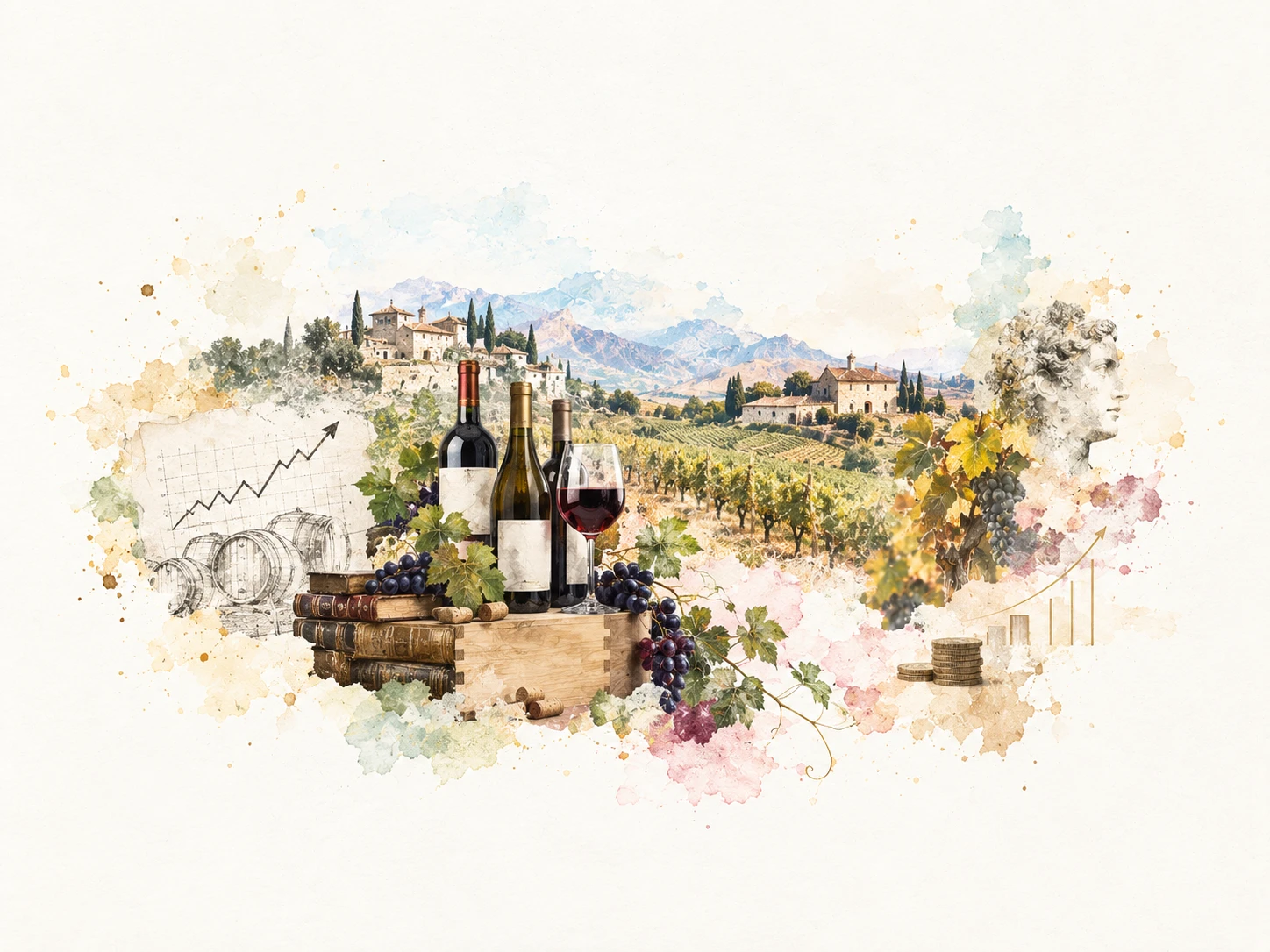
French Wine Diplomacy: The Bottle as Soft Power
Last updated: 25 September 2026What is French wine diplomacy? It is both the use of wine as an instrument of soft power (influence through attraction rather than coercion, from state dinners to diplomatic gifts) and the defence of wine itself in trade negotiations, from appellations to tariffs. France has practised it for centuries, and it has rarely mattered more. When Donald Trump threatened a 200% tariff on French wines and Champagne on 20 January 2026, after Emmanuel Macron declined to join his “Board of Peace”, initially created for Gaza, the move was widely read as yet another episode in the transatlantic trade war. In Paris, it landed as something more fundamental: an attack on one of France's oldest instruments of statecraft.
Far from being merely a cultural export, French wine operates as a form of influence that no tariff schedule can fully capture. At a moment when traditional diplomacy is under pressure (multilateral institutions weakened, bilateral trust fraying), Paris continues to project power through an asset that attracts rather than coerces. France does not impose its power through wine; it diffuses it, through every export, every state dinner and every protected appellation. The concept of soft power, introduced by the Harvard political scientist Joseph Nye in Bound to Lead (1990), finds no better illustration than a bottle of Chambertin placed before a head of state.
A Short History of French Wine Diplomacy
French wine diplomacy is not a modern invention; its continuity is what makes it remarkable. Under Louis XIV, the finest Bordeaux were already crossing borders as emblems of French refinement. In London, on 10 April 1663, Samuel Pepys recorded in his diary “a sort of French wine, called Ho Bryan, that hath a good and most particular taste that I never met with”: the first known tasting note of Haut-Brion. Later, Champagne became synonymous with celebration on a dynastic, then republican, scale, its bubbles inseparable from the idea of French excellence.
By the twentieth century, state dinners at the Élysée Palace had fully institutionalised the tradition. The choice of bottles was never incidental: every vintage served at an official table told a story, underscored a friendship or sent a discreet political signal. Serving a grand cru during a state visit is more than hospitality. It is the sharing of a heritage, a territorial narrative condensed into a single bottle.
This continuity, the unbroken thread from Versailles to the modern republic, is itself a form of power. Few nations can claim such narrative depth around a single export. It is precisely this historical credibility that makes French wine a uniquely durable diplomatic instrument. France did not simply inherit that credibility; it built it over 2,500 years, drawing on its own savoir-faire as well as on foreign expertise.
How Much Are French Wine Exports Worth?
French wine carries both. According to the Fédération des Exportateurs de Vins et Spiritueux de France (FEVS), French wine and spirits exports reached €15.6 billion in 2024, down 4%: €10.95 billion for wine and €4.48 billion for spirits. In 2025, they fell to €14.3 billion (−7.9%): €10.5 billion for wine and €3.7 billion for spirits.
The decline reflects structural shifts: weaker Chinese demand after years of rapid growth, changing consumption habits in Western Europe, and the cost of successive tariff disputes. Yet even at €14.3 billion, wine and spirits remain France’s third-largest trade surplus by sector, at €13.2 billion: a commercial footprint that most countries’ diplomatic corps would envy.
The United States alone accounted for €3 billion of French wine and spirits exports in 2025. That is 21% less than the year before, under the combined effect of tariffs and a weaker dollar, yet it remains the sector’s leading market, worth nearly twice the United Kingdom. This is why a transatlantic dispute touching French bottles is never purely economic: it is a test of the relationship itself. When Washington threatened 200% tariffs on French wine, it did not target a commodity; it targeted a symbol.
French Wine and US Tariffs Since 2019
The history of American tariffs on French wine is itself a diplomatic narrative in miniature. It shows how a bottle can become a bargaining chip, a barometer of tension or a signal of rapprochement, sometimes all at once.
On 18 October 2019, in the Airbus–Boeing dispute, the first Trump administration imposed a 25% tariff on French still wines, sparing Champagne and other sparkling wines. The tariffs were lifted in March 2021, early in the Biden presidency, as part of an EU–US truce. In March 2025, the second Trump administration once again threatened European wines and spirits with a 200% tariff, in response to a 50% EU levy on American whiskey. From April 2025, new US tariffs began to weigh on French exports, and since 1 August 2025 European wines have faced a 15% tariff under the EU–US trade agreement, with no exemption for wine. On 20 January 2026 came a new 200% threat, this time aimed squarely at French wines and Champagne.
These episodes reveal a constant: tariffs on Bordeaux or Champagne never seem purely economic. They are symbolic declarations, which can be read as deliberate provocations. A 200% threat is not a trade figure; it is a diplomatic ultimatum dressed in the language of commerce.
The reverse is equally true: lifting sanctions on wine can signal rapprochement. In 2020, China imposed anti-dumping duties of up to 218% on Australian wine, to the benefit of French producers: by early 2021, France had become China’s leading wine supplier. When Beijing lifted those duties in March 2024, Australian wine returned. These episodes are a reminder that, in wine as in diplomacy, market share follows the political weather.
This dual function (wine as an economic asset and as a political signal) is what makes it genuinely strategic. A country that controls a globally coveted, geographically protected, historically loaded export holds leverage that goes far beyond the invoice value of its bottles.
Why France Defends Its Wine Appellations Abroad
One of the most underappreciated arenas of French wine diplomacy is the defence of its appellations. The French AOC (appellation d'origine contrôlée) model has become a global standard: imitated, litigated over and fiercely protected in trade negotiations. At European level, AOC wines fall under the PDO category (protected designation of origin).
The inscription of Burgundy’s climats on the UNESCO World Heritage List on 4 July 2015 was not merely a cultural achievement. It strengthened their international standing, adding cultural legitimacy to the legal protection that names such as Chambertin or Meursault already enjoy. That same prestige has turned Burgundy’s vineyards into one of the world’s most coveted asset classes. [Inside Burgundy’s investment market →]
Defending Champagne against generic use in foreign markets is, ultimately, the defence of a revenue stream and a claim of sovereignty over a word. In European trade negotiations, geographical indications have become a non-negotiable chapter. France’s insistence on protecting its wine names in agreements with the United States, Japan or Mercosur is a direct extension of domestic wine policy into international law. The vineyard, in this sense, has its own foreign policy.
The Threats to French Wine’s Soft Power
French wine’s diplomatic power rests on a foundation of perceived excellence and irreplaceability. Both are under pressure. New World producers, from California to New Zealand and from Chile to South Africa, continue to close the quality gap. Climate change is redrawing the viticultural map of Europe: Champagne grape varieties now thrive in southern England, where Champagne Taittinger planted its first vines in Kent in 2017.
Meanwhile, the structural decline in wine consumption, particularly among younger generations, in France’s key markets threatens the cultural resonance on which soft power depends. A product that fewer people drink has less diplomatic reach.
France’s response (investment in sustainable viticulture, organic and biodynamic certification, lower-alcohol wines and vigorous enforcement of its appellations worldwide) reflects a clear conviction: the soft power of French wine must be actively maintained, not merely inherited. The strategic value of the bottle does not renew itself.
What French Wine Diplomacy Teaches Us
In a world where coercive power is showing its limits and multilateral institutions are under strain, France’s vineyard diplomacy offers a lesson in long-term strategic thinking. The bottle is at once a luxury product, a national symbol, a legal instrument and a trade weapon. Few assets in any country’s portfolio combine all four.
The deeper lesson is structural. France has built an architecture of influence around wine that extends from AOC law to UNESCO listings, and from Élysée dinner menus to WTO negotiating positions. No single element is decisive. Together, they form a system that has proved remarkably resilient across centuries of political change.
As global trade grows more contested and non-coercive influence gains in value, the lessons of the vineyard endure. Power, it turns out, can be cultivated, bottled and shared. And sometimes the most effective diplomacy arrives with a glass in hand.
Sources and references:Joseph S. Nye Jr., Bound to Lead: The Changing Nature of American Power (Basic Books, 1990), developed in Soft Power: The Means to Success in World Politics (PublicAffairs, 2004).Joseph S. Nye Jr., "Soft power: the origins and political progress of a concept", Palgrave Communications, 2017: https://doi.org/10.1057/palcomms.2017.8Harvard Kennedy School, Soft power: Not just winning hearts and minds, but saving lives: https://www.hks.harvard.edu/faculty-research/policy-topics/international-relations-security/soft-power-not-just-winning-heartsThe Diary of Samuel Pepys, 10 April 1663: https://www.pepysdiary.com/diary/1663/04/10/FEVS, Les exportations des vins et spiritueux français en 2024, February 2025: https://www.grandcruandetiquette.com/s/20250211-dp-fevs-bilan-2024-export-vins-spiritueux-vf-complet.pdfFEVS, Les exportations des vins et spiritueux français en 2025, February 2026: https://www.grandcruandetiquette.com/s/FEVS-2025-Wine-Export-Report.pdfFarella Braun + Martel, A Brief Guide to Wine Tariffs, 10 April 2025 (25% tariff of 18 October 2019; rollback in 2021): https://www.fbm.com/publications/a-brief-guide-to-wine-tariffs/Al Jazeera, Trump vows 200% retaliatory tariff on European wine and spirits, 13 March 2025: https://www.aljazeera.com/news/2025/3/13/trump-vows-massive-retaliatory-tariffs-on-european-wine-and-spiritsVinePair, 15% tariffs on European wine and spirits start August 1, 2025: https://vinepair.com/booze-news/eu-us-tariff-agreement-wine-and-spirits/Euronews, Trump threatens 200% tariffs on French wine if Paris does not join "Board of Peace", 20 January 2026: https://www.euronews.com/business/2026/01/20/trump-threatens-200-tariff-on-french-wine-leaks-macron-text-exchangeVino Joy News, France outstrips Australia to become China's top wine supplier, 2 May 2021: https://vino-joy.com/2021/05/02/france-outstrips-australia-to-become-chinas-top-wine-supplier/ABC News, China's government officially abolishes heavy tariffs on Australian wine, 28 March 2024: https://www.abc.net.au/news/2024-03-28/china-government-officially-abolishes-heavy-tariffs-on-wine/103644884UNESCO World Heritage Centre, The Climats, terroirs of Burgundy, inscribed 4 July 2015 (39th session, Bonn): https://whc.unesco.org/en/list/1425/Champagne Taittinger, Domaine Evremond (first vines planted in Kent in 2017): https://www.taittinger.com/en/webzine/evremond
You May Also Like