
Can AI Replace the Sommelier, Winemaker or Oenologist?
Last updated: 27 August 2026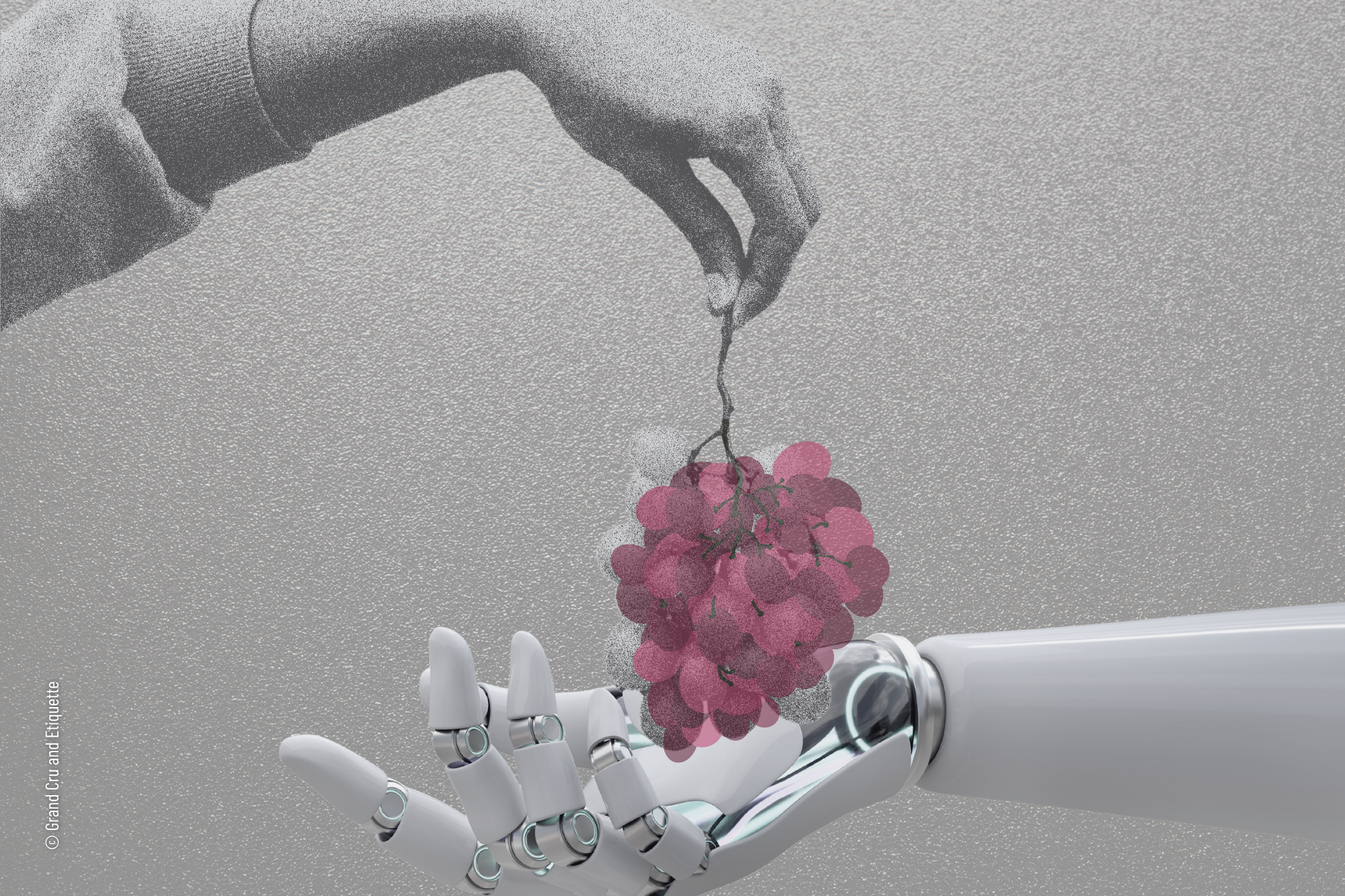
Artificial intelligence can recommend a bottle in seconds, continuously monitor a fermentation, analyse thousands of pieces of agronomic data and anticipate certain developments in a vineyard. But can it replace those whose experience, judgement and sensitivity give wine part of its meaning? The question is tempting. It is also probably the wrong one.
The real issue is not whether AI will replace the sommelier, winemaker or oenologist tomorrow. It is to determine which tasks can be automated, which skills can be enhanced, and where human judgement remains irreplaceable — or, at the very least, difficult to substitute. AI can collect, compare, monitor, predict and recommend. It does not necessarily decide what is worth doing.
A Revolution That Begins with Democratising Wine Advice
For most consumers, professional wine expertise has never been particularly accessible. Someone looking for a bottle to accompany grilled salmon, with a €15 budget, does not necessarily need a sommelier. They need a recommendation that is quick, clear and reliable enough.
That is precisely where artificial intelligence brings new value. It is available at any time, requires no specialist vocabulary and can instantly compare styles, regions, grape varieties and price points. Apps already allow users to manage their wine collections, record their preferences, search for bottles or suggest food-and-wine pairings.
For some consumers, AI is therefore the first genuinely accessible form of wine advice. It would consequently be wrong to present technology systematically as competition for the sommelier.
Very often, the choice is not AI versus expertise.
It is AI versus no advice at all.
That distinction is essential. Artificial intelligence can reduce the sense of intimidation that wine sometimes creates for consumers. It can explain the difference between two grape varieties in simple terms, help identify a particular style or enable a beginner to understand their own tastes better.
It does not necessarily eliminate the need for expertise. It may even create a desire to access it.
But Information Is Not Taste
This is where the first boundary appears.
An AI can analyse sensory descriptions, compare thousands of tasting notes, study reviews and identify frequent associations between dishes and wines. But it does not experience wine in quite the same way as a human taster.
It does not perceive the texture of a sauce. It does not taste how a wine evolves after thirty minutes in the glass. It does not directly experience the balance between acidity, bitterness, alcohol, texture and length. Above all, it does not experience the situation in which the tasting takes place.
A food-and-wine pairing is never simply an equation between two products.
Imagine roast sea bass served with a vierge sauce, grilled fennel and citrus-infused oil. An AI given the dish, cooking method, textures, budget and preferences could suggest three particularly relevant options: a classic pairing, a regional interpretation and a more unexpected choice. It could even explain the reasoning behind its suggestions.
But it would not necessarily know whether, that particular evening, the sauce was more acidic than expected. It would not know how the bottle was actually evolving. And it would not know whether the guest wanted reassurance or surprise.
A technically sound pairing can therefore fail. Conversely, a bottle that seems less obvious on paper can become remarkable in the right context.
Wine reminds us of a fundamental truth: the relevance of a recommendation sometimes depends less on the quality of the information than on the quality of its interpretation.
The Sommelier Does More Than Recommend a Wine
This is precisely what makes the sommelier’s profession particularly interesting in the age of AI.
A good sommelier is not simply someone who knows more wines than their customer. They interpret a situation. They ask questions, listen and notice hesitation. They understand that the same dish may call for different recommendations depending on the person.
One guest may be looking for something familiar. Another may want to step outside their usual habits. One may be celebrating a special occasion, while another may be attending a business dinner and looking for something more discreet.
The recommendation then becomes a form of dialogue. That relational dimension is difficult to reduce to a database.
This does not mean, however, that sommeliers should keep their distance from artificial intelligence. Quite the opposite. AI can become a remarkable professional assistant.
It can analyse a wine list, rapidly compare several bottles, research information about a producer, prepare educational material, rephrase a technical description, simulate a conversation with a customer or suggest alternatives when a particular wine is unavailable. It can also speed up the preparation of training sessions or help structure a sales pitch.
The distinction is crucial:
AI can prepare the decision; the sommelier still owns the judgement and the responsibility.
That responsibility also calls for a simple rule: automatically generated information must be checked before being used professionally. Producer, vintage, price, availability, technical characteristics or regulations do not become true simply because a machine states them confidently.
In the Vineyard, AI Sees More Than a Human — but Does Not Decide for Them
The same logic applies to viticulture.
The development of sensors, imaging and analytical tools now makes it possible to gather far more observations across individual plots. Soil moisture, weather conditions, temperature, vegetation development, signs of water stress and indicators of disease can be monitored with a frequency and precision that are difficult to achieve through human observation alone.
Solutions combining onboard imaging, geolocation and artificial intelligence are therefore being developed to analyse individual vines and monitor how vineyard plots evolve.
The aim is not necessarily to replace the winemaker’s eye. It is to help them know where to look first.
That is a fundamental difference.
A system can detect an anomaly in a vineyard plot. It does not automatically turn that anomaly into an agronomic decision. The winemaker still has to understand the context: the plot’s history, the stage of vine development, weather conditions, soil characteristics, production objectives and the estate’s overall strategy.
Technology therefore enhances our ability to perceive. It does not necessarily remove the need for interpretation.
In the Cellar, the Machine Monitors; the Oenologist Makes the Call
In oenology, the potential is equally significant.
Digital tools can continuously monitor certain fermentation variables and track temperature, density, pH and dissolved oxygen. They can compare several tanks, identify deviations and trigger an alert before a problem becomes more difficult to correct.
This continuous monitoring represents a considerable gain. But an alert is not yet a diagnosis.
A change may be normal. It may be temporary. It may be cause for concern. It may also reveal a situation requiring immediate intervention.
This is precisely where the oenologist’s expertise retains all its value. It is not simply a matter of knowing that a variable is changing. It is necessary to determine what that change means and what should be done about it.
The transition from data to decision therefore remains a professional act.
The Real Transformation: A Redistribution of Expertise
This is probably where the deepest transformation lies.
As routine tasks become increasingly automatable, the professional’s role can shift towards activities where context, interpretation and responsibility offer the greatest value.
The winemaker could spend less time monitoring certain information and more time deciding which interventions to make. The oenologist could receive earlier alerts and devote more time to analysing complex situations. The sommelier could spend less time on documentary research and more time investing in the customer experience.
The wine merchant could gain a better understanding of their customers’ general habits while retaining the freedom to introduce an unusual bottle or a small producer that sales data might not necessarily favour.
The question, then, may not be:
“What will AI do instead of the professional?”
But:
“What will the professional be able to do with AI that they could not do before?”
The change in perspective is considerable.
The Other Face of AI: The Risk of Standardisation
This evolution nevertheless carries risks.
Algorithms are particularly effective when preferences can be turned into measurable and comparable criteria. Yet wine resists precisely this kind of simplification.
A consumer who says they do not like powerful wines may fall in love with one particular powerful wine. Someone who normally drinks Bordeaux may want something completely different for a particular dinner. A technically imperfect wine can become memorable in an exceptional context.
Wine culture is full of contradictions, exceptions and unexpected discoveries.
A recommendation system may therefore reinforce what it already knows. If the available data favour popular wines, models may mechanically promote the wines that are best represented in their databases. Conversely, small producers, unconventional styles or experiences that are difficult to categorise may become less visible.
The problem is therefore not simply one of algorithmic bias.
It is also a question of diversity of taste.
The constant optimisation of predictability could, paradoxically, impoverish what makes wine so rich: its ability to surprise.
When Does a Tool Become a Crutch?
Another risk deserves attention: dependency.
A powerful tool can save time and improve decision-making. But a tool used without critical thinking can gradually replace the reasoning of the person using it.
If every recommendation is systematically validated by an algorithm, professionals may lose the habit of developing their own analysis.
AI should therefore remain a second opinion, rather than becoming an automatic authority.
This distinction is particularly important in professions where responsibility cannot be transferred to software. When an agronomic, oenological or commercial decision has real-world consequences, someone must still be able to explain why that decision was made.
What If AI Learned to “Taste” Better?
It would nevertheless be unwise to regard today’s limitations as permanent.
Multimodal systems are advancing. Sensory databases are expanding. Analytical technologies are becoming increasingly precise.
It is entirely possible that machines will become capable of modelling certain aspects of sensory experience with a level of sophistication that is difficult to imagine today.
Saying that AI cannot taste today does not therefore mean that no technology could ever represent or predict certain dimensions of tasting in a meaningful way.
But even in that scenario, one question would remain:
What do we really mean when we talk about expertise?
If the objective is to find the wine that is statistically best suited to a particular dish, AI could become extraordinarily effective.
If the objective is to create a memorable experience, convey a producer’s identity, educate a customer or understand the atmosphere around a table, the problem becomes broader.
Wine is not merely a liquid to be optimised.
It is also a cultural experience to be interpreted.
Towards Augmented Expertise
The most credible future is therefore probably neither the disappearance of wine professions nor a status quo protected by tradition.
It is a future of augmented expertise.
Under this model, artificial intelligence takes care of tasks where speed, the volume of data and repetition are the main considerations. The professional retains those requiring perception, interpretation, judgement, human connection and responsibility.
This evolution calls for new skills.
Wine professionals will not need to become developers or AI specialists. But they will need to understand the tools they use well enough to know how to:
formulate a precise request;
verify generated information;
interpret data or probabilities;
identify bias or uncertainty;
understand the limitations of a model;
protect confidential data;
retain their ability to exercise judgement in the face of automated recommendations.
At the same time, certain human skills could become even more valuable: tasting, observation, listening, teaching, adaptability, a sense of context and the ability to make decisions when the available information is incomplete.
In other words, the better machines become at producing information, the more valuable our ability to give that information meaning may become.
What AI Could Ultimately Reveal About the Wine Professions
There is an interesting paradox here. By automating part of the knowledge that is readily accessible, artificial intelligence could actually force us to define more clearly what it means to be an expert.
Expertise is not simply a matter of memory, nor is it merely the ability to recognise aromas. Nor is it a nostalgic resistance to technology. Perhaps, at its heart, expertise lies in the ability to exercise judgement when data are incomplete, contradictory or insufficient.
A sensor can detect, an algorithm can compare and a language model can recommend. But someone still has to determine what really matters.
That is probably where the future value of the wine professions will be decided. Technology will gradually take over what can be standardised, while human expertise will increasingly be judged by what resists standardisation.
The result, then, may not be a battle between AI and the sommelier, winemaker or oenologist. It could instead be a new division of roles in which technology handles what it does best, while professionals concentrate on the aspects of their work that require judgement, interpretation and human connection.
AI democratises access to knowledge and augments our capabilities. Human expertise interprets, adapts and gives meaning.
After all, wine has never been solely about choosing the right bottle. The most interesting question is sometimes not simply which wine we should drink, but why we should drink that particular wine, on that particular evening, with those particular people.
And answering that question may well remain one of the most distinctive forms of human expertise.
You May Also Like
Sources:Li et al., 2026: Machine Learning-Enabled Intelligent Technologies Across the Grape and Wine Value Chain: From Vineyard Sensing to Winemaking Optimization, Comprehensive Reviews in Food Science and Food Safety.Karpik, L. (2007). L'économie des singularités. Paris: Presses Universitaires de France.Hennion, A., & Teil, G. (2004). Le goût du vin : pour une sociologie de l'attention. In V. Nahoum-Grappe & O. Vincent (Eds.), Le goût des belles choses. Paris: Maison des sciences de l'homme.Polanyi, M. (1966). The Tacit Dimension. New York: Doubleday.Suchman, L. (1987). Plans and Situated Actions: The Problem of Human-Machine Communication. Cambridge: Cambridge University Press.Inria / Vitidrone: https://www.inria.fr/fr/vitidrone-veut-faire-decoller-lagriculture-durableHull, W. J. (2005). The terroir of Champagne: A historical and contemporary perspective. University of Bordeaux Press.Legeron, I. (2011). Organic and biodynamic winegrowing. University of California Press.OpenAI, GPT-4 Technical Report, 2023: https://doi.org/10.48550/arXiv.2303.08774Gordon M. Shepherd, Neuroenology: How the Brain Creates the Taste of Wine, Columbia University Press, 2016: https://cup.columbia.edu/book/neuroenology/9780231542876/Study on the impact of sommelier service on restaurant wine revenue, ScienceDirect, 2025: https://www.sciencedirect.com/science/article/pii/S0278431925000623