Is Paris Still a Culinary Capital? Food Historian Loïc Bienassis Answers
Last updated: 26 September 2026Paris remains a culinary capital, but its standing has changed profoundly. Its gastronomic reputation was long tied to the prestige of French cuisine and to a handful of emblematic districts. Today it also rests on the sheer range of cuisines the city has to offer. Paris has kept its prestige by becoming a showcase for the world’s cuisines, driven by a changing population, migration and Parisians’ own appetite for other culinary traditions. This internationalisation began as early as the interwar years, and it is the deep-rooted trend that the quarter-century from 2000 to 2025 seems to have confirmed.
A historian of gastronomy and food practices at the European Institute for the History and Cultures of Food (IEHCA) in Tours, and the author of La Grande Histoire de la gastronomie (Larousse, 2024), Loïc Bienassis was involved through the IEHCA in the inscription of the gastronomic meal of the French on UNESCO’s list of the Intangible Cultural Heritage of Humanity in 2010. His analysis places today’s changes within a much longer history: that of a capital whose culinary centres, table practices and diners have never stopped evolving.
Interview conducted in French on 28 May 2026
Photo © Pignatta
Why Has the Culinary Heart of Paris Kept Moving?
The culinary heart of Paris follows the pleasures and social life of its elites. Since the birth of the restaurant at the end of the eighteenth century, it has never stopped changing districts. Its first home was the Palais-Royal. Over the nineteenth century, the most fashionable establishments moved to the Grands Boulevards, notably the boulevard des Italiens. At the turn of the twentieth century, some of the most prestigious addresses drifted west, towards the Champs-Élysées and the Bois de Boulogne.
Loïc Bienassis cautions against reading these shifts as desertions. The Palais-Royal went on hosting many restaurants when the boulevards took over; it was simply no longer the place to be seen. “There are restaurants everywhere, but some places are more fashionable, more lively, more favoured by the elites,” he sums up.
Conceived as a kind of shopping arcade, the Palais-Royal of the late eighteenth and early nineteenth centuries brought together cafés, food shops, gaming rooms and prostitution. It was a genuine pleasure quarter for the elites, and “the restaurant, which was a new kind of place, found its place there quite naturally,” the historian explains. The ban on gaming houses, which took effect at the end of the 1830s, then helped draw this clientele towards the boulevards, where dining once again followed fashionable society. “The restaurant is always part of a wider system. On the boulevards, it is boulevard life, it is leisure, it is the theatres,” Loïc Bienassis stresses.
The same logic holds today. A district can attract diners from elsewhere because it has built an image that suits certain practices. In the 8th arrondissement, the presence of institutional power and corporate headquarters shapes customs of its own, such as the business lunch.
Bistronomy, which has flourished in eastern Paris and particularly in the 11th arrondissement, follows the same pattern. Loïc Bienassis describes it as a style of dining that meets expectations of “relative simplicity”, while being aimed “at people with a reasonably well-lined wallet”. The historian sees it as a cuisine “in keeping with this bobo Paris” – the Paris of the bourgeois-bohemians – while admitting he is never quite sure what the word means. Like the Palais-Royal and the boulevards before them, these new culinary territories go hand in hand with the social and economic transformation of their districts.
Les Halles, Bistros and Bouillons: When Social Classes Shared a Table
The old Les Halles market district offers a striking example of social mixing at the table. In the early hours, its bistros brought together at the same counter two worlds that had nothing else in common. On one side, revellers from polite society came to end their night over the famous onion soup gratinée of Les Halles, a ritual that, the historian insists, is no legend. On the other, the market workers were starting their day.
“You had at once those who worked there – the Les Halles labourers, the lorry drivers who brought in the goods – and all those Parisian bourgeois who, after a night out, came to finish it by eating something in these bistros,” Loïc Bienassis recounts. Several accounts attest to this coexistence, he notes. The market’s move to Rungis in 1969 put an end to this neighbourhood life in the heart of Paris.
The bourgeois taste for simple bistro cooking is, in fact, long-standing. The historian recalls a newspaper article from the 1930s that presented as a new fashion the habit of the bourgeoisie going slumming in bistros to eat unpretentious food, although he remains cautious about how far this reflected actual practice.
The bouillons – large, inexpensive Parisian eating houses that have come back into fashion in recent years – call for a note of caution. They are often presented as working-class canteens open to all. Yet the Bouillons Duval of the second half of the nineteenth century were aimed chiefly at “the middle classes, the petite bourgeoisie, clerks”. Labourers went to even cheaper places. Loïc Bienassis nonetheless acknowledges that “a certain social mix” prevailed there. The model, born in Paris, spread to the provinces by the end of the nineteenth century.
From Carving Trolleys to Celebrity Chefs
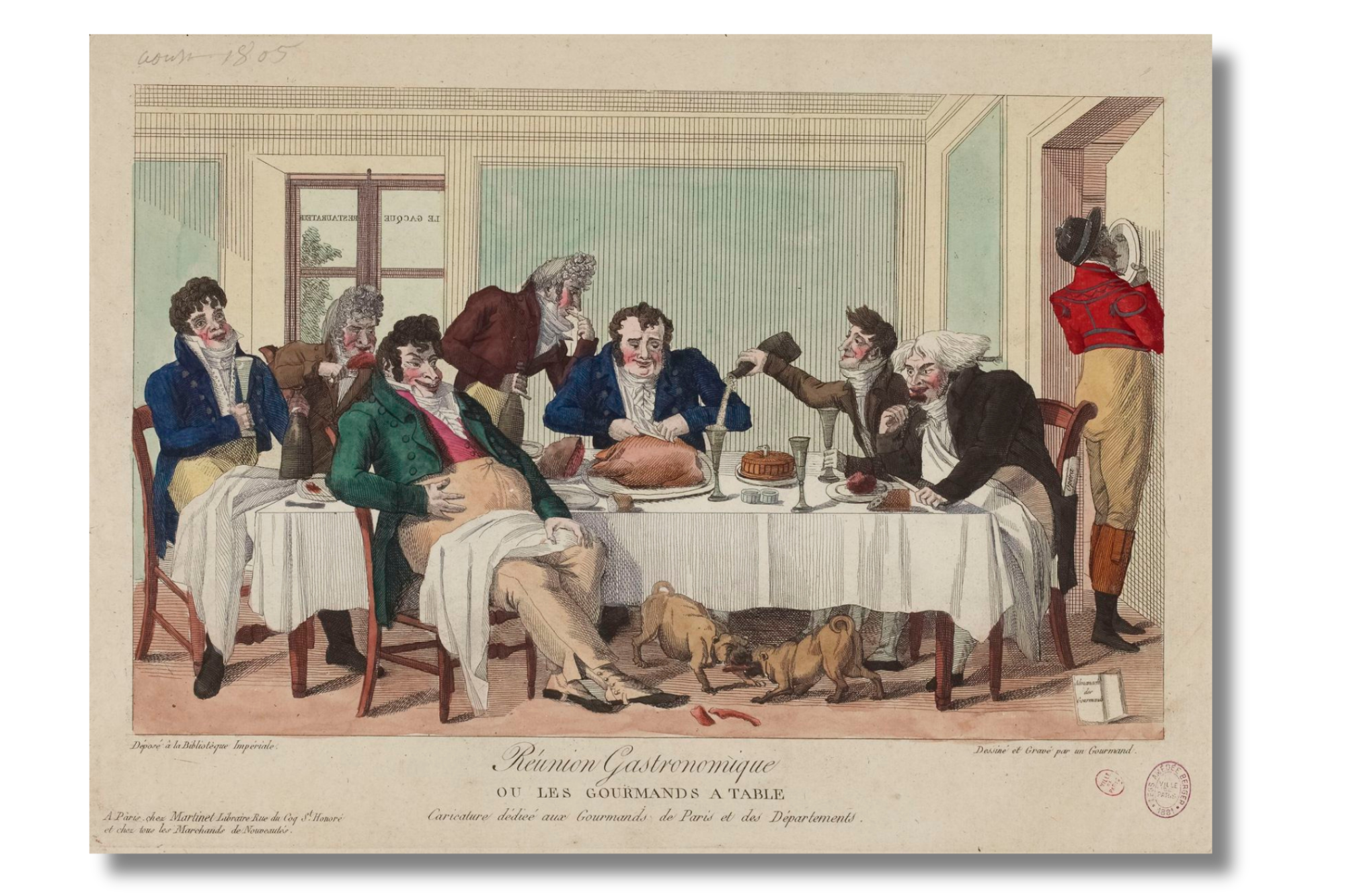
In upmarket restaurants, plated service only truly took hold from the 1960s and 1970s. “It is something we find hard to imagine,” the historian observes. Before then, the dish arrived whole in the dining room, the meat was carved there, and only then were the guests served.
The dining room was then at the heart of the meal, almost as much as the kitchen. Flambéing, carving, trolley service, the cheese trolley and the dessert trolley made up a veritable performance resting on a wealth of skills. “There were all sorts of dining-room rituals that were truly essential, that were part of the life of the restaurant,” Loïc Bienassis explains. Some fine-dining establishments still practise them or are reviving them, but what was once the norm has become the exception.
The retreat of the dining room went hand in hand with the rise of the chef. For a long time, and still in the 1960s, the name that made a house’s reputation was that of the restaurateur – that is, the owner. “Often we do not even know the cook’s name. Cooks were largely hidden away in their kitchens,” the historian recalls. Paul Bocuse liked to claim credit for turning cooks into stars. Loïc Bienassis sees it rather as a deeper movement that went beyond him, noting that there were others before him. Chefs stepped out of the shadows, gained the upper hand over the dining room and often became the owners of their own establishments.
French, Russian and English Service: What Is the Difference?
Historians and hospitality professionals do not give these three terms the same meaning, Loïc Bienassis warns.
For historians, French service means placing all the dishes of a single course on the table together, then replacing them with those of the next. Russian service, by contrast, presents the dishes one after another, often already carved, or carved after being shown to the table.
In hotel schools, the terms describe a waiter’s gestures. In French service, the waiter presents the dish from the left and guests help themselves. In English service, the waiter serves the food onto the plate. Russian service refers to carving the dish in the dining room, on a side table known as a guéridon, before offering it.
The historian says he has witnessed genuine “dialogues of the deaf” between historians and chefs on the subject. To be understood by everyone, he advises speaking instead of plated service, guéridon service or trolley service.
Paris, a Showcase for the World’s Cuisines
Paris was long a world culinary capital because French cuisine was “the great reference cuisine on an international scale, unquestionably”. That status has changed. “Nobody would dare say today that the greatest cuisine in the world is French cuisine,” Loïc Bienassis observes, quickly adding that its prestige “remains very strong”. What has disappeared is the very idea that one national cuisine could reign over all the others.
Paris responded to this change by welcoming cuisines from all over the world. The roots of this internationalisation probably go back to the interwar years, and the phenomenon unfolded over decades. For the historian, it is the lasting trend that will be remembered from the period 2000–2025, far more than fashions such as veganism, on which there is not yet enough hindsight. “Paris built itself as a culinary capital around French cuisine, but what also defines Paris today is this international offering, restaurants from every country,” he analyses.
This demand comes first from Parisians themselves. Tourists, Loïc Bienassis reckons, are “probably keener to eat French food”. The appetite for cuisines from elsewhere reflects the changing population of Paris and its aspiration to openness. The historian is amused, in passing, by the label “world cuisine”, which in his view means nothing, since every cuisine belongs to the world.
Why Tokyo Needs Only Its Own Cuisine
The demand for culinary diversity is above all a Western one. A great food city such as London or New York is now expected to offer every cuisine in the world, and it is hard to imagine such a capital being carried by its own gastronomy alone.
Tokyo escapes this rule. “Everyone considers it a world capital of gastronomy, but for Japanese cuisine,” Loïc Bienassis observes, and this “does not detract from its status”. Paris long worked on the same model: that of a capital consecrated by its own tradition. Why does this logic no longer hold for Western cities? The question, the historian concedes, deserves closer study.
What Keeps Paris a Culinary Capital?
Paris remains a world culinary capital because it has adapted to a new way of measuring culinary prestige, driven by the evolution of its population and the migration that shapes the city today.
For Loïc Bienassis, it is precisely this capacity to adapt that keeps Paris in the first rank. A city’s influence “also depends on its ability to show that it is a showcase for the world’s cuisines”. And it is the fact that all these cuisines are represented in Paris “that also allows Paris to maintain its reputation, its culinary standing”.
Further Reading:Loïc Bienassis, La Grande Histoire de la gastronomie, Paris, Larousse, 2024.Loïc Bienassis and Francis Chevrier, Le Repas gastronomique des Français, Paris, Gallimard, 2015.The GC&E Review, "The Art of Deliberate Choice", Issue 01, June 2026.
You may also like