“Bon Appétit”: What It Really Means in France — And What It Says About Your Rank
“Bon appétit” literally translates as “good appetite” — a wish for the enjoyment of a meal. In most of the world, it functions as a simple, pleasant formality. In France, and particularly in Parisian professional circles, it functions as something else entirely: a social signal whose meaning depends entirely on who says it, to whom, and in which context. Understanding the difference is the beginning of cultural fluency.
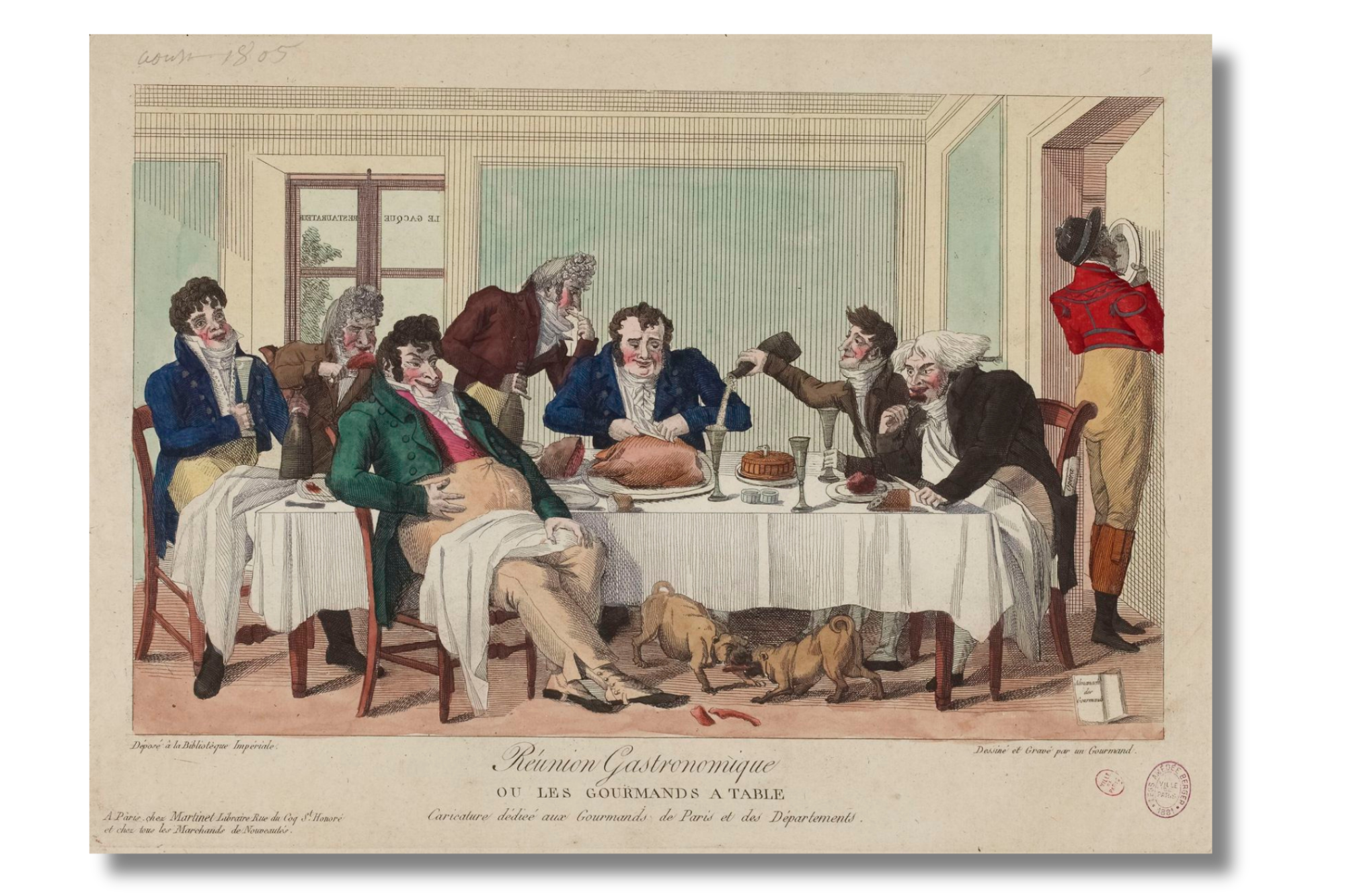
Réunion gastronomique ou les gourmands à table, published by Martinet (printer-bookseller), created by an anonymous author/engraver.
What Does Bon Appétit Mean in French Culture?
In French elite circles, a dinner table phrase is never merely polite, it is a signal. Understanding who says “bon appétit”, when, and why some say nothing at all, is the key to decoding the invisible grammar of French power, and what it means for any executive operating in this space.
Picture the scene: a business lunch at a two-Michelin-star restaurant in Paris's 8th arrondissement. Your French counterpart, CEO of a CAC 40 group, watches as the plates are set down. You smile and say: “Bon appétit”. An imperceptible pause crosses the table. Nothing hostile. But something has just happened. An informal test has been taken, or failed. Not out of ill will. Out of structure.
The French debate around “bon appétit” is typically framed as a quirk of table manners, a folkloric footnote in the etiquette handbook. That reading is accurate but insufficient. It misses the point: this phrase is a social boundary marker, an instrument of what sociologists call distinction, and, for any international executive, a window into how power operates in France, not through declaration, but through implication.
The Strategy of Silence: The Luxury of the Unstated
In 19th-century French bourgeois and aristocratic households, saying “bon appétit” at the table was considered a lapse of taste. Not from caprice, but from logic: to state what everyone already knows, that one is about to eat, was deemed vulgar in the literal sense of the word, meaning common. Refined politeness required no words. It manifested precisely through their absence.
This silence was not neutral: it was performative. It signaled that whoever remained quiet had internalized the codes so thoroughly as to have no need to vocalize them. This is precisely what Pierre Bourdieu called “embodied cultural capital”, those dispositions acquired so early and so deeply that they no longer resemble rules, but nature itself. To say “Bon appétit” was to display effort. To say nothing was to prove that effort had long since become unnecessary.
“Elegance is not the goal, it is the instrument. What is at stake is not the comfort of your guests. It is the demarcation of a boundary”.
For any executive, the parallel with other forms of implicit leadership is immediate. The most influential figures in high-culture organizations tend to speak sparingly in meetings, not out of timidity, but because speaking too quickly would signal the need to persuade. Their silence is their authority. The French table, in this sense, is a miniature laboratory of management by implication, a skill that transfers directly to boardrooms, negotiations, and client dinners across sectors.
The Semantic Arms Race: How Elites Shift the Codes
If silence was the original strategy of distinction, it gradually ceded ground as “bon appétit” became ubiquitous. Once confined to working-class households and informal family meals, the phrase progressively colonized the full social spectrum; brasseries, corporate lunches, dinners among friends. Everywhere, it settled in as a reflex of conviviality. Its democratization was its undoing in the eyes of those who had used it as a marker of belonging.
This is where Bourdieu becomes genuinely strategic. In his “race for distinction”, elites never abandon a territory without conquering another. Once “bon appétit” ceased to be discriminating, fine-dining establishments performed a precise lexical substitution: “Bonne dégustation”, sometimes “Excellente dégustation” in the most formal houses. The shift is revealing.
Popular register – “Bon appétit.”Body. Hunger. Need.
Bourgeois register – silence. Discretion. Incorporation. Evidence.
Elite register – “Bonne dégustation.” Palate. Experience. Aesthetics.
“Bon appétit” refers to the body and its satisfaction. “Bonne dégustation” summons the educated palate and the sensory experience. This is not merely a register shift: it is an ontological translation. The meal is no longer a need to be met, but an experience to be traversed. And this translation is far from trivial from an economic perspective: it describes precisely the transition from a service economy to an experience economy, as theorized by Pine and Gilmore in 1998. French haute cuisine understood before the consultants that value does not reside in the plate, but in the semantic framework in which it is placed.
Strategic parallel
The mechanism mirrors that of luxury branding at large: the moment a distinctive sign is democratized, a logo, a model, a phrase, the parent house quietly withdraws it from its own communications, leaving it to the mass market, and invests in a new semiotic territory. Exclusivity is not a state. It is a perpetual movement.
Executive Application: The Table as an Extension of the Boardroom
For an international executive (American, British, Asian) navigating the Parisian business world, understanding this grammar is not a cultural curiosity. It is a competitive advantage.
Research in Cultural Intelligence (CQ), notably advanced by the work of Christopher Earley and Soon Ang, establishes that the ability to read and adapt to the implicit codes of a foreign culture is one of the most reliable predictors of performance in cross-cultural contexts. And French implicit codes concentrate precisely in these interstices: the length of a silence, the choice of a phrase, the moment one begins to eat. None of these elements is ever explained. All of them are observed and interpreted.
The operational rule is simple to state, difficult to execute: observe before acting, and let your interlocutor set the register. An informal lunch with a Parisian partner at a neighborhood bistro: “Bon appétit” is not only acceptable, it is warm and human. A closing dinner at a gastronomic restaurant: silence, or at most, a nod as the plates arrive, will be read as cultural fluency, in other words as a mark of seriousness and respect. This is not cultural submission. It is relational precision.
“In Parisian business circles, mastery of the implicit can carry as much weight as a technical memorandum in closing a deal. What goes unsaid structures what gets signed.”
It would be reductive, however, to treat this competency as a simple code to be memorized. True sophistication does not lie in knowing the rules, it lies in understanding their logic, so that one can navigate with ease even in unforeseen situations. An executive who grasps that table silence is an economy of language, rather than an absence of courtesy, will be able to transpose that intelligence to other contexts: the meeting that opens without an explicit agenda, the commercial offer that is never stated directly, the refusal that takes the form of deferred enthusiasm.
The Symmetry of the Response: What to Say When Someone Wishes You “Bon Appétit”
Knowing when to say it is one half of the equation. Knowing how to respond when it is said to you is the other. The response “bon appétit” calls for is equally coded — and equally revealing of one's position in the social field.
In working-class circles: reciprocity as social bond
In working-class circles, “bon appétit” is a sincere and expected mark of conviviality. To say it and receive it in return is to acknowledge the other person before eating; not to reciprocate can be read as coldness, even rudeness. The expectation is explicitly symmetrical — "bon appétit" on one side, "merci, bon appétit" on the other. This reciprocity is not a protocol. It is the social fabric of the table. To depart from it, even out of discretion, risks being read not as a mark of refinement, but as an unnecessary distance.
In intermediate circles: the tolerated formula
In an informal professional setting or a lunch among colleagues, “merci, vous de même” or “merci également” has established itself as the standard response. It is functional: it acknowledges the phrase without extending the exchange. Neither cold nor expansive, it occupies a comfortable space of neutrality.
In elite and gastronomic circles: the register echo
At a formal dinner or in a gastronomic establishment, the most calibrated response is a brief nod, or silence — consistent with the logic of discretion that governs these circles. In the highest registers, a symmetrical “bonne dégustation” is the most precise reply: it mirrors the host's register without attempting to outbid it. The logic here is the same as in negotiation: the party who echoes the other's register signals comprehension; the party who raises it signals positioning; the party who lowers it signals discomfort. At the table as in the boardroom, the response to a social cue is never merely courteous. It is diagnostic.
What the Table Is Really Saying
“Bon appétit” is a small phrase carrying a large idea. In France, the meal is not a break from life — it is where life is negotiated. Business is settled between courses, relationships are read in the choice of wine, and status is signalled by what is poured and how. Knowing what to say is the first step. Knowing what is happening is the advantage.
The Invisible Hierarchies of an Apparently Relaxed Society
Contemporary France likes to think of itself as an open, meritocratic, post-protocol society. “Bon appétit” is now uttered by everyone, including in circles that would once have proscribed it. But beneath this apparent informality, the mechanics of distinction continue to operate, more subtly, more lightly, more difficult to catch for the foreign eye. Which is precisely what makes them more effective.
For the analyst, this is a durable lesson: hierarchies do not disappear when their codes are democratized. [How the French table really works, and the social codes behind it →] They relocate. They colonize a more implicit register, more deeply embodied, harder to imitate without understanding the underlying logic. “Bon appétit” has long ceased to be the frontier. But it remains the symptom of a system of frontiers that, itself, has never stopped existing.
The frontier, moreover, is not only in the saying. It is equally in the response. A phrase returned with the wrong formula, in the wrong register, at the wrong table, is as diagnostic as the phrase itself. The invisible grammar of French power does not merely dictate what is spoken. It dictates what is spoken back.
You May Also Like