
What Wine to Order at a Business Dinner: The Choice That Elevates You Without Overdoing It
The right wine at a business table is neither the most expensive nor the rarest. It is the one that fits the context.
At a first professional dinner, you want a safe choice. With connoisseurs, a discreet but well-judged bottle. On a terrace, a serious wine worn lightly. The right choice is not there to impress: it is there to show that you have understood the moment.
At a business table, wine is rarely just a pleasure. It is a signal. It says something about your ease, your attention to the other person, and your ability to read a situation before it has even been put into words.
Business Wine is a Signal, Not a Demonstration
Ordering a great Bordeaux on a Tuesday evening, one-to-one, does not send the same message as the same wine at a closing dinner for twelve.
The difference lies not in the bottle but in the context. The person who chooses well does not prove that they know wine. They show that they understand the moment.
Before you order, ask yourself three simple questions: what is the occasion? What register is expected? And, if you know it, what does the person across from you drink?
What Your Choice of Wine Says About You
Francesco Cosci, Wine Director at Le Bristol Paris, observes this grammar every day. In France, people readily order an appellation; in the English-speaking world, they more often order a grape variety. Two ways of thinking about wine, and therefore two ways of presenting oneself at the table.
But the essential point lies elsewhere. When a guest orders a great Bordeaux or a prestigious Burgundy, they are not speaking only of taste. They are also expressing the importance they place on the person they are hosting. The wine becomes a message addressed to the guest as much as to the palate.
For Cosci, the sommelier's role is never to parade his knowledge or to correct a guest in front of their companions. It is to guide them discreetly, to put them at ease, and to preserve the flow of the exchange. As he puts it: wine is a tool; the real subject is the people.
What Wine to Order With Connoisseurs
This is the trickiest situation. The risk is not choosing a poor wine, but turning the choice into a demonstration.
The right instinct is to favour a well-judged bottle, slightly off the most obvious names. A confidential but respected appellation will often make a better impression than an over-familiar classic.
A white Irouléguy from Domaine Arretxea illustrates this approach perfectly. Those in the know will recognise the quality of the choice at once; the others will discover an excellent wine without feeling they are being given a lesson.
The signal is simple: I know the classics, but I don't feel obliged to recite them.
What Wine to Choose for a First Business Dinner
When you are hosting someone you do not yet know, this is neither the moment for risk nor for self-assertion.
Choose a wine that is recognised, legible and reassuring — established enough not to draw attention away from the conversation.
A white Sancerre from Domaine Henri Bourgeois fills this role perfectly. It is a familiar, well-regarded name that inspires confidence without seeking the spotlight.
A bottle that is too spectacular would impose a subject before you even know whether it interests the other person.
The signal is clear: I gave it some thought, but I have not made the wine the subject of the evening.
What Wine to Serve at a Summer Terrace Dinner
A summer dinner, jackets off, a more relaxed tone: the stakes have not disappeared. They have simply changed shape.
It is often in these more informal moments that trust, rapport and the intuitions that will shape future decisions are built.
A Bandol rosé from Domaine Tempier captures this balance well. Light in appearance, serious in the glass.
Choosing carefully on a terrace shows not only that you appreciate wine. It shows that you know the difference between ease and carelessness.
The signal is this: the stakes did not disappear simply because the jacket stayed at the door.
Prices are indicative and vary according to the vintage, the merchant and the restaurant.
The Mistake to Avoid at a Business Restaurant
The most common pitfall is not ignorance, but knowledge on display.
It shows in a few small details: a wine list studied well beyond any genuine deliberation, a question put to the sommelier more to be overheard than to be answered, an unprompted comment as the wine is served.
Taken individually, these gestures seem harmless. Together, they reveal someone playing a role rather than naturally inhabiting the situation.
At a professional table, what inspires the most confidence is never erudition. It is ease.
The Venue Speaks as Much as The Wine
The choice of restaurant follows the same logic as the choice of bottle.
In Paris, an address is never entirely neutral. It places your invitation within a register, an atmosphere, and a particular way of conceiving the relationship.
The historian Loïc Bienassis points out that gastronomic neighbourhoods shift over time, but their logic never does: they follow the places where economic, political and cultural elites are concentrated.
The 8th arrondissement remains associated with business lunches and institutional power. The 11th, shaped by the bistronomie movement, conveys a more contemporary simplicity, aimed at a culturally well-versed clientele.
To propose an address is already to position yourself.
Abroad, The Codes Change
These reflexes do not travel everywhere.
Jean-Charles Letellier, founder of Vinifield and a specialist in Asian markets, points out that in China the business meal is not a break from the negotiation: it is fully part of it.
The way you sit, greet, propose a toast, handle silence or approach sensitive subjects is watched as closely as the words themselves.
Where the French table readily values expression, the Chinese table favours the reading of the relationship.
Internationally, then, wine is no longer always the principal language. It is your behaviour that becomes the first signal.
Choosing The Right Wine Means Reading The Situation
Wine is only a tool. The real subject remains the people, the context and the moment.
The next time a wine list is handed to you, do not look first for the most prestigious bottle. Ask yourself instead what your choice will say about your reading of the situation.
Because at a business table, the best wine is not the one everyone remembers.
It is the one that allows the conversation, the trust and the relationship to take up all the space.
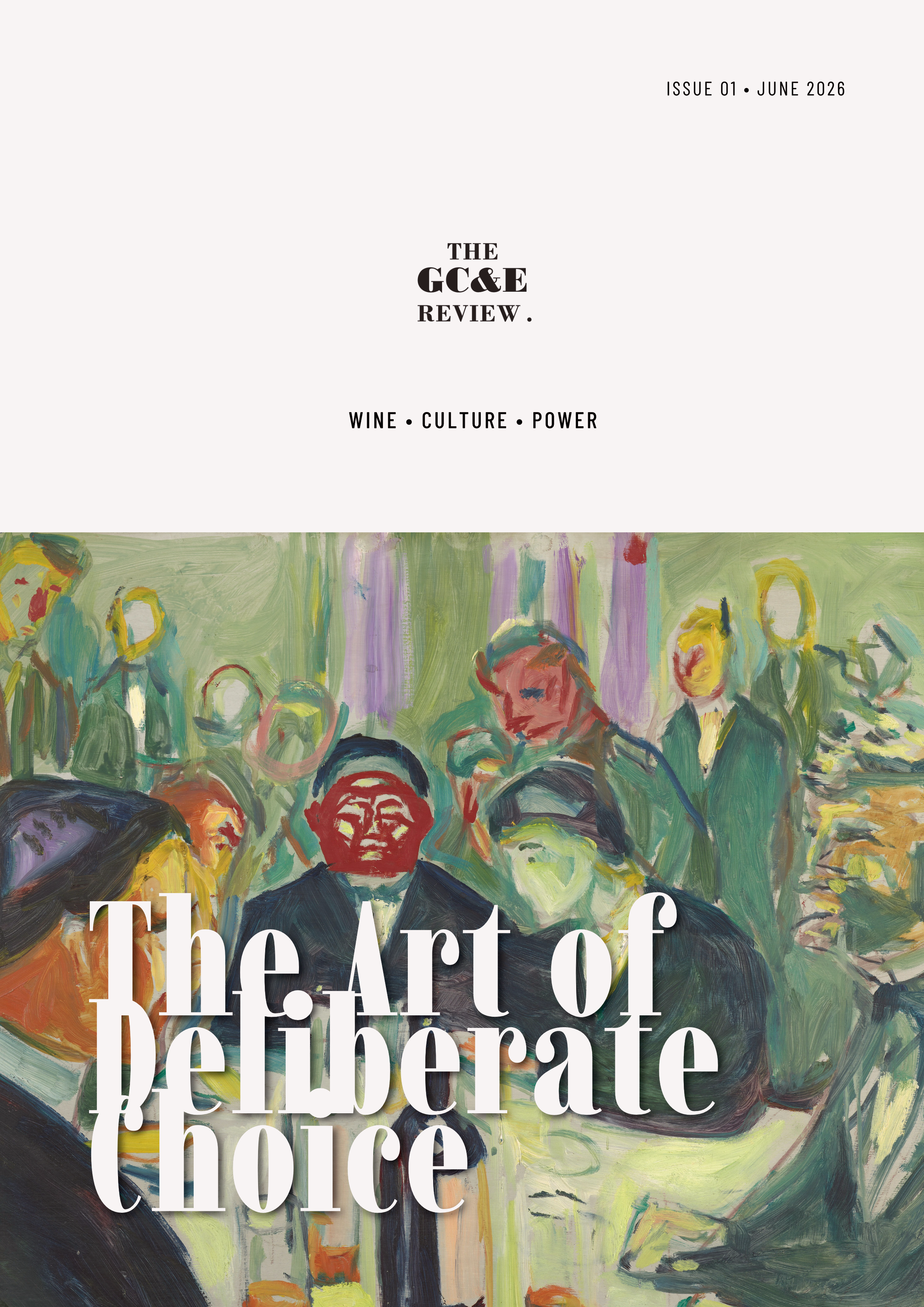
To Go Further Read
The Art of Deliberate Choice »
The first issue of The GC&E Review begins with a simple, unsettling idea: in a boardroom, what is truly decided is almost never said aloud. Power speaks softly — through the choice of a wine, a silence held a second too long, the seat one takes at the table. This issue is an initiation into that language no one teaches and everyone is expected to understand.
GET THE ISSUE →