
A fungus fought almost everywhere else, a warm wind sweeping down from the Pyrenees, grapes left on the vine long after the usual harvest: France’s great sweet white wines are born of a wager on nature. From Sauternes to Coteaux du Layon, from Jurançon to Alsace, here is how the grapes become concentrated, and what these methods change in the glass.
In Sauternes, the appellation’s rules strictly regulate interventions against Botrytis cinerea, the fungus most winegrowers try to keep under control. In Jurançon, growers rely on the foehn, a dry wind that dehydrates the bunches on the vine. In Alsace, the Vendanges Tardives designation may only appear on the label if the grapes reach sugar thresholds set by regulation. Three situations, three ways of taking risks at harvest time, with one shared goal: more intense sugars and aromas.
Noble rot, passerillage, late harvest: these terms appear on labels and wine lists without always being well understood. Noble rot concentrates the berries through the action of a fungus; passerillage relies on drying them out; late harvesting means leaving the grapes to ripen longer on the vine. These processes can combine, and partly explain why a Sauternes, a Coteaux du Layon and a Gewurztraminer Vendanges Tardives have such different profiles.
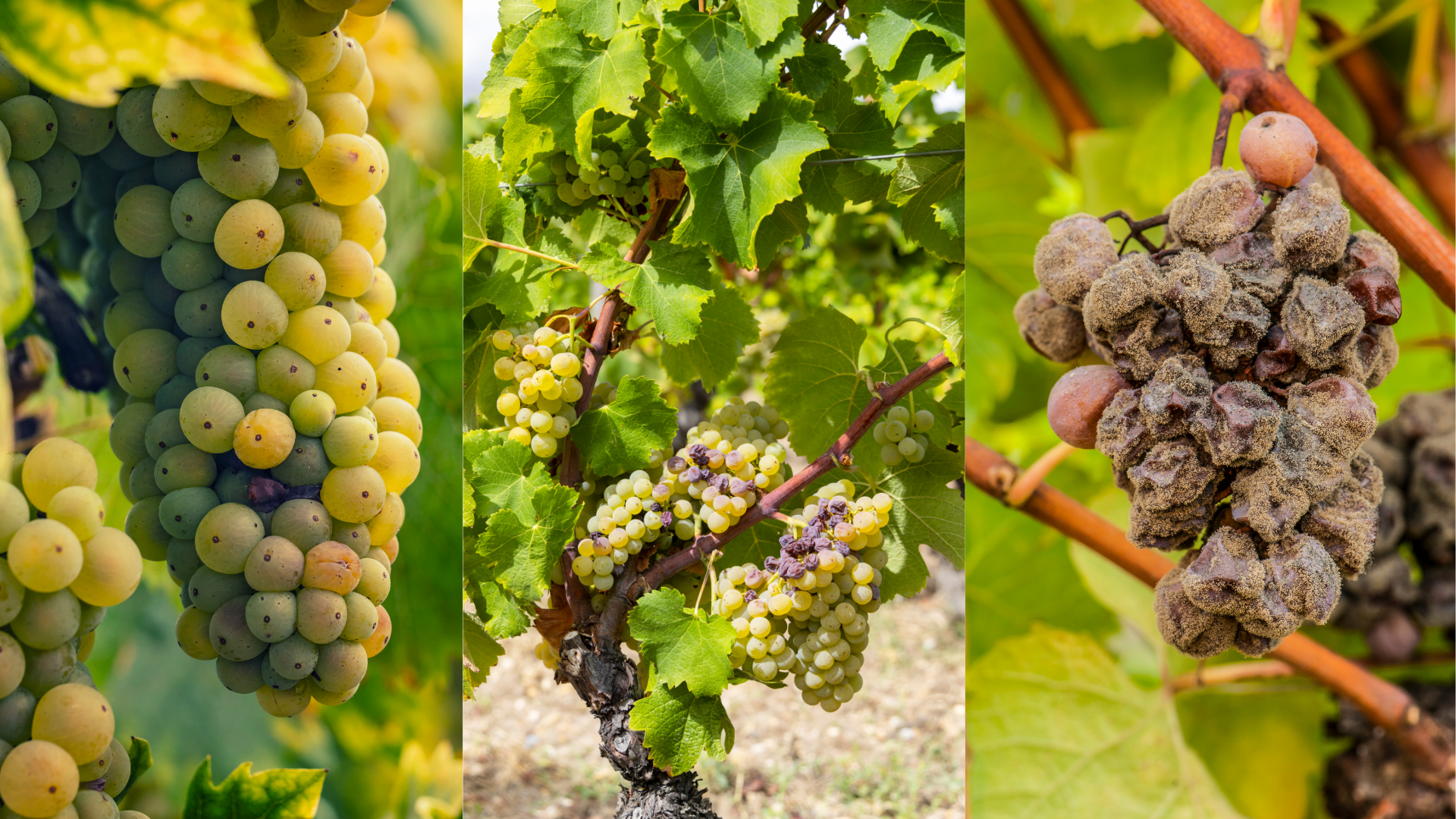
From late harvest to noble rot. Photos © Vitomirov, Phbcz, Esperanza33
Moelleux, doux, liquoreux: what do these French terms mean?
The terms moelleux, doux and liquoreux describe wines that retain natural residual sugar, but they do not correspond to the same level of sweetness. Under EU rules, a moelleux (medium sweet) wine contains more than 12 g of residual sugar per litre (or 18 g/L depending on acidity) and up to 45 g/L; a doux (sweet) wine contains at least 45 g/L. Liquoreux, on the other hand, is not a regulatory term: it refers to the most concentrated sweet wines, those English speakers often call lusciously sweet or dessert wines.
| Wine type | Sugar content | Characteristics | Examples |
|---|---|---|---|
| Moelleux (medium sweet) | More than 12 g/L (or 18 g/L depending on acidity), up to 45 g/L | Noticeable sweetness, usually balanced by a certain freshness. | Depending on the cuvée: Coteaux du Layon, Jurançon (more than 40 g/L) |
| Doux (sweet) | At least 45 g/L | Pronounced sweetness, with great aromatic richness. | Pacherenc du Vic-Bilh doux (at least 45 g/L), Jurançon Vendanges Tardives (more than 55 g/L) |
| Liquoreux | At least 45 g/L, often much more | Common term for the most concentrated sweet wines. It is not an EU regulatory term. | Sauternes (at least 45 g/L) |
These differences are largely explained by fermentation: when the grapes are particularly rich in sugar, fermentation can stop before all the sugar has been converted into alcohol. The wine then retains part of its natural sugar.
Yet the perception of sweetness does not depend on sugar content alone. Acidity, alcohol, texture and aromatic intensity also play an essential role. Sufficient acidity, in particular, balances the richness of the sugar and gives a fresh, harmonious finish.
How are sweet white wines made in France?
A sweet white wine is born first in the vineyard: its winemaking follows the main stages of a classic white wine, but the grapes are picked far richer in sugar.
To obtain grapes particularly rich in sugar and aromas, winegrowers have several techniques at their disposal: encouraging noble rot, delaying the harvest, or letting the berries dry out naturally. These practices concentrate the sugars and aromatic compounds in the grapes, producing wines that are more or less sweet, rich and complex.
Noble rot: letting a fungus transform the grapes
Noble rot is caused by a microscopic fungus, Botrytis cinerea, which develops on ripe berries when weather conditions are favourable. In the Sauternes area in particular, damp, misty mornings encourage its growth, while sunny, breezy afternoons allow the grapes to gradually lose some of their water.
This climatic balance remains fragile: if the humidity persists, the same fungus can cause grey rot, which is detrimental to wine quality. When noble rot develops in the right conditions, the berries become concentrated and their composition changes, contributing to the aromatic complexity of sweet wines.
Harvesting then demands great precision. Pickers go through the rows several times to select the bunches, or even individual berries, that have reached the desired level of concentration. These successive passes are called tries. This painstaking selection, combined with low yields and constant monitoring of the vineyard, partly explains the price of great sweet wines.
Late harvest: letting the grapes ripen for longer
Late harvesting means delaying the harvest so that the berries reach a more advanced stage of ripeness. They accumulate more sugar and develop more intense aromas. Depending on the weather, some of their water may also evaporate, increasing their concentration.
Late harvest therefore refers above all to the timing of the harvest. It can go hand in hand with natural passerillage or with the development of noble rot, depending on the region, the vintage and the condition of the grapes.
Vendanges Tardives and Sélection de Grains Nobles in Alsace
In Alsace, the designations Vendanges Tardives (VT, late harvest) and Sélection de Grains Nobles (SGN, selection of noble berries) are reserved for four grape varieties: Gewurztraminer, Riesling, Pinot Gris and Muscat. Any sugar enrichment, such as chaptalisation, is prohibited.
Vendanges Tardives wines often show aromas of exotic and candied fruit, with a finish that can retain good freshness. The grapes are harvested overripe and may be concentrated by natural passerillage, by noble rot, or by both. Botrytis cinerea is not required for this designation.
Sélection de Grains Nobles is a separate, more demanding designation. These wines come from even more concentrated grapes, most often through noble rot, and are generally more powerful and denser, with notes of candied fruit and fruit paste. Not every Vendanges Tardives, therefore, is a Sélection de Grains Nobles.
Passerillage: letting the grapes lose their water
Passerillage, or raisining, is based on a simple principle: the berries lose some of their water, which naturally concentrates their sugars and aromatic compounds. It differs from noble rot because it relies mainly on dehydration of the grape rather than on the action of a fungus. The two can, however, occur at the same time.
Passerillage takes two forms:
On the vine: the grapes stay on the vine after reaching ripeness. They gradually dry out before harvest, concentrating their sugars and aromas.
Off the vine: after picking, the bunches are left to dry in a suitable place, on racks, trays or straw. This technique is used in particular to make vin de paille (straw wine), produced in the Jura among other places.
Raisined grapes often produce concentrated wines marked by ripe, dried or candied fruit. The texture can be dense and the finish long. The aromatic profile also depends on the grape variety: a highly aromatic variety will give an expressive wine, while a grape with high acidity can retain more freshness and tension despite its richness.
Noble rot, late harvest, passerillage: summary table
| Noble rot | Late harvest | Passerillage | |
|---|---|---|---|
| Principle | Action of Botrytis cinerea, water loss and transformation of the berry | Harvest at a more advanced stage of ripeness | Dehydration of the berry and concentration |
| Role of Botrytis | Central | Possible depending on the vintage | Not needed for the process |
| French appellations | Sauternes, Barsac, Loupiac, Cadillac, Sainte-Croix-du-Mont, Monbazillac, Coteaux du Layon, Bonnezeaux, Quarts de Chaume, Coteaux de l’Aubance; Alsace Sélection de Grains Nobles | Alsace and Alsace Grand Cru (Vendanges Tardives designation), Jurançon (Vendanges Tardives designation) | On the vine: Jurançon, Pacherenc du Vic-Bilh, Coteaux du Layon After harvest (vin de paille): Arbois and the Jura vineyards, Hermitage |
| Common aromas | Honey, apricot, candied fruit, citrus | Exotic fruit, lychee, candied fruit, flowers, rose, spices depending on the variety | Ripe fruit, dried and candied fruit |
| Possible texture | Full, enveloping and persistent | Rich, with variable freshness | Dense and concentrated |
This list is not exhaustive. The same appellation may combine several methods depending on the vintage, as in Coteaux du Layon or Quarts de Chaume, where concentration can result from noble rot as well as from passerillage.
None of these techniques guarantees superior quality on its own. The result depends on the condition of the grapes, the variety, the vintage, the acidity retained and the care taken in both vineyard and cellar.
Sweet wines and vins doux naturels: not the same thing
Sweet white wines should not be confused with vins doux naturels, the fortified sweet wines of southern France such as Maury or Banyuls, which are made by mutage. In that case, adding alcohol during fermentation stops it and preserves some of the grape’s sugar. The sweet wines described here rely instead on the natural concentration of the grapes and on how their fermentation is managed.
Five iconic sweet wines, from Sauternes to Coteaux du Layon
Sauternes, Gewurztraminer Vendanges Tardives, Jurançon, Pacherenc du Vic-Bilh and Coteaux du Layon each illustrate a different way of concentrating the grapes. Sauternes is the archetypal expression of noble rot, with rich, concentrated and complex wines. Gewurztraminer Vendanges Tardives stands out for a particularly expressive aromatic palette dominated by floral notes, exotic fruit and spices.
In South West France, Jurançon illustrates concentration through passerillage on the vine, while retaining a lively acidity that keeps the wine fresh. Pacherenc du Vic-Bilh offers another expression of this method, with local grape varieties that shape its identity. Finally, Coteaux du Layon showcases the versatility of Chenin Blanc, whose natural acidity balances the sweetness and brings aromatic finesse and vivacity.
These appellations do not all fall into a single sweetness category. Jurançon and Pacherenc du Vic-Bilh, notably, exist in both dry and sweet versions. The final style depends on the cuvée and its residual sugar.
Comparison table: grape varieties, aromas and food pairings
| Appellation | Region | Grape varieties | Method | Aromas | Food pairings |
|---|---|---|---|---|---|
| Sauternes | Bordeaux | Sémillon, Sauvignon Blanc, Sauvignon Gris, Muscadelle | Overripeness and noble rot (Botrytis cinerea) | Honey, ripe or candied apricot, orange, exotic fruit and flowers |
|
| Alsace Gewurztraminer Vendanges Tardives | Alsace | Gewurztraminer | Harvested overripe, with possible passerillage or noble rot | Rose, lychee, mango, pineapple, honey and spices |
|
| Jurançon moelleux | South West France | Petit Manseng, Gros Manseng | Passerillage on the vine | Fruity and floral notes when young, evolving towards dried fruit and spices |
|
| Pacherenc du Vic-Bilh doux | South West France | Petit Manseng, Gros Manseng, Petit Courbu, Courbu, Arrufiac | Overripeness and passerillage on the vine | White fruit, exotic fruit and flowers, evolving towards candied and honeyed notes |
|
| Coteaux du Layon | Loire Valley | Chenin Blanc | Natural concentration on the vine, with or without noble rot | Ripe pear, quince, white flowers, honey and yellow fruit |
|
Note: the pairings above are suggestions. They may vary depending on the sweetness level, acidity, richness and ageing style of each cuvée.
Food pairing: what to serve with sweet white wines?
Sweet white wines are not just for dessert. Their aromatic richness and sweetness open up many possibilities at the table, provided a good balance is struck between sugar, acidity and the flavours of the dish.
Four principles make these pairings work:
Play on contrast: salt and powerful flavours balance the wine’s sweetness. Roquefort with a Sauternes or a Coteaux du Layon is a classic example, as is foie gras with a wine that has enough freshness.
Look for aromatic harmony: the wine’s aromas can extend those of the dish. Gewurztraminer Vendanges Tardives pairs with cuisines scented with ginger, lemongrass or mild spices, while Coteaux du Layon goes well with pear and quince desserts.
Favour freshness: the wine’s acidity balances its sugar and prevents any feeling of heaviness. A lively wine such as a Jurançon or a Coteaux du Layon is particularly suited to rich or creamy dishes.
Choose a dessert less sweet than the wine: next to a dessert sweeter than itself, the wine seems thinner, more acidic and less expressive. Fruit-based desserts that are not too sweet or slightly tart work better, such as a pear tart, roasted apricots or a citrus dessert.
What temperature should sweet white wine be served at?
Sweet white wine should be served cool but not ice-cold: between 8 and 12 °C (46–54 °F), depending on its age and style.
Young, very fruity wines, such as a Gewurztraminer Vendanges Tardives or a young Coteaux du Layon, are best between 8 and 10 °C (46–50 °F): the coolness highlights their vivacity and tempers the sensation of sugar. Older or more complex wines, such as a great Sauternes or a Jurançon with a few years in bottle, benefit from being served slightly less cold, between 10 and 12 °C (50–54 °F), to let their aromas of candied fruit, honey and spice come through.
Too cold, a sweet wine closes up: its aromas become muted and its texture seems harder. Too warm, it loses its freshness: sugar and alcohol take over and the wine feels heavy.
With a spicy dish or a dessert, a temperature at the lower end of the range enhances the sense of freshness. In practice, it is best to serve the bottle slightly cooler than the target temperature, as wine warms up quickly in the glass. A bucket filled with water and ice will then keep it at the right temperature throughout the meal.
Sweet wines: a matter of balance and character
A sweet wine cannot be reduced to its sugar content. Its character depends on the climate, the grape variety, the condition of the grapes at harvest, the method of concentration and the winegrower’s choices.
Sauternes often expresses a honeyed richness and a complexity linked to noble rot. Coteaux du Layon showcases Chenin Blanc, capable of combining generous body with structuring acidity. Gewurztraminer Vendanges Tardives shows another side of sweet wines, marked by flowers, exotic fruit and spices. Finally, Jurançon recalls the role of the wind in South West France and, together with Pacherenc du Vic-Bilh, that of passerillage on the vine.
Passerillage shows that dehydration can concentrate the grapes without the need for a fungus, while late harvesting underlines the importance of timing. In every case, the challenge is to find the right balance between sugar, acidity, alcohol, aromas and texture.
These wines open up many possibilities at the table: blue cheeses, spicy dishes, poultry in sauce, cooked fruit or delicate desserts.
Keep reading

Sources:Specifications (cahier des charges) of the Sauternes AOC, order of 25 March 2026: https://info.agriculture.gouv.fr/boagri/document_administratif-eadb5a1d-5cbd-4817-90a8-05163683bb05/telechargementSpecifications of the Jurançon AOC, order of 26 May 2025: https://info.agriculture.gouv.fr/boagri/document_administratif-d645c8b2-51ab-4b49-838c-4339610be9ac/telechargementSpecifications of the Pacherenc du Vic-Bilh PDO, order of 26 November 2025: https://info.agriculture.gouv.fr/boagri/document_administratif-f98a4f82-b5de-47fc-92b6-afed6141e44e/telechargementINAO, Sauternes: https://www.inao.gouv.fr/produit/sauternes-24314INAO, Alsace Vendanges Tardives Gewurztraminer: https://www.inao.gouv.fr/produit/alsace-vendanges-tardives-gewurztraminer-17108INAO, Coteaux du Layon: https://www.inao.gouv.fr/produit/coteaux-du-layon-18151INAO, Quarts de Chaume: https://www.inao.gouv.fr/produit/quarts-de-chaume-17035Commission Delegated Regulation (EU) 2019/33, Annex III: https://eur-lex.europa.eu/eli/reg_del/2019/33/oj