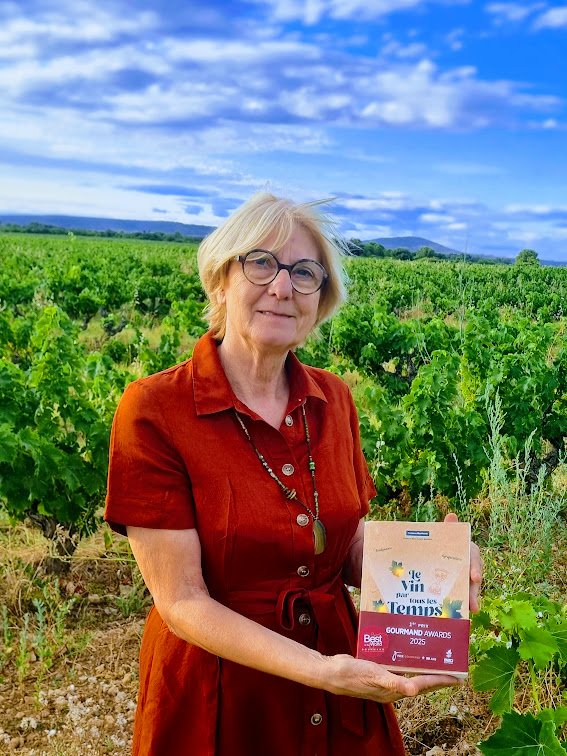
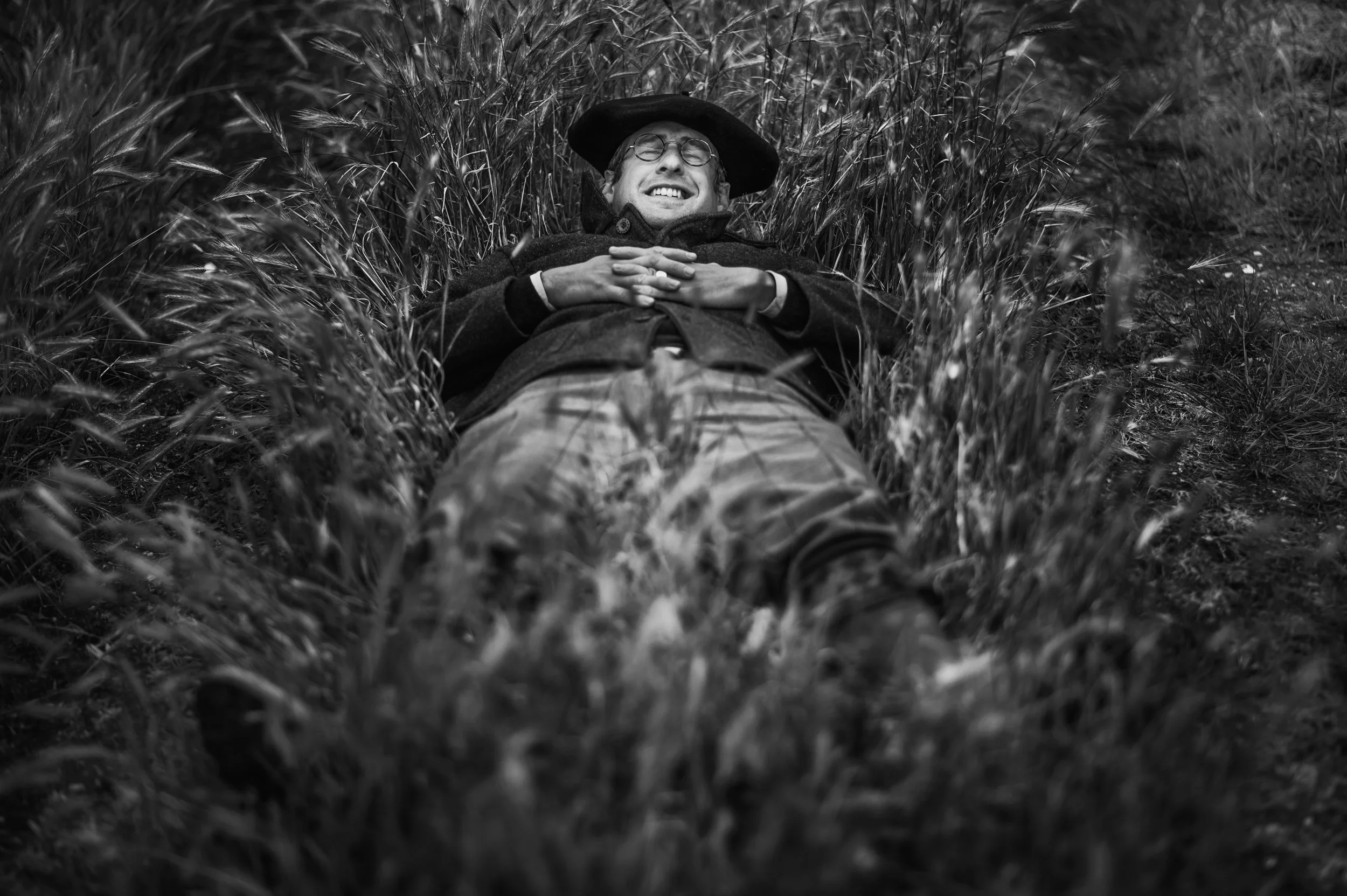
Natural wine, made without added sulphites, is winning over a new generation of drinkers, yet it still carries a stubborn reputation: whiffs of pony or cow dung, mousiness, faults passed off as the signature of the style. Can a natural wine be beyond reproach? At Domaine Serre Besson in Vinsobres, in the Drôme Provençale, Victor Taylor has staked everything on it. Since 2020 he has been making natural wines there that he wants free of faults, from organically farmed vines, rigorously sorted grapes and meticulous monitoring at every stage of winemaking. The estate also produces a wine under the Vinsobres AOC, one of the crus of the Rhône Valley.
An American who has lived in France since 2000, Victor Taylor first built his career in America’s finest restaurants. As a sommelier in New York, he created the wine list for a restaurant that opened in a luxury hotel and was awarded four stars by The New York Times nine months after opening. He repeated the experience in Washington, D.C., then took charge of wine buying at the Carlyle hotel. At 55, he fulfilled a long-held ambition: taking over a vineyard and finally crossing to the other side of the trade.
Interviewed on 4 November 2026.
Photos © Domaine Serre Besson.
From New York Sommelier to Rhône Valley Winegrower
A childhood in California, not far from Napa, in a farming family, made him familiar with working the land from an early age. “My family had cows and corn. I spent my childhood on a tractor,” he says.
It was his career as a sommelier, however, that would give shape to his project. After starting out in a starred New York restaurant, creating the list for a luxury hotel restaurant plunged him into the world of buying. “I spent my life negotiating, every week. It was an extraordinary experience.” At the Carlyle, he then managed wine buying for the Café Carlyle and the hotel restaurant, until 2000.
Those years also brought frequent trips to meet producers and discover their terroirs. The Rhône Valley already held a special place in his affections. “In the United States, on wine lists, you would find Châteauneuf-du-Pape, Vacqueyras, Gigondas. No small villages at all.”
When he settled in France in 2000, he stepped away from the wine world for a while to work in property. He bought, renovated and sold flats. In Nyons, he restored a ruin with an architect friend, an experience that would later prove invaluable.
Everything changed during a stay in the Drôme Provençale, when he came across a small ad for a house in poor condition, surrounded by old vines. The visit was decisive. From the property, the view of Mont Ventoux and the Dentelles de Montmirail is spectacular. “When I went up, Mont Ventoux was right in front of me. When I saw that, I knew.”
Despite the dilapidated state of the buildings and the vineyard, he made an offer on the day of the visit. He went into partnership with a French friend, Xavier Nyssen, to make the project happen. At the outset the ambition was modest: to produce a small cuvée, a garage wine, and to experiment. But restoring the vines would quickly take on a quite different scale.
An American Winegrower in France: Victor Taylor’s Experience
For Victor Taylor, being American was no major obstacle to setting up. He nevertheless advises foreigners who want to become winegrowers in the region to rely on a French partner. “For an American or a foreigner who wants to get started, I strongly recommend going into partnership with a French person first,” he explains.
In his case, the administrative procedures did not seem particularly complicated. Already in his fifties when he began farming the vines himself, he says he did not have to produce an agricultural qualification.
He also remembers a warm welcome from local winegrowers, whose advice helped him understand the area. “The generosity of the winegrowers and the information I was given were incredible.” He also points to the prominent place of women, many of whom run well-regarded estates in the area: “We have some very strong women in the region.”
Taking On Old Vines in Vinsobres
Planted for the most part in the 1960s and 1970s, the vines needed a long programme of restoration.
At first, Victor Taylor entrusted the farming to a third party under a tenancy agreement. The experience soon proved disappointing. “The person working the vines was doing it badly. I felt sick every time I walked through the rows. The state of the vines was not improving at all.” No longer being in control of the work done on his own plots became unbearable.
He then decided to take over the farming himself, with no employees. He replaced dead vines, fed the soils, and took pruning and trellising back in hand. He had the soils analysed and spent long hours observing the plots, tasting the grapes and working out the best picking dates. Ten years on, the vineyard is in fine health.
That restoration made him aware of the difference between knowing wine and knowing how to make it. “It is not a good idea to launch a project like this without help if you do not have the know-how to look after the land and the plants,” he admits.
His experience as a sommelier nonetheless shaped his vision of the craft. Having tasted a very large number of wines and discovered a wide range of styles, he knew fairly precisely what he wanted to produce. But moving from buying to making changed his outlook. “When you buy wine, it is a little too easy to criticise other people’s. When you make it yourself, it is different. I am much harder on myself.”
His farming childhood did give him some grounding. He also relies on the Chamber of Agriculture, which helped him “enormously”, and on the estate’s oenologist, Vincent Hudon, with whom he has worked since 2017. Their relationship rests on dialogue and experimentation, and Victor Taylor retains great freedom in his winemaking choices. “It is always a debate between the two of us. Nothing is fixed. He is very open to listening to our needs, and his ideas are brilliant.”
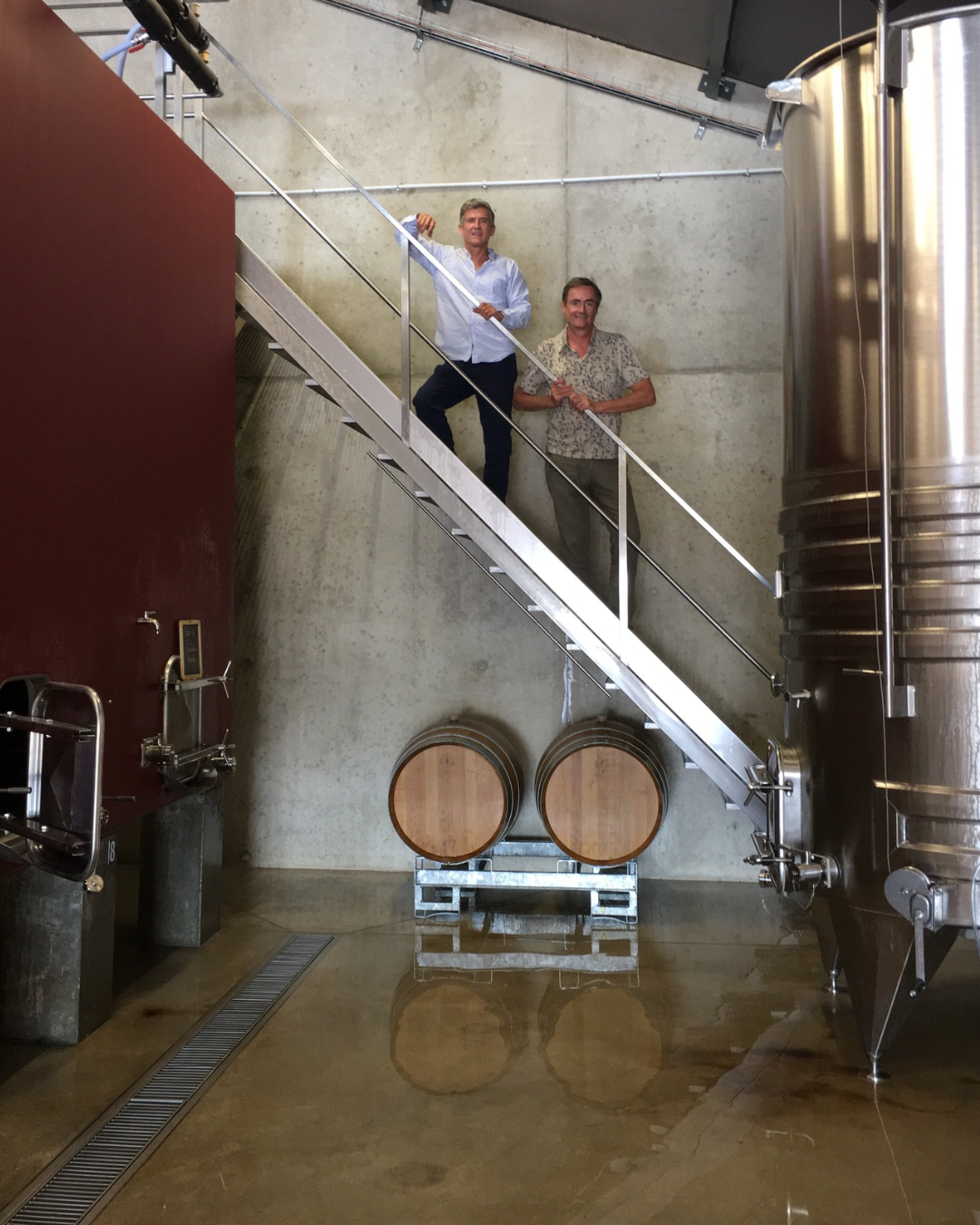
For the winery, he turned again to his architect friend and designed with him a building that works by gravity. Dug into the hillside, it allows the grapes to move naturally from one piece of equipment to the next. Among other things, the system makes it easier to keep them cool for a few days, before the cooling is switched off to let fermentation start naturally.
Organic Farming: A Conviction Rooted in California
When Victor Taylor took over the estate with his partner, the vines were not farmed organically. Yet conversion quickly became the obvious course.
The decision has its roots in his Californian childhood, where he witnessed the massive use of pesticides in agriculture. “Part of my family developed brain tumours. It was the same among friends. Some died very young.” At the time, he recalls, organic farming was still very uncommon.
The natural conditions of his plots reinforced his choice. Sitting high up, facing due south and swept daily by the mistral, they seem to him particularly well suited to this way of farming. “It is a bit silly not to farm organically,” he sums up.
The transition went ahead without major difficulty. As soon as he arrived, neighbouring producers encouraged him: “I hope you are going to farm organically, or biodynamically!”
Natural Wine: Fault-Free, Not Just Hands-Off
With no legal definition, the term “natural wine” generally refers to wines made from organic grapes, vinified without additives and, in principle, without added sulphites, even though the French Vin Méthode Nature label allows a small dose, within a limit of 30 mg/l in total.
It was in 2020 that Victor Taylor began making natural wine. His interest in the category, however, grew out of a certain perplexity.
In the United States he had never tasted any. His first tastings in France left him baffled: “A lot of brett, a lot of mousiness, and worse.” During a meal at a renowned restaurant, he ordered a bottle in which he noticed several faults. When he mentioned it to the sommelier, the reply was: “Sir, it is a generational thing. There is no fault, it is a natural wine.”
The answer did not convince him. He decided to make this kind of wine himself, with a clearly defined ambition: “Clean, fault-free and high quality.”
With Vincent Hudon, the estate’s oenologist, he selected a first plot of Grenache covering 0.33 hectares. The old vines on this plot, which narrowly escaped being grubbed up, yield few grapes, but ones he considers remarkable. “Tiny, not much juice, but extraordinary.”
Domaine Serre Besson’s Three Natural Wines
Three plots, three different vinifications, but the same exacting standard.
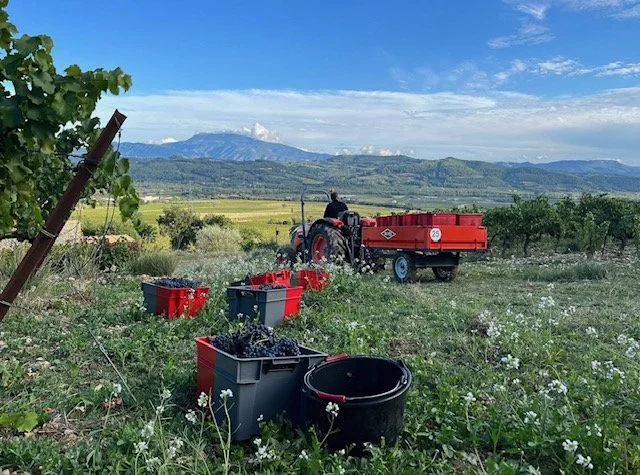
Victor Taylor relies on rigorous selection and constant monitoring. “I am obsessive about cleanliness,” he confides. He tastes the fermenting wines every three days, runs analyses every week and harvests entirely by hand. The bunches pass over a sorting table, and only grapes judged to be flawless go into the vats. When he keeps some of the stems, he retains only those that are perfectly ripe and lignified.
Yields are deliberately capped at 25 hectolitres per hectare, a considered choice that puts quality ahead of quantity.
Pauvre Diable, a Whole-Bunch Grenache
The estate’s first natural cuvée, Pauvre Diable was born in 2020 from this plot of old-vine Grenache. It is the only cuvée in the range made with whole bunches. Its name, which means “poor devil” in English, refers to the state of the vines when he first saw them: “I said to myself: what a poor devil!”
Success came quickly: the bottles found their customers soon after release, and the wine made its way on to the lists of Michelin-starred restaurants in Paris.
Ragots, a Barrel-Aged Syrah
In 2021 came Ragots, a Syrah from a plot set high up, on the edge of the forest. Exposed to the sun in the morning and sheltered in the afternoon, it attracts ragots every year, the young two-year-old wild boar that devour a good third of the crop and gave the cuvée its name. “They are not stupid animals: the grapes are delicious.”
For this cuvée, the grapes are destemmed, then fermented in concrete vats. The wine is then transferred to barrels to go through malolactic fermentation, before spending twelve months there. The stage does not come without apprehension: “I was so stressed about keeping a sulphur-free wine in barrel,” he admits.
The result eventually reassured him. In 2025, Ragots won 95 points and a gold medal at the Millésime Bio competition. He takes the distinction without losing his critical sense: “I doubt my abilities all the time. You cannot be too sure of yourself. You have to keep questioning yourself constantly.”
Binôme, a Field Blend of Grenache and Cinsault
In 2024 a third cuvée joined the range: Binôme. It comes from an old plot planted in the 1960s, where Grenache and Cinsault grow side by side in varying proportions: three Grenache vines for every two Cinsault on one part of the land, one for every five on the other. The two varieties are picked together and co-fermented. Another distinctive feature of the cuvée: only the free-run wine is kept.
Natural Wine and Headaches: Not So Simple
Is natural wine, because it generally contains fewer sulphites, less likely to cause headaches? It is a question drinkers ask regularly.
According to Victor Taylor, we should be wary of shortcuts. The quantity consumed remains decisive, and natural winemaking does not change the alcohol level. “If you empty a bottle, of course you will probably have a headache the next day.”
He does acknowledge that he is personally sensitive to heavily sulphited wines, which disturb his sleep. “At three in the morning I am ready to run a marathon, with my heart beating a little too fast.” That does not stop him remaining open to every style: “I love discovering all kinds of wine. I do not limit myself to natural or organic.”
Should You Decant Natural Wine, and How Long Does It Keep Once Opened?
Service also plays an important part in tasting. Victor Taylor points out that wines without added sulphites can sometimes contain an excessive amount of carbon dioxide. “I really try to find the balance. CO2 protects the wine, but if there is too much of it, the fruit and the spices are masked.”
He recommends decanting bottles before serving. Failing that, he advises placing a finger over the neck and shaking the bottle gently to release some of the gas.
Once a bottle is open, he uses an argon spray, which he applies to the surface of the wine before recorking. How long the wine keeps then varies from one cuvée to another. Binôme is particularly enjoyable the next day, but “three days is too long”. Pauvre Diable and Ragots can last a few days when properly protected.
What Food Goes With Natural Wine?
A former sommelier, Victor Taylor thinks about his cuvées as he does his dishes, paying particular attention to flavours, aromas and extraction. “I am fairly energetic. The only place where I stay calm is the kitchen.” For him, food and wine pairing is an integral part of tasting.
Pauvre Diable goes readily with duck, in particular a duck breast that the winegrower smokes himself and serves with a red-fruit sauce. The cuvée also pairs well with pheasant, guinea fowl or dishes prepared with herbes de Provence and sage.
Ragots, the Syrah, is better suited to game dishes. As for Binôme, it comes into its own as an aperitif, with saucisson, other charcuterie and nibbles. It can also accompany chicken or mushrooms.
The United States: Still Out of Reach for the Estate’s No-Added-Sulphite Wines
Despite his nationality and his professional experience across the Atlantic, Victor Taylor does not yet sell his natural wines in the United States. The main obstacle remains production volume: importers generally want larger quantities than he can supply. He is still looking for a partner, however. “We keep looking and looking. I really want to find one.”
The situation is different for the Vinsobres cru, which was widely exported to the United States soon after the estate was created. In the wake of the 2024 US presidential election, orders fell sharply and he chose to focus his efforts on the European market. Concerns about customs duties and a climate of mistrust towards France weighed on that decision. “Everyone was afraid of the tariff nightmare. And the anti-French sentiment that emerged did not help.”
Beyond the Natural Wine Clichés
The animal notes often associated with natural wine are not inevitable, according to Victor Taylor. He does not deny that these faults can exist. He even recounts having had a problem with one small vat, which he chose never to bottle. “It is a question of strategy, of positioning.”
At a fair devoted to wines without added sulphites, he received an enthusiastic welcome, but also a few unexpected remarks: several visitors complained that his bottles were not “natural enough”, precisely because they did not show the aromas they associated with the style.
The situation amuses him, but in his view it reveals a perception that is still deeply rooted. He believes an entire generation discovered wine through natural cuvées that were not always clean. He is nonetheless glad of it, because it is thanks to that generation that the natural wine market has boomed. “But at the same time, it needs to get used to drinking wines without faults.”
It is precisely this view that he wants to change. For him, the absence of intervention cannot justify faults: a natural wine must above all remain a good wine.
Keep reading