Long associated with cellars, wineries and tastings, wine is now asserting itself as a cultural experience in its own right. On a growing number of estates, the vines play host to works of contemporary art and sometimes become an extension of artistic creation itself. These places, known as vineyard sculpture parks, combine winegrowing with open-air exhibitions, blurring the boundaries between agriculture, heritage, tourism and creation.
But behind this appealing alliance, what do they really tell us? Where does the line fall between showcasing an estate and exploiting art?
An art historian, specialist in sculpture parks and wine merchant, Raphaël Blazy knows this phenomenon from the inside. Originally from Provence, he spent six years as a guide and lecturer at Château La Coste. That experience led him to devote his academic research to open-air museums, and more specifically to vineyard sculpture parks, the subject of a doctorate undertaken jointly at the Université du Québec à Montréal and Université Paris 8. In 2023, he founded Vineyart, a company through which he pursues this work at the crossroads of art history and wine culture.
Raphaël Blazy spoke to Grand Cru and Etiquette on 18 September 2026.
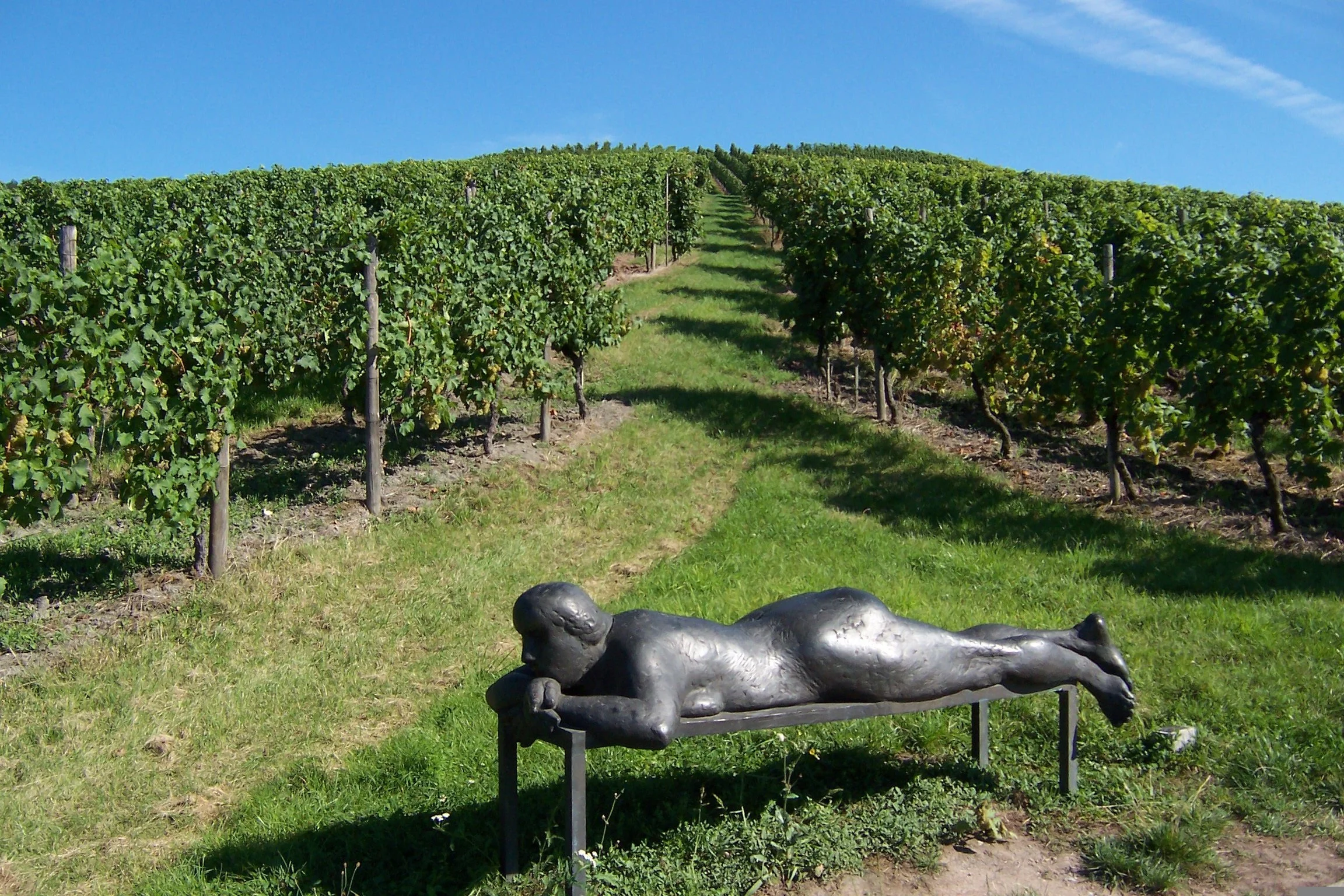
Photo © Wstuber. Sculpture of a reclining woman among the vines in Strümpfelbach, Germany.
What is a vineyard sculpture park?
Raphaël Blazy defines a vineyard sculpture park as an agricultural estate that keeps its primary purpose, growing grapes and making wine, while opening up to the display of works of art. The term sets it apart from open-air museums and sculpture gardens, which appeared much earlier: the deCordova, near Boston, opened in 1950; the sculpture garden of the Kröller-Müller Museum in the Netherlands, opened in 1961; and the Fondation Maeght in Saint-Paul-de-Vence, founded in 1964. What makes it distinctive is the combination of genuine winegrowing activity with an artistic programme.
Art and wine: a long-standing relationship
The association between wine and art is nothing new. Raphaël Blazy points out that Mouton Rothschild, in Pauillac, began commissioning artists to illustrate its labels in the 1920s, and did so more systematically after the Second World War. The estate now devotes a room to this history. For the wine merchant he also is, the label remains an essential marketing lever, especially in supermarkets, which account for around 70% of wine sales in France. While most buyers remain attached to traditional codes, consumers in large cities are more open to bold designs.
Installing works of art among the vines, on the other hand, is more recent. In France, the practice began to develop in the late 1990s before accelerating in the 2000s with the rise of wine tourism. The major wine regions, notably Champagne, Bordeaux and Provence, then saw the value of opening their estates to new audiences. In Champagne, the house of Pommery led the way: it exhibits contemporary art in its crayères, the old chalk pits dug beneath Reims, where artists such as Bertrand Lavier have been shown. A few years later, the opening of Château La Coste to the public in 2011 took the model to a new scale.
This shift is part of a broader context: while overall wine consumption is falling, direct sales at the estate have been rising since the early 2020s, according to Raphaël Blazy. For wine estates, welcoming visitors and developing a cultural offer have become new ways of adding value.
Château La Coste: art in situ
For Raphaël Blazy, what makes Château La Coste unique is less the presence of artworks than the importance given to site-specific creation. Most of the permanent installations were designed specifically for the estate. Invited to discover the site, artists take time to observe its landscape, architecture and terrain before imagining their project. They then have real freedom in choosing where to place it.
This close relationship with the surroundings is particularly visible in Tadao Ando’s chapel and in Andy Goldsworthy’s Oak Room. The artist built his work into an old restanque, a dry-stone terrace wall dating roughly from the 17th century, when the estate was a hunting ground belonging to a notary from Aix, M. La Coste, who gave it his name.
Visitors enter the wall through a door, go down underground and discover a structure of interwoven oak trunks, salvaged by the artist after a storm in Burgundy. The installation does not simply sit on the estate: it becomes part of its history and extends its relationship with the landscape. Its door faces the Domaine de la Quille, a kilometre away, on a promontory with a 360-degree view over the Luberon, Mont Ventoux, the Montagne Sainte-Victoire and the Alpes-de-Haute-Provence.
Sculpture exposed to the elements
Installing a work on a wine estate is not simply a matter of moving a sculpture from a museum to a garden. Outdoors, the environment becomes part of the work itself.
In a museum, the art historian explains, viewing conditions remain relatively constant: the light is controlled and the works are protected from the weather. Outdoors, they change with the light, the wind, the rain, the seasons and the time of day. The same sculpture can be perceived very differently in the depths of winter and at the height of summer. “Time and the weather play a part in its transformation, and we even accept that nature changes it,” he sums up.
The visitor’s experience changes too. In a museum, “you move from one room to the next in a space that is often crowded, where you shuffle along”. In a vineyard sculpture park, by contrast, discovery relies on wandering freely through the landscape. Visitors have to walk, take their time and seek out the works along the way. The experience becomes as physical as it is visual.
Showing work in the open air does, however, impose certain constraints: the works must be made from materials robust enough to withstand outdoor conditions. Large parks such as Château La Coste also have indoor spaces, which make it possible to vary the displays and to welcome visitors with reduced mobility or those unable to walk long distances.
The Peyrassol case: genuine dialogue or a juxtaposition of prestige?
The line between dialogue and mere decoration is sometimes thin. According to the art historian, some estates favour the artist’s renown and the prestige of the work, used as a way to attract visitors, over its integration into the site.
He points in particular to the Commanderie de Peyrassol, owned by the collector Philippe Austruy. Several works by Lee Ufan, originally conceived for his retrospective in the gardens of Versailles in 2014, were acquired two years later and reinstalled on the estate. Yet, stripped of the context for which they were conceived, they lose part of their meaning. Visitors unaware of their history do not know they were created for Versailles. The work keeps its prestige, but its meaning is partly transformed by the move.
That said, there is nothing artificial in itself about bringing art and wine together. True dialogue arises when a work is conceived in relation to the place that hosts it, rather than simply displayed against its backdrop.
Art and landscape: the soul of the vineyard
This is precisely where the interest of the vineyard sculpture park lies: the landscape renews how the work is perceived, while the work reveals its surroundings in a new light. In Oak Room, the restanque, the underground coolness, the half-light and the view that opens up from the entrance are all part of the experience. Visitors no longer discover just a sculpture, but also, through it, a dimension of the estate’s landscape, history and architecture.
Raphaël Blazy stresses a notion that is hard to define, that of a “soul”: an intangible presence, inherited from the history of the place, which resonates with contemporary creations. He finds it at Château La Coste as well as at Castello di Ama in Italy, and even at Peyrassol, despite the reservations mentioned above. Even when artists have profoundly reshaped their surroundings, this identity endures.
This also explains why a visitor can return several times to the same vineyard sculpture park without ever feeling they are having exactly the same experience. Subject to changes in the landscape, the light and the weather, the work never quite reveals itself in the same way. It thus acquires a life of its own.
Where to see contemporary art in French vineyards
Château La Coste is far from an isolated case. The phenomenon has spread across several wine regions in very different forms, from the vast sculpture park designed as a destination to a local artist’s summer exhibition. The overview drawn up by Raphaël Blazy maps out a contrasting geography of these initiatives.
Provence, from La Coste to Peyrassol
Driven by highly developed wine tourism, Provence has the largest number of vineyards open to contemporary art. Beyond La Coste and Peyrassol, Raphaël Blazy singles out Château Vignelaure, north of Aix-en-Provence, for its remarkable collection, and Château Turcan in Ansouis, in the Vaucluse, whose small museum devoted to the vine, wine and farm equipment remains, in his view, “little known outside Provence”. The region also encourages collaborations with smaller estates through summer exhibitions. These initiatives give winegrowers greater visibility, give artists a place to exhibit and give the public a chance to discover lesser-known properties.
Bordeaux, the Loire and Cognac
In Bordeaux, it is above all historic heritage that provides the setting for the meeting of art and wine. The region’s aristocratic legacy has left many châteaux where collections and artistic creations naturally find their place. Raphaël Blazy mentions in particular Château d’Arsac in Margaux, which he counts among vineyard sculpture parks, and Château Chasse-Spleen in Moulis-en-Médoc.
Further north, the Bouvet-Ladubay art centre in Saumur illustrates the dynamism of the Loire Valley. In the Charente, the Fondation Martell, created by the house of the same name in Cognac, hosts leading artists.
Champagne, from Pommery to Ruinart
In Reims, Pommery remains, in Raphaël Blazy’s eyes, “the oldest vineyard sculpture park in France”. Champagne is now among the most dynamic regions in this field: many houses, in Reims as in Épernay, now welcome artists. Ruinart stands out for the scale of its commitment and its choice of internationally renowned artists. The house has notably staged acclaimed exhibitions by Tomás Saraceno, Jeppe Hein and Eva Jospin.
Burgundy: taking a different approach
Burgundy, by contrast, has been slower to adopt the model. Raphaël Blazy offers an economic explanation: the reputation of its wines is enough to attract buyers, without estates necessarily needing to develop an additional tourist offer. The situation differs from that of many Provençal producers, for whom wine tourism is also a way of supporting sales, particularly of rosé. There are nonetheless a few exceptions, especially among the wealthiest estates of the Côte-d’Or.
Enhancing heritage or exploiting art?
This is probably the most delicate question. Raphaël Blazy does not condemn the use of art as a way to attract visitors. For an estate of modest means, hosting a temporary exhibition can be a form of “soft power”. The line is crossed, however, when the work serves only the prestige of the place, without any real presentation of the artist, their approach or their connection to the estate. The art historian also points to a paradox: some estates highlight their historic roots in their communication without actually passing that history on to visitors.
Hence the importance of interpretation, so that older heritage is not overshadowed by contemporary creations. Guides and lecturers, explanatory material and visitor tools give visitors keys to understanding and bring the different dimensions of the place into dialogue. It is a challenge that, far from concerning museums alone, applies equally to vineyard sculpture parks.
The question, then, is not so much whether an estate can legitimately use art to attract visitors (its economic dimension is undeniable) as what it offers them beyond that first draw. As Raphaël Blazy points out, visitors no longer travel simply to buy a bottle of wine or see an isolated work: they are looking for an experience, a place that justifies the journey in itself. To illustrate this, he cites sites that are not wine estates, such as the island of Naoshima in Japan or Gibbs Farm in New Zealand, as well as the Fondation Carmignac on the island of Porquerolles: all destinations where art is an integral part of the identity of the place.
On that condition, the vineyard sculpture park can go beyond a mere sales pitch: it is no longer just a matter of placing works among the vines, but of bringing a landscape, a product, a heritage and a creation into dialogue. The wine estate then becomes more than a place of production and sale: it is a space for passing on knowledge and for discovery, where wine and art become two complementary ways of telling the story of a place.
Keep Reading