
Beaujolais: The Gamble to Build a Premier Cru Hierarchy
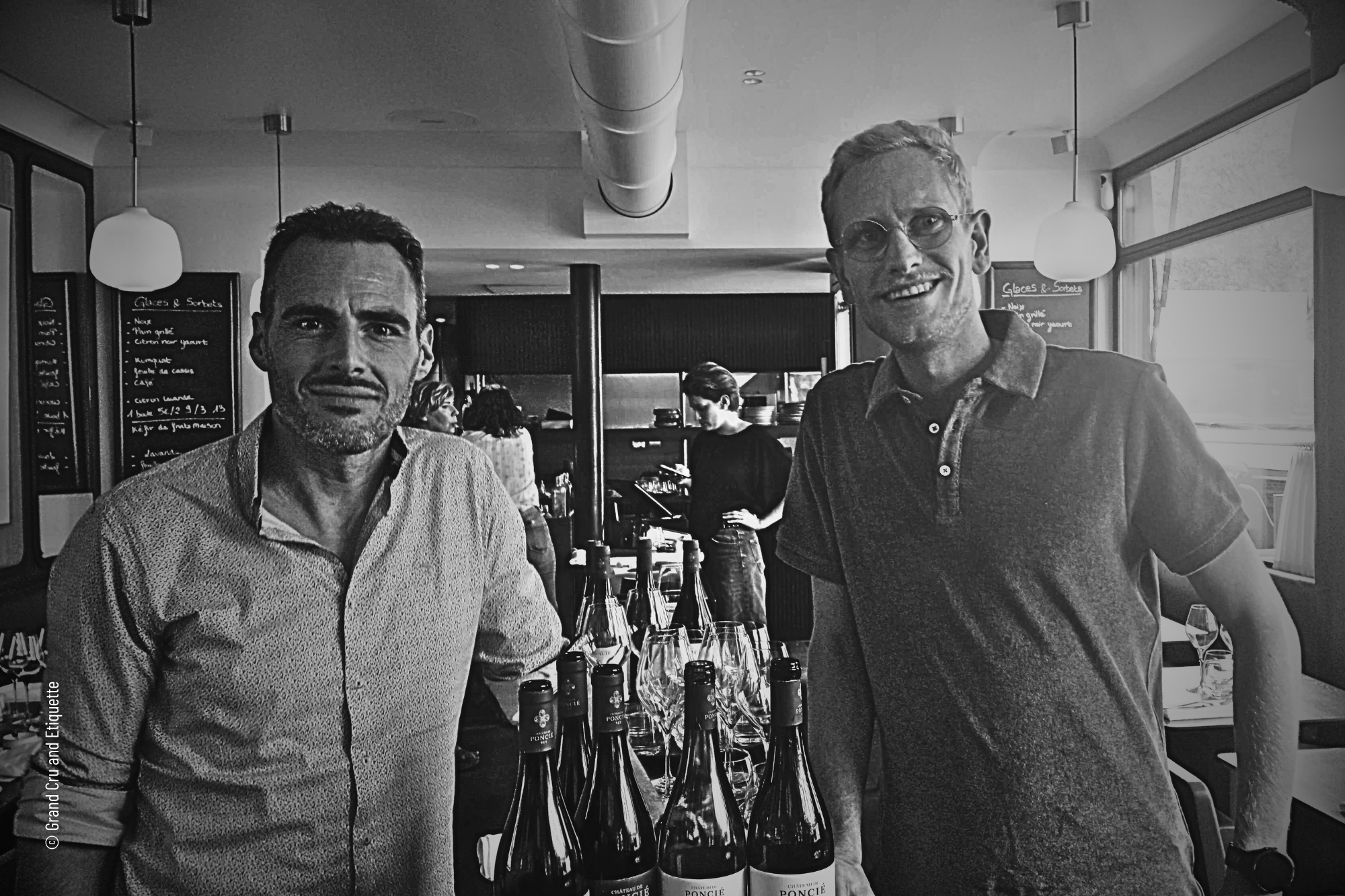
From left to right: Eddie Lachaux and Alexis Cuzenard at Céna, Paris, following the press lunch held on 21 July 2026. Photograph by Maria Kumessa.
Beaujolais has never had a premier cru. In 2024, the growers of Fleurie asked the INAO (Institut national de l’origine et de la qualité), the French public body responsible for defining and protecting appellations of origin and quality labels, to recognise seven of their lieux-dits, two of them belonging to Château de Poncié. It was a formal bid to establish that certain pink-granite slopes deserved a place in a hierarchy that Burgundy has, until now, largely kept to itself. It is the story of a region that, after half a century spent selling forgetfulness, is now seeking to earn its rank.
For nearly fifty years, Beaujolais's prosperity rested on a wine intended to be drunk in November and forgotten by Christmas. Beaujolais Nouveau was never quite a wine; it was a calendar, a joyful ritual of drinking now, a shrewd piece of regional economics and, at the same time, a ceiling on its own ambitions. In the economics of wine, a wine intended to be drunk within a few weeks effectively forfeits rank. Primeur sold lightness, and that lightness hardened into a sentence: people came to believe that Beaujolais was this, and nothing more.
Why Beaujolais Never Had a Premier Cru
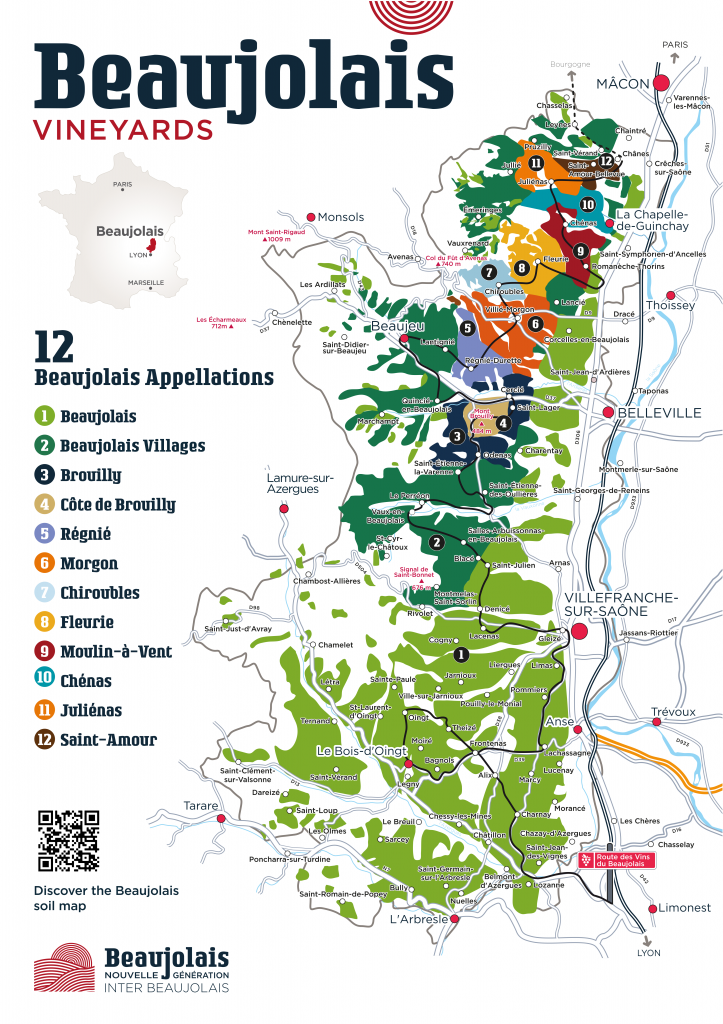
The ten crus of Beaujolais have never had premiers crus, which is what makes Fleurie's move so radical.
A premier cru is neither a brand nor a vintage: it is a place. The term refers to a precisely delimited vineyard parcel, a lieu-dit, which the INAO officially recognises as producing, year after year, a wine superior to that of the surrounding appellation. Its name then joins that of the cru on the label: no longer simply “Fleurie”, but “Fleurie Premier Cru Les Moriers”.
Nothing like this exists yet in Beaujolais. Unlike the Côte-d'Or in Burgundy, where the hierarchy of premiers and grands crus has structured the vineyards and their prices for decades, Beaujolais has no level between the communal appellation and the individual, unclassified parcel. To create such a level is to establish a hierarchy where none exists and, potentially, to create value.
Fleurie led the way with seven lieux-dits: La Chapelle des Bois, Les Garants, Grille-Midi, La Madone, Les Moriers, Poncié and La Roilette. Their candidature was approved by 85% of growers after ten years of work. Moulin-à-Vent followed in early 2025 with fourteen parcels, then Brouilly with sixteen.
But the procedure is far longer than a simple local collective decision. As things stand, the application concerning Fleurie entered the formal review process through the Permanent Commission of the National Committee for Wine Appellations (CP of CNAOVins) on 11 June 2025. The application is now proceeding through the examination process.
For Brouilly, the formal application is still at the pre-assessment stage within the INAO services, with a view to being presented to the relevant bodies, first to the CRINAO (the INAO Regional Committee) for an opinion and then to the CP of CNAOVins for a decision, towards the end of 2026.
The Long Road to Becoming a Premier Cru
The move to recognise premiers crus within Beaujolais's communal appellations has been approved by the Union des Crus du Beaujolais, which represents all ten crus. But the different appellations are not progressing at the same pace in preparing their applications. The submission of applications is therefore likely to be spread over several years.
Once the formal examination has begun, several stages still have to be completed.
First stage: establishing the eligibility of the climats proposed for premier cru status. This phase falls to the currently appointed Investigation Commission. It has chosen to draw on the expertise of independent consultants, appointed by the National Committee in January 2026. They are to assess the historical and contemporary reputation of the lieux-dits, the history of their claims, their market positioning and the organoleptic quality of the wines produced from them. Before any potential delimitation work, they must also study the natural environment of each lieu-dit.
Second stage: delimitation. The boundaries of the premier cru areas deemed eligible will have to be defined, submitted to a public inquiry and then examined in light of any objections.
Third, running in parallel: defining stricter production requirements. The Union des Crus du Beaujolais and the Investigation Commission are considering conditions more demanding than those of the Fleurie communal appellation. Measures currently being considered include lower yields, allowing premier cru status to be claimed only from the fifth year after planting rather than the second, and specific agro-environmental provisions for premier cru parcels, including the preservation of small-scale built heritage such as cadoles and murgers.
This is therefore a long-term process, one that could take several years to complete. For now, there is no officially recognised premier cru anywhere in Beaujolais, and recognition can only come once the full procedure has been completed.
But the direction is now clear: Beaujolais is moving away from selling forgetfulness and towards selling geography.
Château de Poncié: A Terroir Seeking Rank
Neighbouring Burgundy has already shown what classification can achieve over time: its grands crus have become an asset class, an investment as much as a pleasure, at prices that now put them beyond the reach of the ordinary drinker. There, premier cru status functions as a state-guaranteed badge of scarcity.
Beaujolais is now beginning to set the same machinery in motion, starting from the bottom rung. No one expects a Fleurie premier cru to rival the great Burgundy auctions tomorrow. But the gap between the current reputation of terroir-driven Gamay, still modest, and the institutional recognition it is seeking marks precisely the territory in which re-ratings occur. You never buy a vineyard as well as at the moment its status begins to change.
Two of the seven lieux-dits proposed by Fleurie, Poncié itself and Les Moriers, belong to Château de Poncié. The estate is not watching the movement from the sidelines: it is one of the dossiers at its heart.
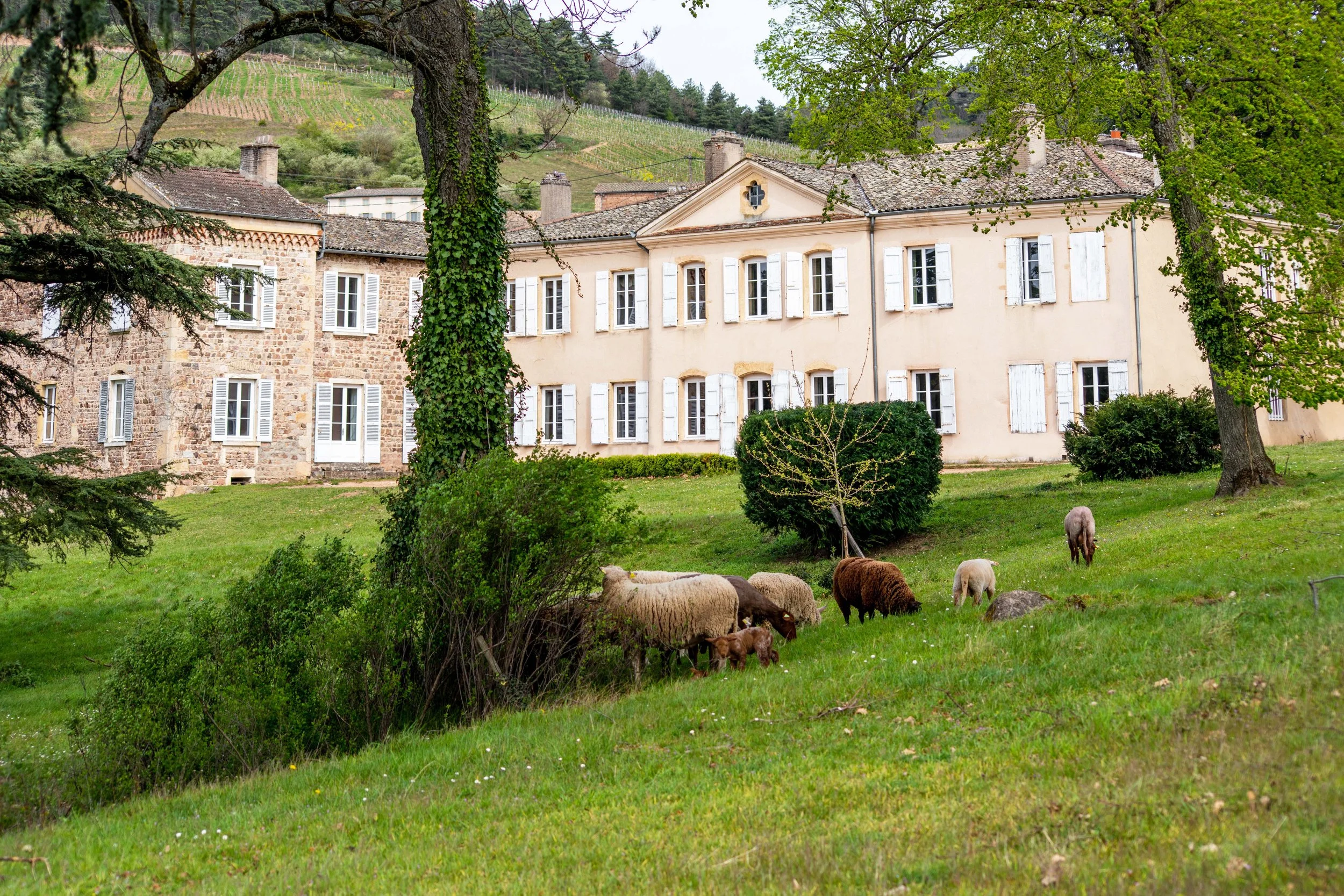
Château de Poncié, the castle and its animals in Beaujolais, France.
The place has the historical depth that such a claim requires. Written records attest to its existence as early as 949, making it one of the earliest fiefs of Beaujolais and the earliest in Fleurie. The monks of Cluny developed the vine here; a musketeer count in the service of Louis XV was once its lord; and history has left an anecdote more telling than many arguments.
In 1894, the négociant Antonin Bouchard, looking to expand his holdings, hesitated, at a comparable price, between Clos de Vougeot and Poncié. He chose Poncié.
A century later, in 2008, the Champagne-based Henriot group, under the direction of Bouchard Père & Fils, acquired the property and began its conversion to organic farming. In 2020, Jean-Loup Rogé acquired the estate, one hundred hectares in a single block, thirty-two of them under vine, and restored its status as an independent grower's domaine. He had been won over by a landscape he likens to “a little Tuscany”.
A thousand years of continuity do not guarantee premier cru status, but they provide the story without which no classification can truly hold.
Value in the Vineyard and the Cellar
A classification cannot be decreed on age alone: it has to be justified in the glass. And what has been happening at Poncié since the new cellar was built in 2022 is precisely the kind of work that the ambition of a premier cru implies.
Eddie Lachaux, the estate's vineyard manager and cellar master, has been making this cru for more than ten years and cultivates an aesthetic of restraint: indigenous yeasts, fermentations started at low temperatures, macerations lasting ten to twelve days, very little new oak, and ageing divided between concrete, amphora, foudre and barrel according to the parcel.
The Fleurie 949 cuvée, named after the year of the estate's earliest recorded mention, prioritises fruit and freshness. The single-parcel cuvées are aged in wood. The same granite also produces a little-known Chardonnay in white.
“We don't want our wines to be marked by oak,” says Eddie Lachaux. The aim is not to disguise the Gamay, but to bring it to the level of precision associated with a great wine.
The case does not rest on the cellar alone. Since 2016, the estate has converted its thirty-two hectares of vines to organic farming, achieving certification in 2020, and is now moving towards biodynamics: cover crops, home-made compost, agroforestry and thirteen sheep grazing between the rows.
A premier cru is not judged in the glass alone; it is first decided in living soil.
Les Moriers is the textbook case: eighty-two-year-old vines, deep granite and clay soils crossed by a vein of quartz, the same quartz signature that geologists observe at Poncié itself, on a steep slope.
You do not put ordinary parcels forward for premier cru status. You put forward places that you know can say something singular, year after year, wines worth waiting for in the cellar.
A Wine to Lay Down: How Long Can Beaujolais Age?
Two very different wines shelter under the same word. Primeur is made for the year; the crus are made for the decade.
Most will keep for five to ten years, while the best can go for twenty or thirty in a great vintage, particularly Moulin-à-Vent and Morgon, where time transforms fruit into violet, spice and the undergrowth of an old Burgundy, until even the grape itself becomes difficult to identify blind.
This capacity for ageing is no footnote for collectors: it once determined the price.
Before the Second World War, a bottle of Moulin-à-Vent sold for the price of a Vosne-Romanée premier cru. Today, that Burgundy commands close to ten times the price of the Beaujolais. The wine has not declined; its ageing potential has not changed. What has disappeared is rank.
And it is precisely that rank that Fleurie is now asking the INAO to confer, for wines that are not intended to be drunk by Christmas, but to be laid down.
What Premier Cru Classification Would Change
If the INAO ultimately gives its approval, which could come in the early 2030s at the earliest, once the procedure has been completed, the words “premier cru” will do more than elevate a label. They will enshrine in law what the market is only beginning to recognise: that Gamays planted on granite belong to the heritage of the great terroirs, and that their price, for now, still fails to reflect it.
In practice, premier cru status formalises a scarcity that the market has not yet fully priced in. It is the same mechanism that turned Burgundy's crus into an asset class. The price of granite-grown Gamay should follow the same path, with the lag imposed by its own history.
Beaujolais, born of a grape variety, Gamay, banned by a ducal decree in 1395 and driven into exile towards the south of Burgundy, would then have achieved the most difficult of reversals: turning a reputation for ease into an argument for rarity.
And the founding paradox remains. The region made its name with the wine you do not keep. It is now seeking recognition for the wines you must be prepared to wait for.
Same vineyard; no longer quite the same ambition.
You may also like
Sources:Press lunch with the Château de Poncié team, 21 July 2026.Château de Poncié press dossier.Information provided directly by the INAO Press Office.