
Vallotton's Intimacies: Give and Take in the Bourgeois Marriage
A Maussian Reading of Félix Vallotton's Woodcut Series Intimacies (Intimités)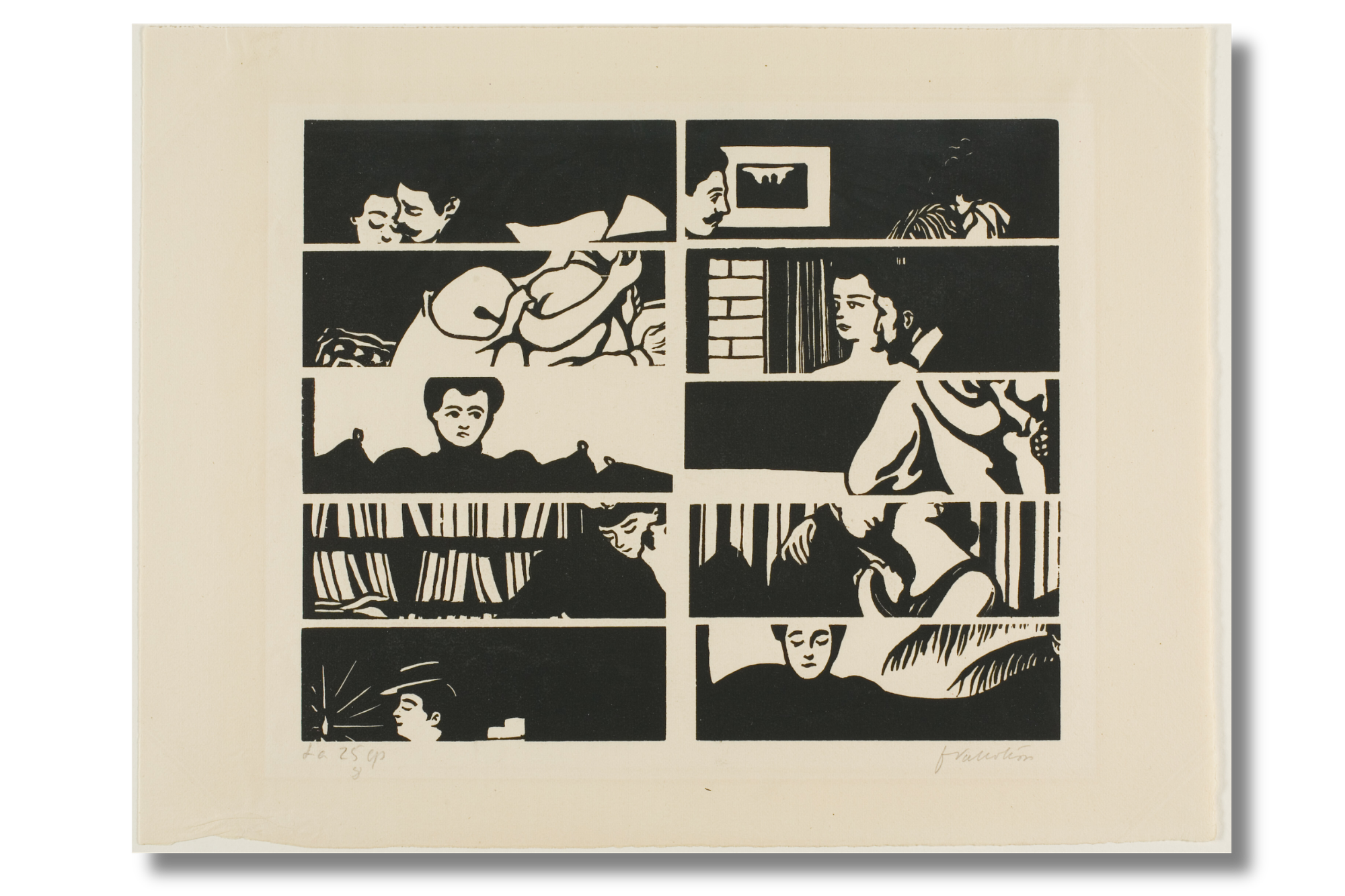
Félix Édouard Vallotton, Cancellation sheet, fragments of ten woodblocks from Intimacies, 1898. © Gift of the Print and Drawing Club.
Ten woodcuts, a single couple, and not an embrace that fails to hide a calculation. Thirty years before Mauss thought through the gift, Vallotton had already reduced bourgeois marriage to an equation: who gives, who owes, who returns.
If there is one sphere where the appearance of a transaction conceals a system of sacred obligations and unconscious debts, it is surely that of intimate relations. To give, to receive and to return are no mere courtesies there; they are the very forces that bind souls together, or bind them in chains.

Intimacies: The Bourgeois Couple as a Gift Economy
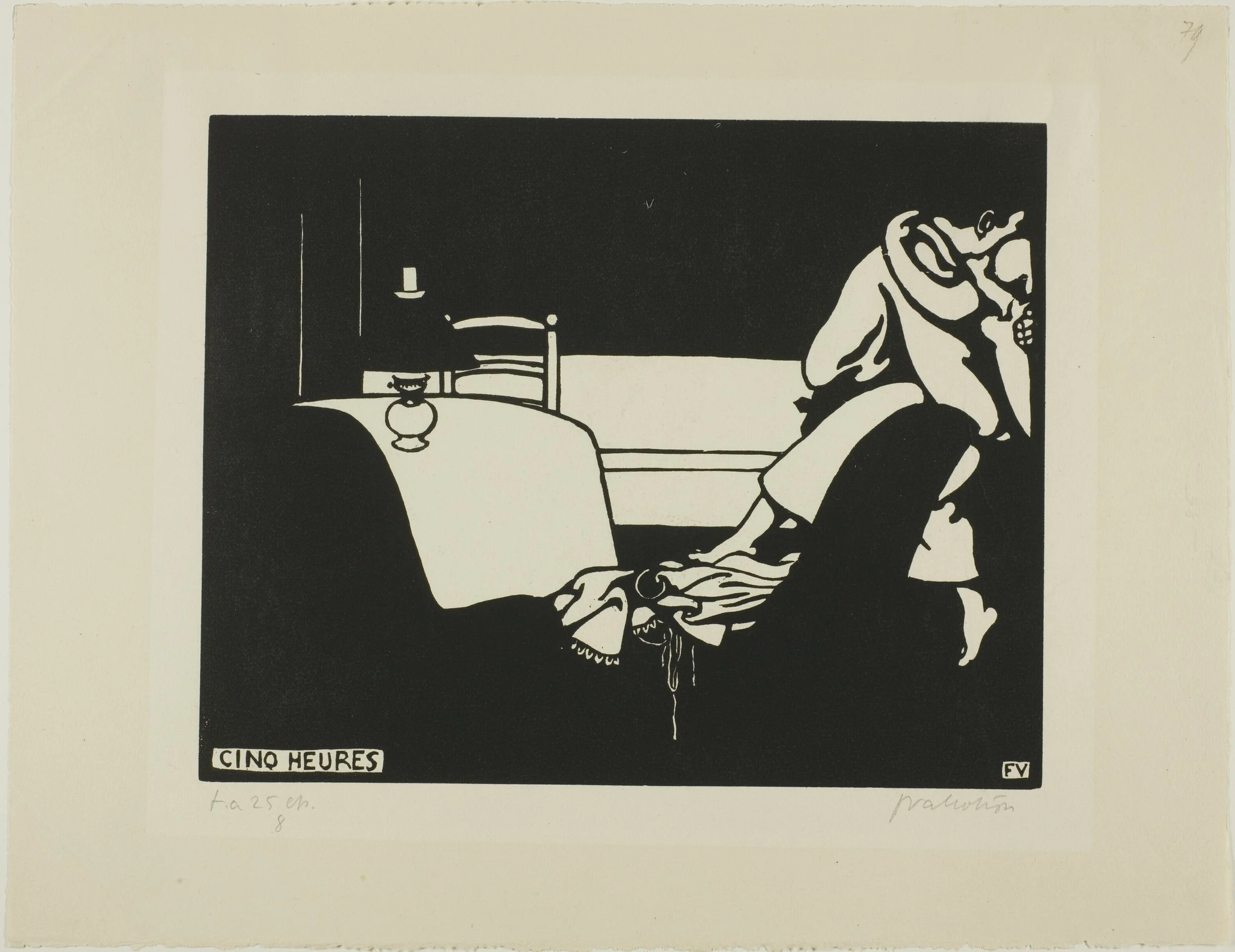
Published in Paris by La Revue blanche in late 1898, in an edition of thirty whose blocks Félix Vallotton would himself destroy, the series Intimacies (Intimités) gathers ten woodcuts. The Franco-Swiss painter and printmaker, a member of the Nabis, offers a fierce, cold, disenchanted autopsy of marriage among the Parisian haute bourgeoisie of the Belle Époque: the world of the salon, the book-lined study and the potted palm. Across these ten plates he pictures not married life so much as marital warfare; beneath the pretences he tracks deceit and adultery, petty cruelty and the struggle for power, down to the money that buys bodies.
Beyond social criticism or satire, these prints disclose something almost anthropological, and it is the wager of this essay to read them in the light of the ideas Marcel Mauss would set out some thirty years later in The Gift (1925). For Mauss, the social bond rests on a threefold obligation: to give, to receive and to return. Held within disinterested reciprocity, this cycle builds alliance and trust; unbalanced, instrumentalised or monetised, it becomes a formidable machine for manufacturing debt and estrangement. In his uncompromising black and white, Vallotton shows us couples whose gift and counter-gift have been corrupted, converted with grim regularity into instruments of power, into emotional blackmail, into transactions in disguise.
The Lie: When an Embrace Betrays
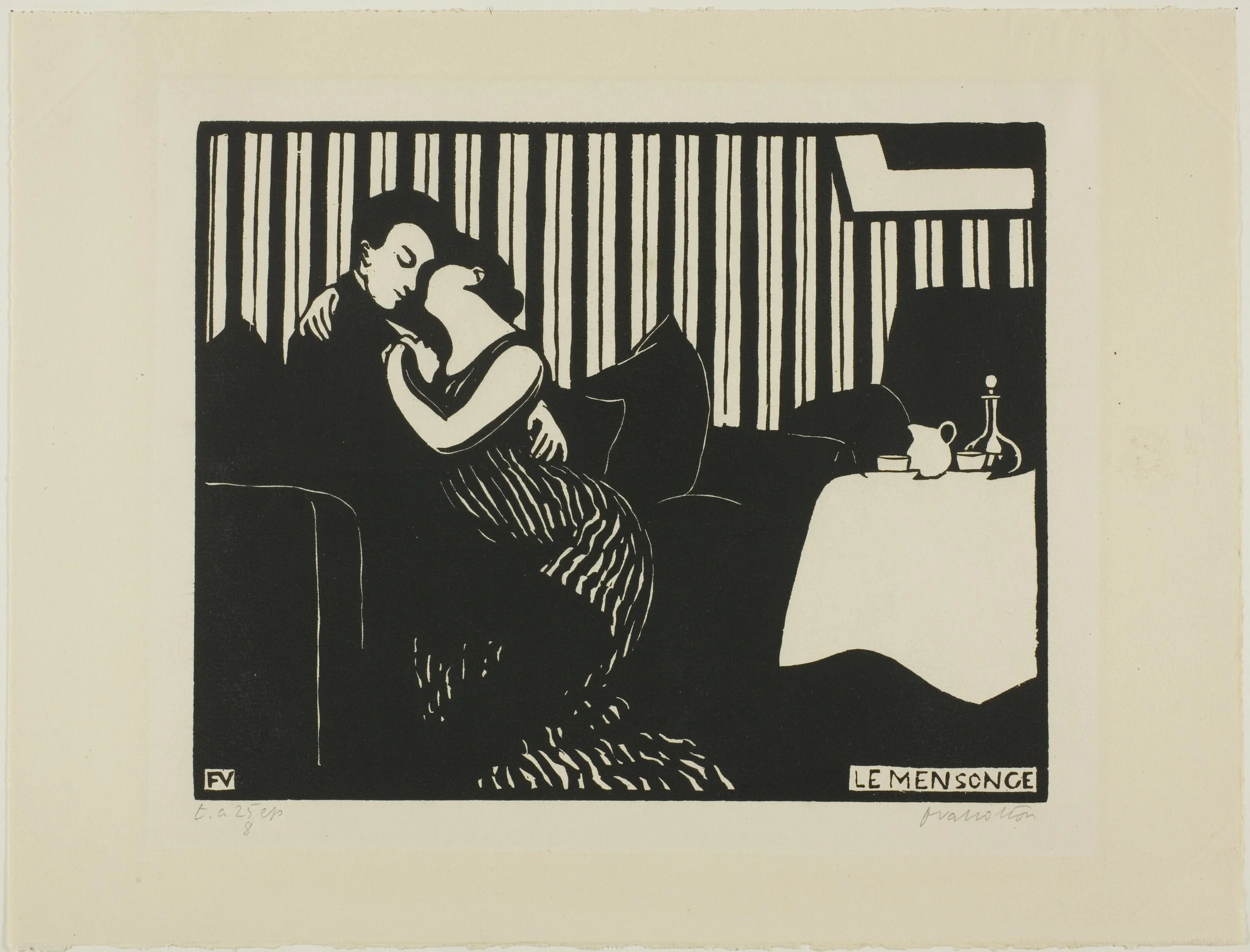
For Mauss, to refuse to give or to receive is tantamount to a declaration of war; yet to give insincerely is an aggression every bit as underhand. In the first plate of the series, Le Mensonge ('The Lie'), a couple embrace on a sofa in what looks like a surge of passion. But the title works at once as an interpretive counter-gift: the physical embrace, which ought to be the supreme gift of the self, is in truth a lie. Here affection is a decoy, meant to hide a secret or a betrayal. The zebra-striped wallpaper, suggestive of prison bars, visually locks the lovers in the cage of their own duplicity.
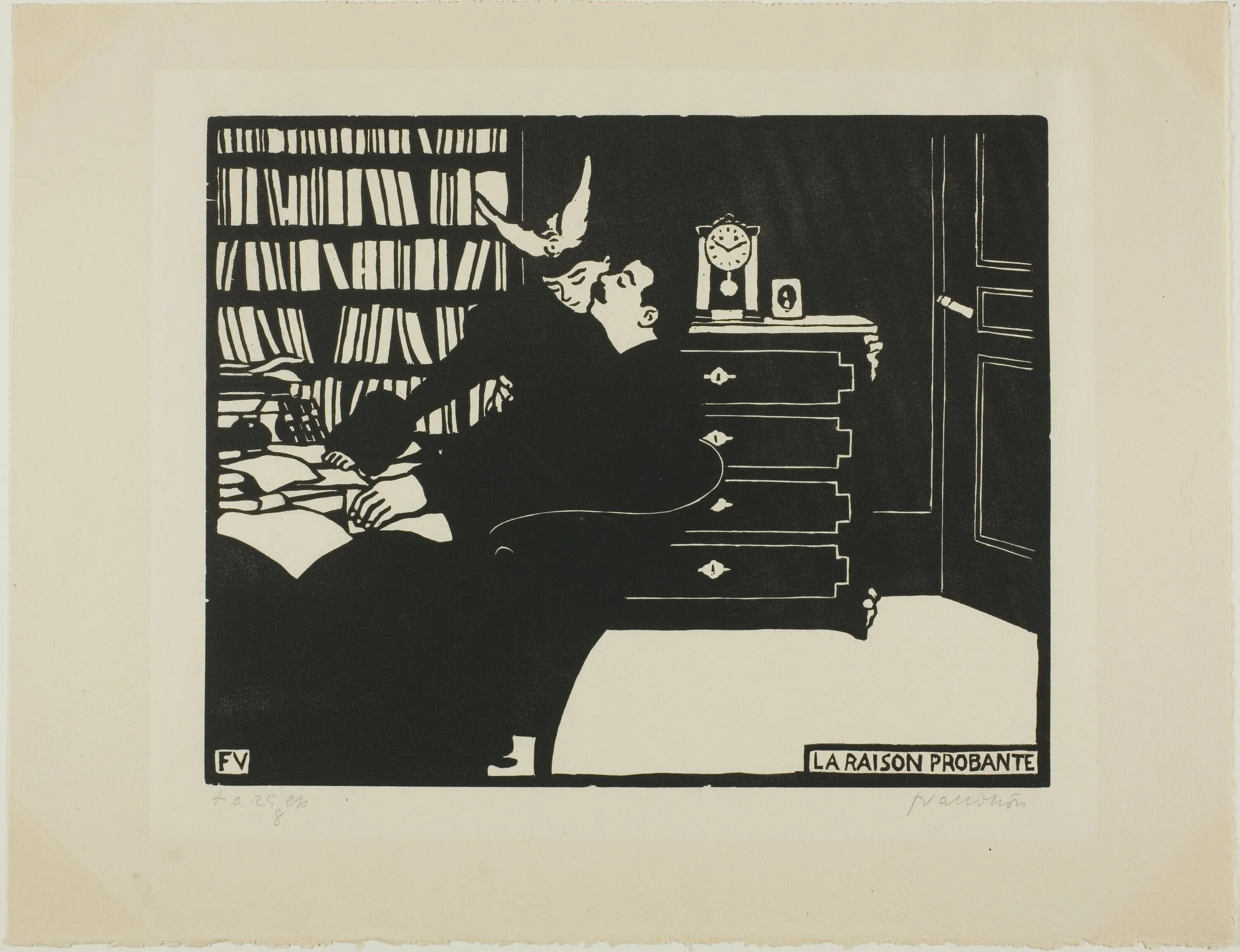
The same weaponising of physical seduction recurs in La Raison probante ('The Cogent Reason'). Seated on her partner's lap in his book-lined study, the woman kisses him to end an argument, or to get her way. The gift of the flesh, the kiss, is not freely given: it serves as the clinching argument and as an obligation to reciprocate. It forces the man to abdicate his space of intellectual reasoning, symbolised by the library, and submit to the other's desire or demand. The gift here is a transaction in disguise, a highly effective technique of domestic negotiation.
Extreme Measures: Tears as Currency
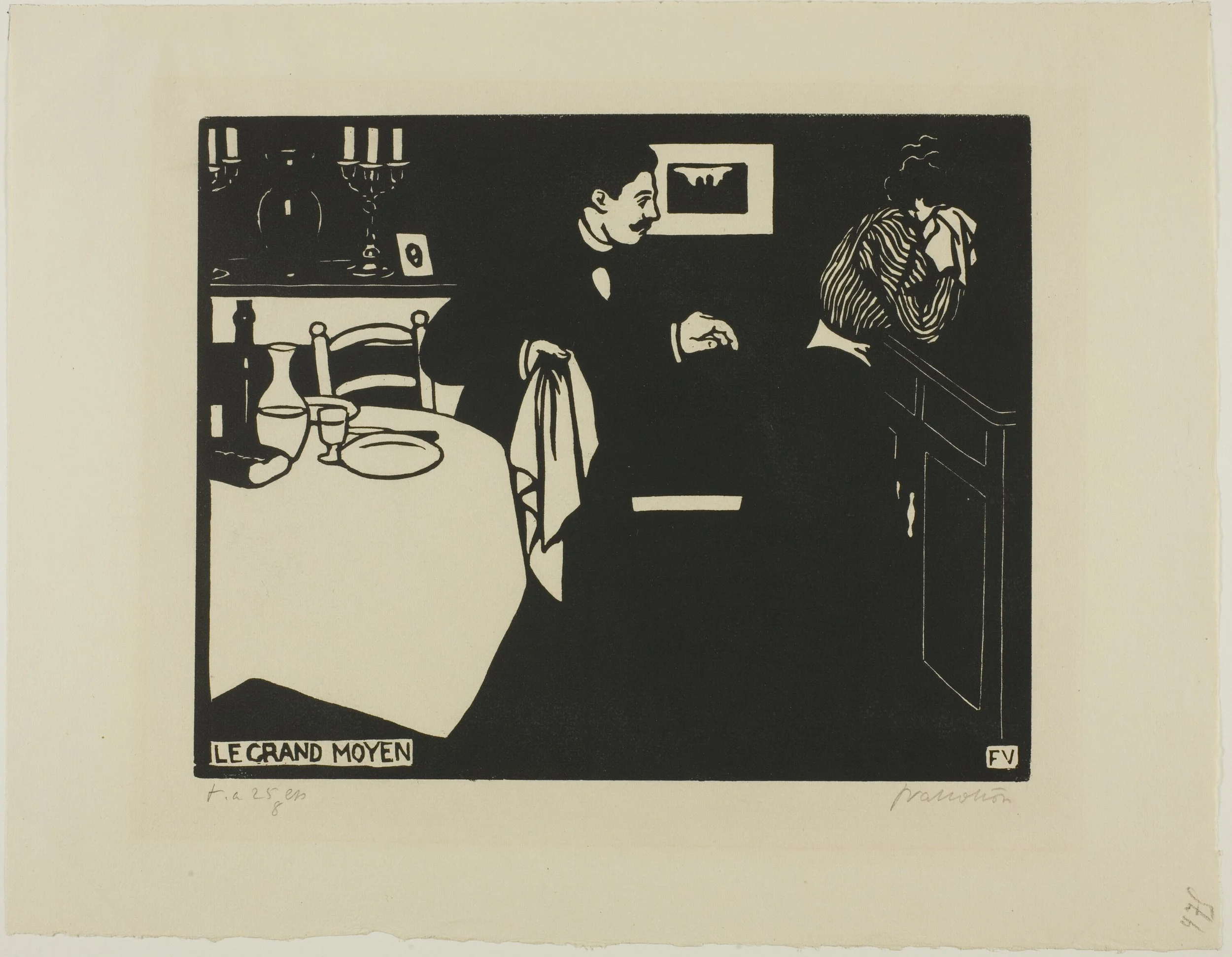
In the Maussian gift economy, to receive obliges one to return, on pain of forfeiting one's dignity or one's power. In the plate Le Grand Moyen ('Extreme Measures'), Vallotton stages a starkly lopsided emotional transaction: the woman dissolves into tears, turning her back on her husband in the middle of dinner. Those tears are a gift of suffering.
This particular 'gift' is instantly convertible into a crushing debt of guilt on the man's side. The husband is shown frozen, a napkin dangling from his hand, wholly disarmed by this emotional display. To soothe his wife's distress, that is, to discharge the debt of guilt she has just loaded onto him, he is forced to drop his arguments and capitulate. The 'extreme measure', then, is the calculated use of an intimate outpouring to secure dominance.
The same mechanism recurs from plate to plate. In Le Mensonge, a passionate embrace buys only false trust and is paid for with a concealed truth. In La Raison probante, a caress compels attention and submission, settled by an intellectual capitulation. In Le Grand Moyen, displayed tears breed guilt and helplessness, until the marital quarrel is surrendered outright.
Money: The Body Traded for Security
Mauss is at pains to distinguish the gift economy, in which exchange binds persons and souls, from the market economy, which detaches things from people. Vallotton shows, implacably, that the bourgeois couple effects a perverse fusion of the two, reifying feeling into the cold, hard coin of exchange value.
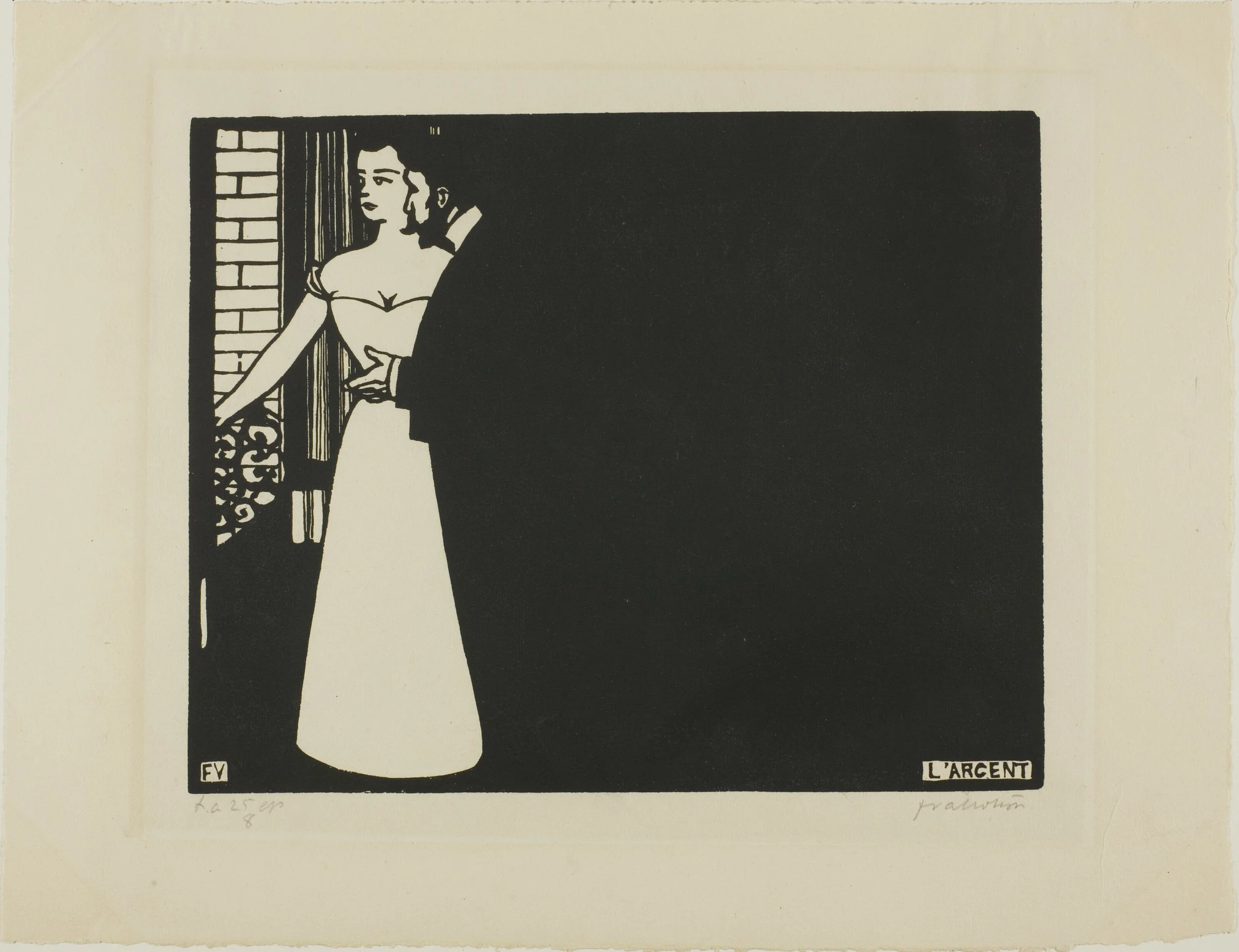
The most famous plate in the series, L'Argent ('Money'), pushes the idea to its aesthetic extreme. A woman in a white evening gown stands in profile, her gaze far off, while a man in dark tails encircles her waist. To the right, a black chasm, a vast flat plane of emptiness, fills more than half the print. This absolute black stands for the emotional void, the deathly silence that defines their bond. The title lays bare the economic footing of their union. The man's original 'gift' is financial: he supplies security and bourgeois standing. In return, the woman takes on an insoluble existential debt. To repay it, she must make a gift of her body and her passive presence, turning herself into a luxury commodity adrift in the void.
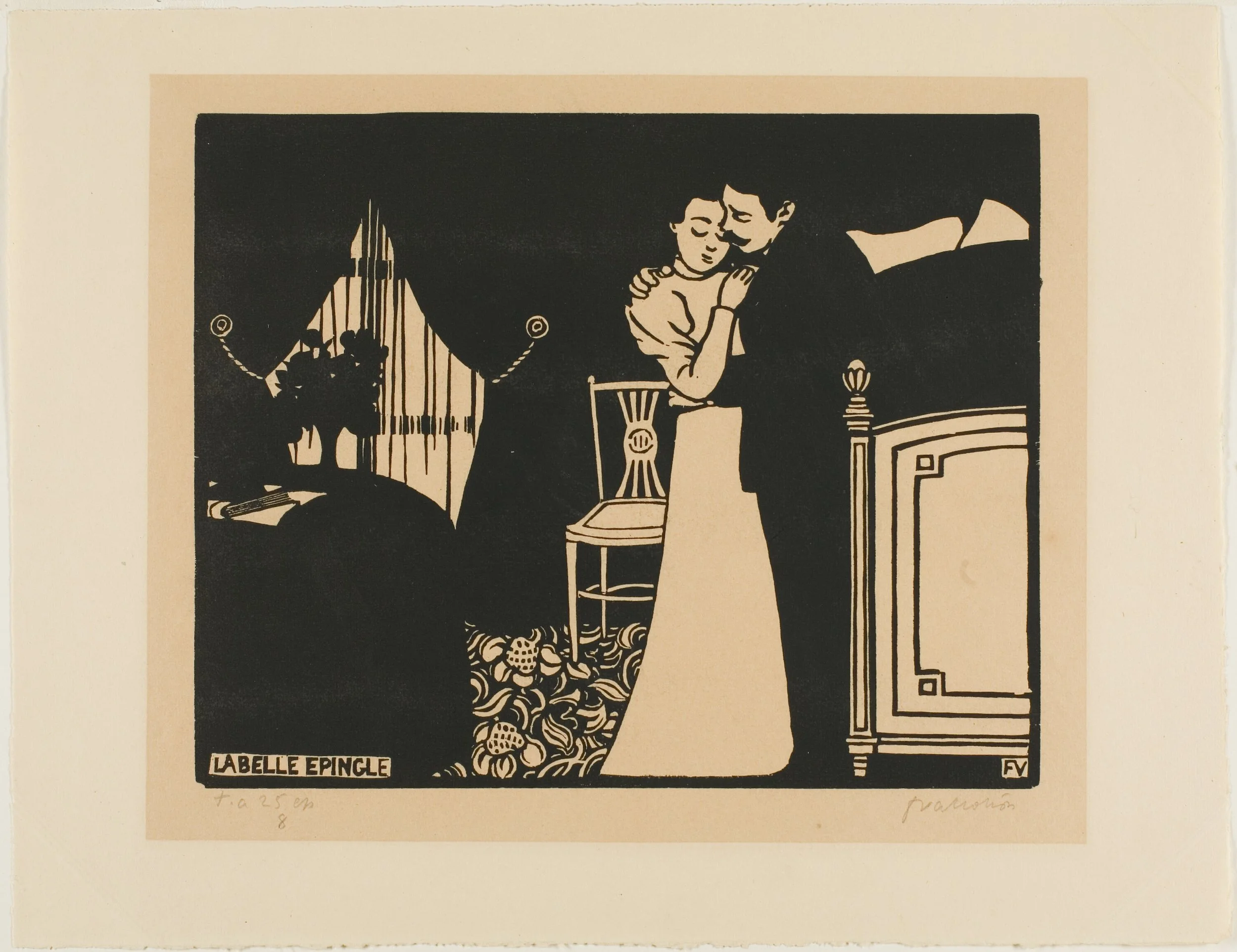
This barter of flesh for valuables is palpable too in La Belle Épingle ('The Fine Pin'), where conjugal affection is staged in the immediate vicinity of a massive bed, hinting that intimacy itself is pegged to gifts or material compensation.
Other People's Health: The Care That Smothers
For Mauss, the gift is not inherently egalitarian: 'To give is to show one's superiority, to be more, to be higher.' The giver stands above the receiver for as long as the debt goes unreturned. Care, then, can become the vehicle of a formidable asymmetry of power.
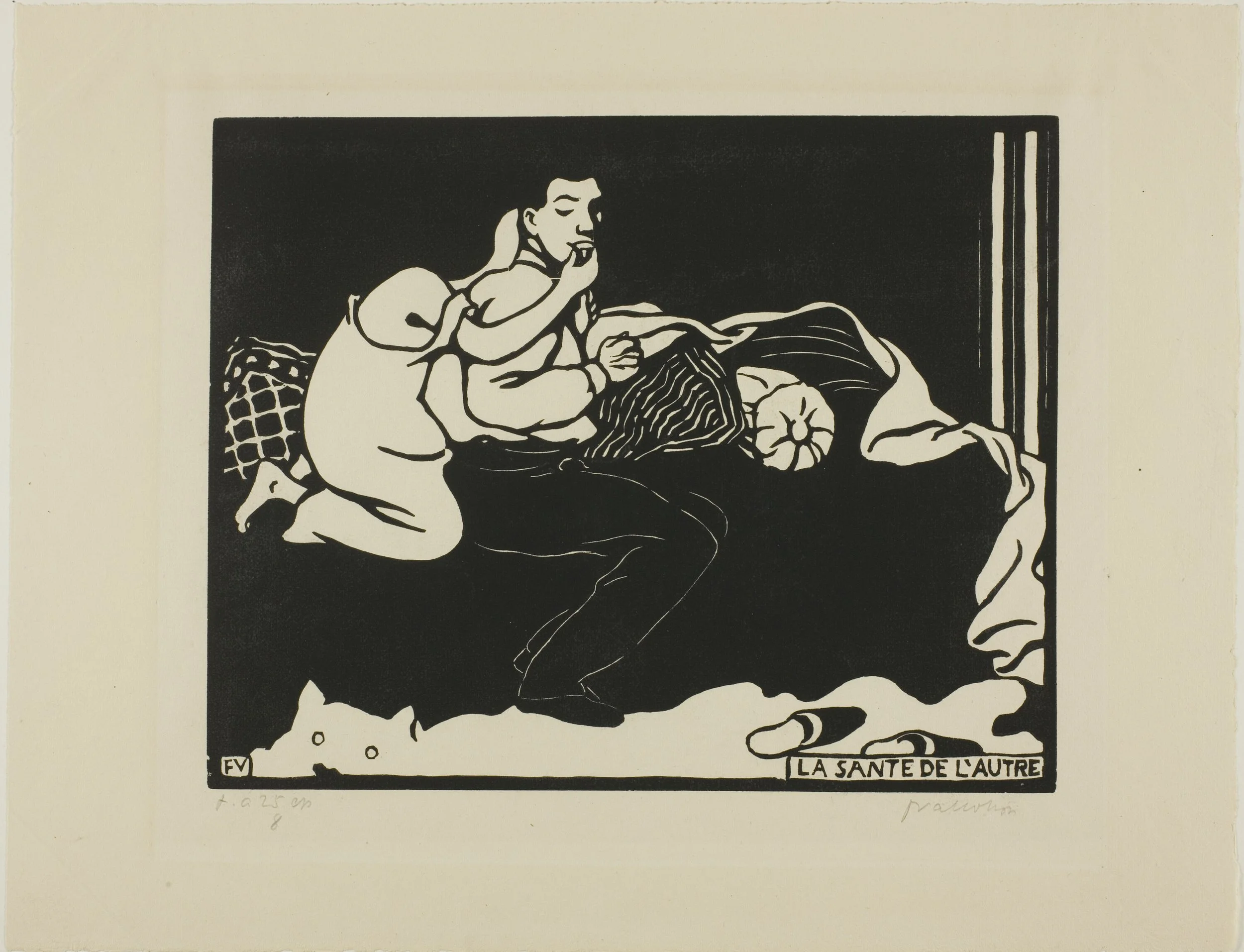
In the ninth plate, La Santé de l'autre ('Other People's Health'), Vallotton illustrates this dynamic superbly. A woman kneels behind her companion, clasping his neck and cupping his chin as if to check for fever, or to see whether he is well. Yet this gift of attention and tender care is rendered in the most disquieting terms. The woman's posture, looming over the seated man, verges on a stranglehold, on physical restraint. By infantilising the man under cover of watching over him, she places him in a state of utter dependence. Finger to his lips, a haggard look about him, the man is imprisoned by a compulsive solicitude he cannot refuse without appearing a monster of ingratitude. The gift of protection is here the instrument of a suffocating psychological control.
A note on Vallotton's Maussian aesthetic. The great flat expanses of black are not merely graphic choices of chiaroscuro. In Vallotton's economy of marital exchange, black gives body to absence, to the void left by the impossibility of authentic giving. It is the unpaid debt, piling up and smothering the figures.
The Irreparable: A Marriage Gone Bankrupt
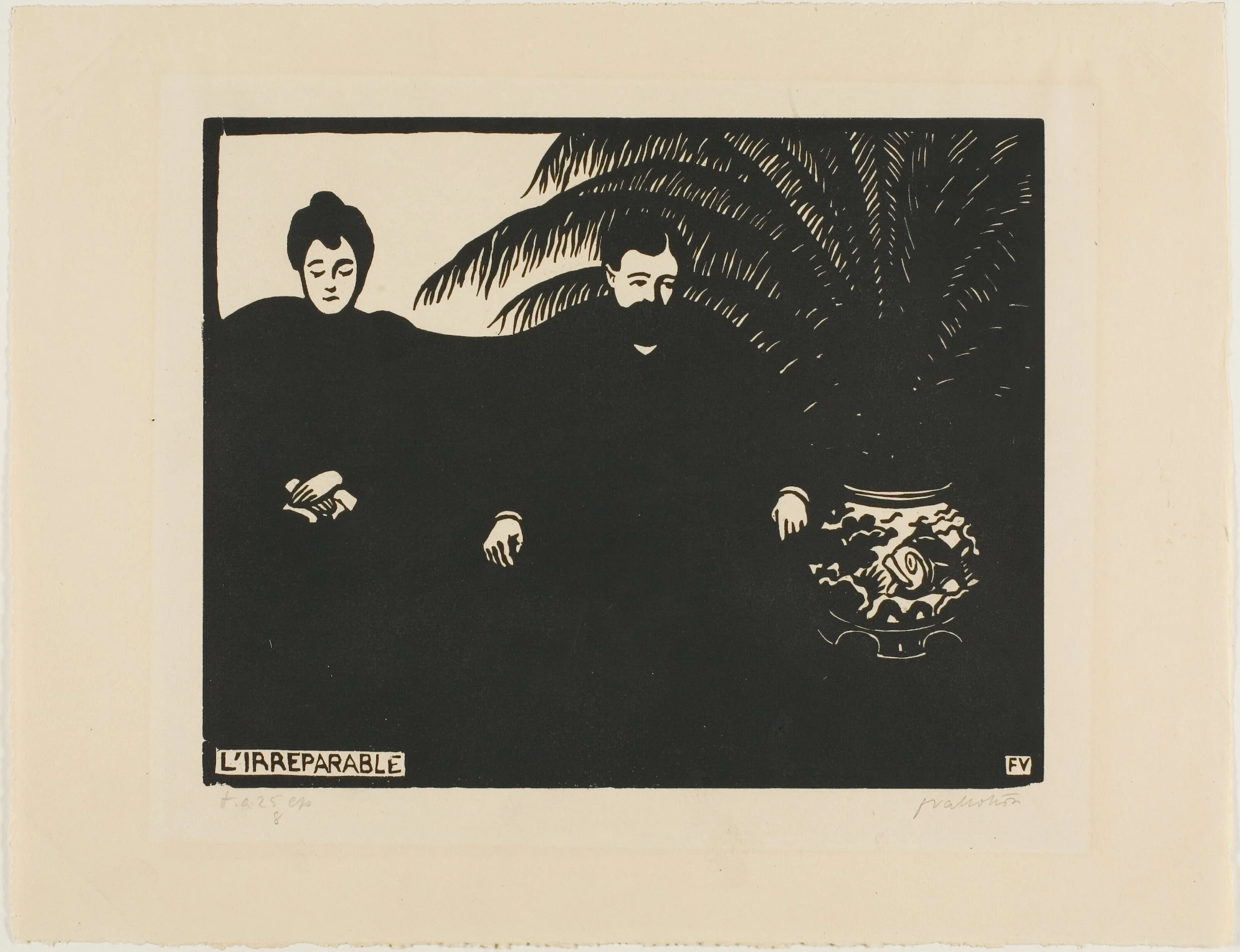
Vallotton's masterpiece closes on a plate whose title is a premonition: L'Irréparable ('The Irreparable'). If the gift creates the bond, the utter absence of exchange destroys the community. In this final woodcut, man and woman sit on the same dark sofa, yet an invisible chasm now divides them. Their heads are bowed, their hands lie inert in their laps, their eyes flee towards opposite corners of the floor. The cycle of giving, receiving and returning is wholly paralysed. There are no more words to exchange, no more calculated kisses, no more manipulative tears. The mutual debt of accumulated grievances and silences has grown too heavy to redeem. The potted palm unfurling behind them, that decorative staple of the period's bourgeois interiors, seems to cast a funereal, stifling shadow over this shipwreck of love. This is the clinical death of the couple, fixed for eternity in all that goes unsaid, in an absolute solitude for two.
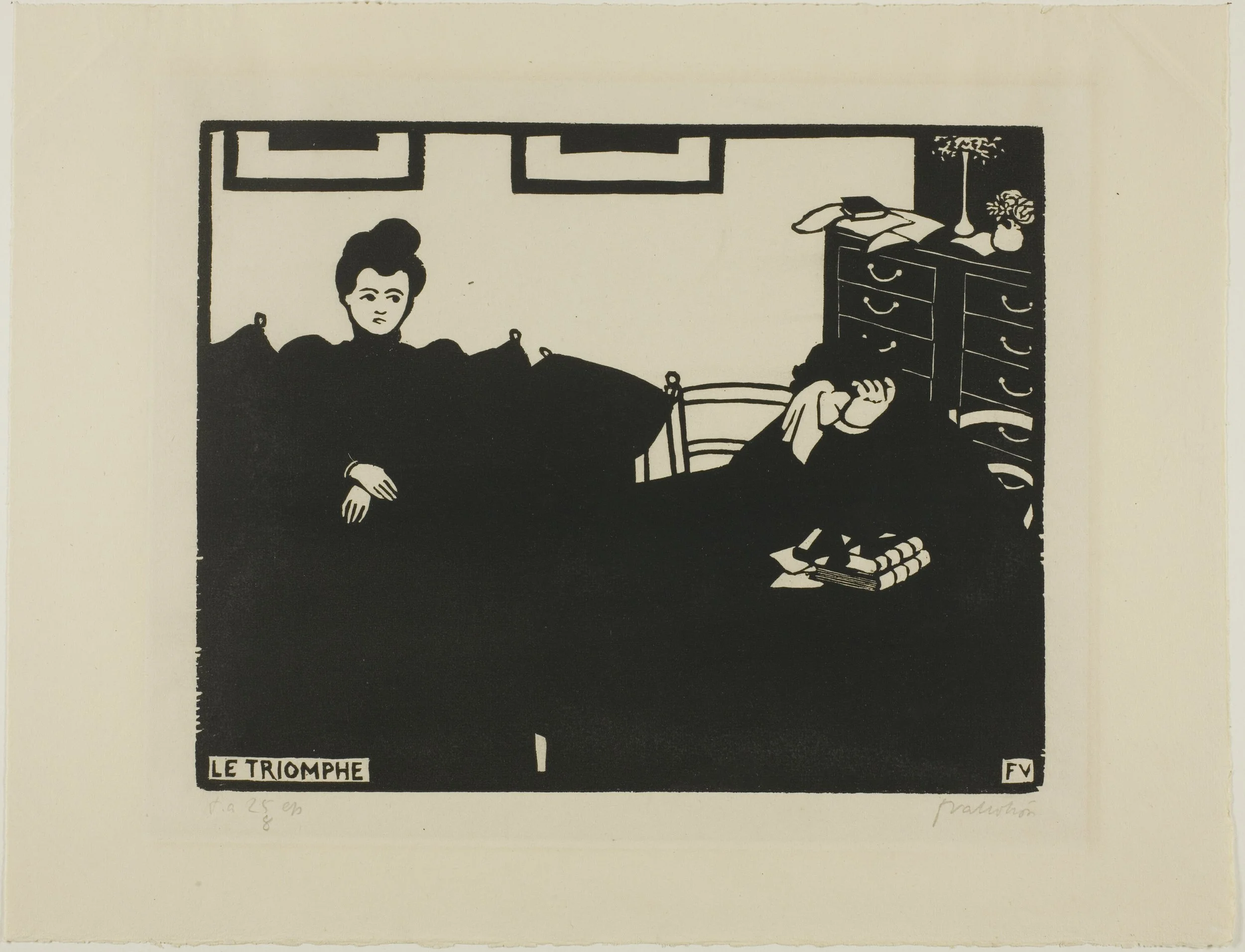
Le Triomphe ('The Triumph') shows another face of the same bankruptcy. After a quarrel or some tragic reckoning, the woman is enthroned alone and magnificent, hands folded, while her husband sits utterly crushed at her side. The victory of one over the other seals the end of the alliance: the triumph of domination is in fact the final ruin of the marital bond, for one has so wholly crushed the other that no future counter-gift is possible.
Vallotton, Sociologist of Marital Alienation
Read through Marcel Mauss's framework, the Intimacies reveal a satire that reaches well beyond the historical bounds of the Belle Époque, or any mere moral caricature of bourgeois marriage. Vallotton emerges as a true visual sociologist of domestic alienation. He grasped, intuitively, that when the gift of love, of care, of physical attention is diverted from pure reciprocity and made to serve the logics of the market, of the contract, of psychological manipulation, the couple turns into a psychic prison.
Through radical graphic compositions, where slashing whites and deep blacks, carceral stripes and impassive faces dramatise the intimate dynamics, Vallotton has immortalised the silent tragedy of insolvent emotional debts. A century on, his work still sounds a powerful warning about the fragility of our bonds once the authenticity of exchange gives way to the asymmetry of power.
You may also like
To Go Further:The Debt You Cannot Refuse, The GC&E Review, Issue 02 (2026).Marcel Mauss, The Gift: Expended Edition, translated by Jane I. Guyer (2016). (Originally published in 1925 under the title Essai sur le don).The Art Institute of Chicago.Institut et Fondation Félix Vallotton.